GPT-6 Sol and Luna Leaked: Smarter, Better at Coding — and Half the Price

GPT-6's Sol and Luna models leaked: stronger agentic capabilities, half the price per token.
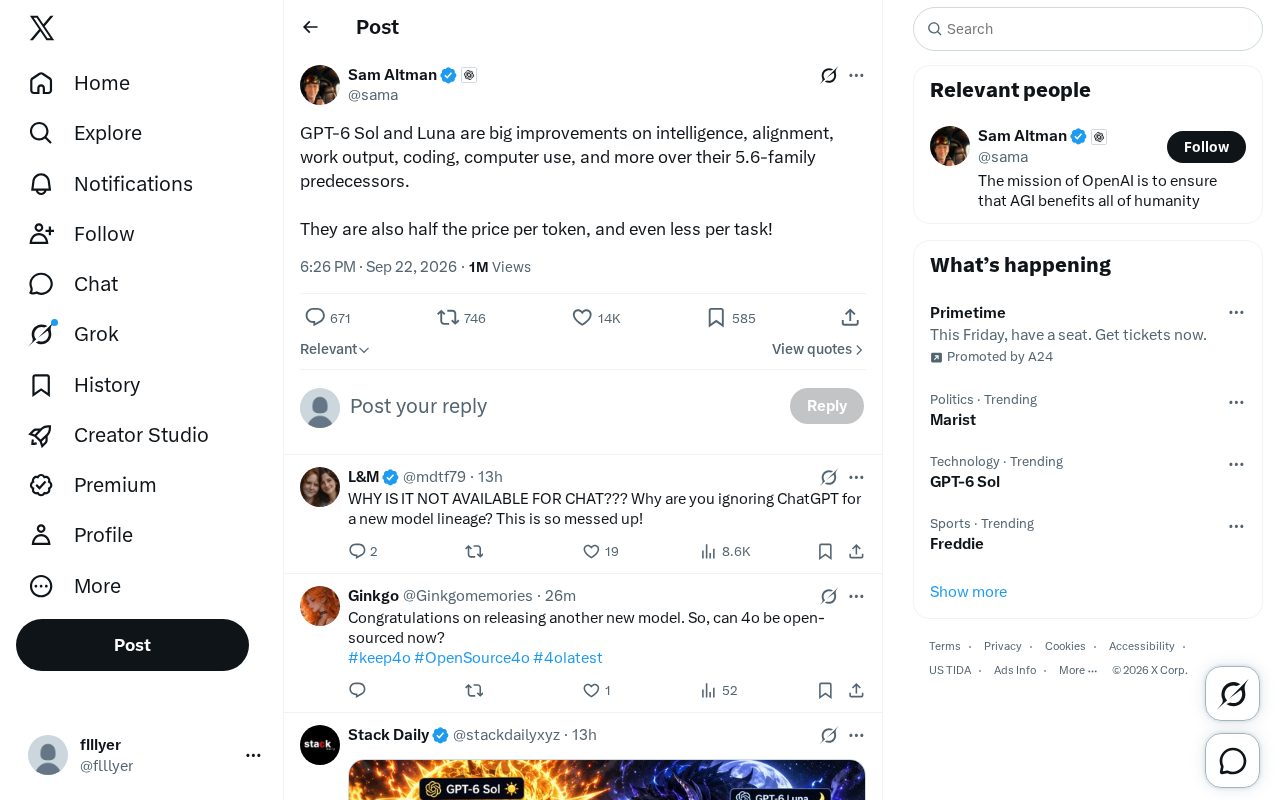
A Twitter leak suggests OpenAI's next-generation GPT-6 lineup will include two models — Sol and Luna — with significant improvements over the 5.6 series in intelligence, alignment, coding, and computer use, while cutting per-token pricing in half. The per-task cost savings could be even greater if the models are more token-efficient. The dual-model naming hints at differentiated positioning along a "powerful reasoning vs. lightweight" axis. Coding and computer use upgrades point to a stronger agentic direction, moving models closer to autonomous "digital employees." The leak comes from a single social media source with no official confirmation, so it's best treated as a directional signal pending a formal release.
GPT-6 Sol and Luna Emerge as Two Distinct Product Lines
A post on Twitter has revealed two members of the next-generation GPT-6 lineup — codenamed Sol and Luna. According to the leak, both models represent significant improvements over their GPT-5.6 predecessors across multiple dimensions: intelligence, alignment, work output, coding, and computer use.
The naming choice — Sol (sun) and Luna (moon) — suggests a deliberate two-track product strategy. This kind of dual-model approach is nothing new in the industry: typically one model skews toward stronger reasoning and complex tasks, while the other prioritizes efficiency and lightweight deployment. While the leak doesn't spell out the exact division of responsibilities, the differentiated design signals an intent to cover distinct use cases with purpose-built models.
Key Capability Upgrades
The improvements mentioned in the leak are worth unpacking one by one. Intelligence gains are the most intuitive expectation — reflecting advances in general reasoning and knowledge application. Improvements in alignment point to better safety and controllability, making model outputs more faithful to user intent and less prone to unwanted deviations. This matters more than ever as models grow increasingly powerful.
Coding and computer use both speak directly to the agentic trend. Computer use means the model can operate graphical interfaces like a human — invoking tools, navigating UIs, and completing end-to-end tasks — rather than just generating text. Combined with stronger coding capabilities, this brings the model closer to a "digital employee" capable of autonomously executing workflows, rather than a simple Q&A assistant.
Work output improvements are the combined expression of all the above — longer coherent outputs, higher task completion rates, and greater practical usability in real production environments.
What is Agentic AI? Agentic AI refers to models that go beyond single-turn Q&A to autonomously plan, break down tasks, invoke external tools, and execute across multiple steps until a complete goal is achieved. Computer use is a prime example: the model perceives screen state via screenshots and simulates mouse clicks and keyboard input to operate real graphical interfaces — filling out forms, browsing the web, running programs, and more. Anthropic's Claude was among the first to ship this capability; OpenAI has also deployed similar functionality through its Operator product. The value here lies in bridging the gap between "generating content" and "taking action," enabling AI to genuinely participate in business workflows rather than just providing suggestions or drafts.
Halving the Price — The Real Headline
If capability improvements are largely expected, the pricing strategy may be the most impactful part of this leak. The new models are reportedly priced at half the cost per token compared to their predecessors — and the per-task cost is said to be even lower.
There's an important distinction between these two claims. Cutting the per-token price is a straightforward price reduction. "Lower per-task cost" implies the new models are also more efficient — achieving the same results with fewer tokens. Combined, the actual cost reduction per task could far exceed 50%.
For developers and enterprise users, cost is the critical threshold for scaling AI deployment. When calling a more capable model actually costs less, use cases that were previously shelved due to budget constraints suddenly become viable again. This also follows the broader industry pattern seen across previous model generations: capability goes up, cost comes down.
What is a token? A token is the basic unit by which large language models measure input and output — roughly corresponding to word fragments in natural language (approximately 4 characters per token in English; roughly 1–2 Chinese characters per token). API pricing is typically quoted per million tokens, billed separately for input and output. "Halving the per-token price" directly reduces call costs, but actual savings also depend on token efficiency — the total number of tokens consumed to complete a given task. If a new model reasons more concisely and takes fewer detours, it will use fewer tokens for the same task, compounding the savings. This is the full picture behind "lower per-task cost." Historically, GPT-4 Turbo was priced more than 90% below the original GPT-4, demonstrating OpenAI's ability to aggressively compress inference costs at scale.
How to Read This Leak
It's worth staying grounded: this information comes from a single Twitter source, with no official announcements or third-party benchmarks to back it up. Key parameters — Sol and Luna's specific positioning, context window lengths, actual benchmark scores, and the magnitude of capability improvements — remain undisclosed.
It's more useful to treat this as a directional signal than a confirmed roadmap: it reflects where the next generation of models may be headed — stronger agentic capabilities, better alignment, and more aggressive cost optimization. How things actually perform will have to wait for an official launch and independent testing.
For teams focused on AI deployment, the more valuable exercise right now is forward-looking: if coding and computer use capabilities genuinely take a significant leap, and costs are cut in half simultaneously, does your existing product architecture and automation pipeline need to be rethought to fully capitalize on what this generation of models could offer?
Related articles

AI Compute Is the New Oil, But the Market Mechanism Has Yet to Take Shape
Hacker News compares AI compute to the new oil, noting the lack of price discovery, concentrated supply, and no hedging tools. The article analyzes structural issues in compute trading and explores a possible three-tier market of spot, contracts, and derivatives, plus the real impact on AI practitioners' cost management.

Running Full iOS 16.5 Firmware on Android Devices: Technical Demo or Marketing Gimmick?
A Hacker News post claims full iOS 16.5 firmware can run on Android, with 315 upvotes. This analysis argues it is more likely a web UI simulation than a true firmware port, and explores the value and risks of such projects.

Etsy Cracks Down on AI Slop: Addressing Buyer and Seller Anxieties
Etsy introduces stricter rules limiting AI-generated content in listings, addressing buyer confusion over AI products and seller fears of original work being diluted by AI slop.