GPT-6 Sol Rumors Examined: Astra Speed Comparisons and Backend Switch Speculation

GPT-6 Sol and Anthropic Opus upgrade rumors examined — most "evidence" doesn't hold up under scrutiny.
The article examines a wave of rumors around OpenAI and Anthropic model updates: Sam Altman and Teebo's social media hints have fueled GPT-6 speculation, but a countdown teaser remains ambiguous; claims of a backend switch to GPT-6 rely on a fundamentally flawed knowledge-cutoff test; the rumored Sol model may trade reasoning depth for faster throughput; GPT-5.5 deprecation could carry real migration costs for teams; and Anthropic Opus upgrade speculation lacks hard evidence. The core message: rumors and official announcements are not the same thing — don't make model decisions based on unverified numbers or names alone.
A String of Numbers Sparks Speculation
Recent hints dropped by Sam Altman and OpenAI's Teebo on social media have shifted attention toward an unconfirmed question: is a new model on the way? Teebo suggested on X that the upcoming announcement could be on the scale of a DevDay-level event, while Sam teased major news ahead. A countdown from 1 to 6 then ignited further discussion — does it represent six new things, or is it a nod toward GPT-6?
For now, everything remains speculation. DevDay-style events typically include more than just model launches — developer tools and product updates are usually part of the mix — so a string of numbers alone tells us little about how many models might actually be released. One line needs to be drawn clearly here: social media teasers are not official announcements. Conflating the two only amplifies misreading.
Has the Backend Already Quietly Switched to GPT-6?
One of the most widely circulated theories is that some GPT-5.6 requests are already being routed to GPT-6 on the backend. The supposed "evidence" comes from a knowledge cutoff test — someone asked the model to name the latest version of Claude Opus without internet access, and one response mentioned Claude Opus 4.7, even though the displayed knowledge cutoff date predated that model's release. At first glance, the model seemed to "know" about something beyond its cutoff, and the screenshot spread quickly.
But this reasoning doesn't hold up. Language models are not databases. When a model states a version number, it doesn't mean it has actually read the relevant announcement — it may have guessed correctly, or it may simply be wrong. More tellingly, another user asked the identical question and received "Opus 4.1" in response. The inconsistency itself proves the point: these kinds of tests can only be treated as loose clues, never as hard evidence. Verifying which model is running on the backend cannot be done with just one or two Q&A exchanges.
Using a "knowledge cutoff test" to determine the backend model version is a common but fundamentally flawed approach. A language model's knowledge cutoff is not a clean boundary: training data density typically decreases as it approaches the cutoff date, leaving the model with a patchy or confused understanding of events from that period. More importantly, when answering questions about its own version or external product version numbers, a model generates predictions based on statistical patterns in its training data — it is not querying an internal database. This means it may "guess" a plausible-sounding but nonexistent version number, or favor a version that appeared more frequently in training data. Getting different answers to the same question on two separate attempts is simply a normal consequence of the language model's stochastic sampling (temperature > 0) — it cannot serve as evidence of a backend version switch.
Sol vs. Astra: Trading Depth for Speed
The rumored GPT-6 Sol is said to be better suited for everyday use. Reportedly already in internal testing, Sol may be significantly faster than Astra, with the two models potentially serving different purposes: Astra pursues deeper reasoning, while Sol may trade some reasoning depth for faster response times and higher throughput.
This reflects two genuinely distinct usage patterns. When working through a hard problem, users are willing to wait. But for power users who ask questions constantly and write code all day, latency directly shapes the experience. The video in question cited an unverified set of numbers: Sol may generate around 28,000 tokens in three minutes, while Astra might produce roughly 25,000 tokens in the same type of task — but potentially taking 19 minutes.
If tested under identical conditions, that speed gap would be substantial. But speed isn't the only metric — task difficulty, answer quality, and whether tools are called mid-generation all affect the real-world experience. Until there's an official release and independent benchmarking, these rumors alone aren't enough to declare which model suits any given use case.
The trade-off between reasoning depth and response speed is one of the central tensions in large language model product design today. "Reasoning depth" typically refers to a model's ability to execute multi-step logical deduction, self-verify, or invoke tool chains — all of which significantly increase compute cost and latency. Token generation speed (tokens/minute) is a common measure of responsiveness, but the actual user experience is also shaped by time-to-first-token — the wait between sending a request and seeing the first character appear. For high-frequency scenarios like code completion or chat, a model with lower time-to-first-token often feels more fluid even if total token count is the same. Vendors typically use models of different scales or different inference configurations to serve both the "fast and light" and "slow and deep" ends of the market — the rumored positioning of Sol versus Astra fits squarely within this established product design logic.
Where Do Luna and Terra Go from Here?
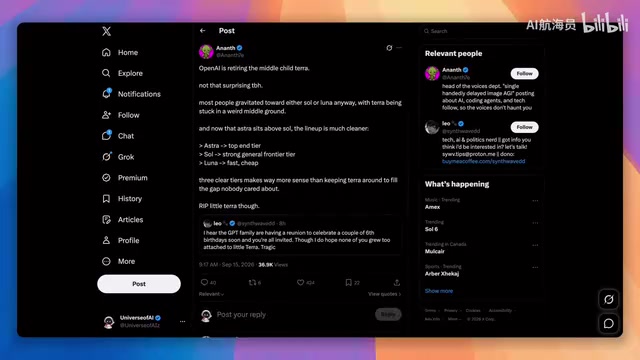
Speculation around the broader model family is also building. Some believe Terra — positioned between Sol and Luna — may not receive further updates, while others expect the entire lineup to see new versions. The product logic is straightforward: if Sol is fast enough and Luna is cheaper, Terra needs a clearer differentiating advantage for users to have a reason to choose it.

Alongside new model arrivals come departures of older ones. Reports suggest GPT-5.5 may be removed from ChatGPT, ChatGPT Work, and Codex. If accurate, users still relying on the older model would need to migrate ahead of time. For teams that have built the old model into established workflows, switching isn't as simple as selecting a different option from a dropdown — it means re-examining output style, tool behavior, and existing prompts. That said, the specific timeline and scope must come from official announcements; treating rumored dates as confirmed schedules would be a mistake.
Model deprecation in AI product lines is an impact that enterprise users often underestimate. When integrating a large language model into a production workflow, teams typically tune system prompts, output format parsing logic, and function calling parameter structures to a specific model version. Different model versions can differ subtly — but enough to break downstream logic — in how they follow instructions, their tendency toward longer or shorter outputs, and their tool-calling behavior. Deprecating an old model therefore isn't just a matter of swapping an API endpoint; it can trigger regression testing, prompt rewrites, and business logic adjustments across the board. For smaller teams in particular, monitoring official deprecation timelines and completing migration testing during the overlap period when both old and new models are available is the standard risk-mitigation approach.
Is Anthropic's Opus Getting Quietly Stronger?
On the Anthropic side, some users feel the current Opus has noticeably improved, leading to speculation that the backend may have already been updated to Opus 5.2. The video showcased several new visual pieces whose creator said took considerable time to generate — some ran well on the first attempt — and the model's performance in writing code, combining assets, and iterating on effects was noted as genuinely impressive.

But the same problem recurs: finished outputs can't be used to reverse-engineer which backend version produced them. Better results don't necessarily mean the model changed — the prompt, tool chain, or the nature of the task itself could all account for the difference. Without an official statement, drawing conclusions on its behalf isn't justified.
Slowing Down or Releasing in a Burst?
An interesting backdrop to all of this: not long ago, multiple labs were openly discussing whether to slow the pace of frontier AI development, and yet markets are once again buzzing with talk of a dense release cycle. Those focused on safety worry that risks can't be properly evaluated at this speed; those eager for new tools want stronger models as soon as possible. Even a company that wants to slow down faces competing pressures from competition, policy, and user demand. There's no simple, unified answer to the tension between safety evaluation and release velocity.

From GPT-5.5 to 5.6 to Astra, progress has been tangible. The visual work shown in the video makes this concrete — models aren't just answering questions anymore; they can write programs, run them, and iterate based on results, which is a fundamentally different capability from generating an image from a prompt. But newer-generation models don't guarantee improvements across every scenario: some users care most about coding ability, others need faster responses, and still others are primarily focused on cost. Making a real choice means weighing task type, speed, pricing, and reliability together — not chasing a model name.
Whether the next batch of models will continue to leap forward significantly, whether Sol can genuinely balance speed with capability, and whether Anthropic will respond quickly — none of these have reliable answers yet. The rational position is to wait for official releases and independent testing before deciding who actually delivers.
Related articles

Free Unlimited Claude Code Solution: Agnes AI + CC Switch Setup Guide
No paid subscription needed — pair the free AI platform Agnes AI with the open-source tool CC Switch to provide a backend for Claude Code, enabling unlimited free calls to text, image, and video models. This guide covers the full setup, test results, and usage boundaries.

A Complete Zero-Cost Guide to Getting Started with Claude Code for Beginners in China
A beginner's guide to Claude Code for users in China: two installation methods (command line and IDE plugin), full configuration steps for replacing the official API with the free domestic LongCat model, and a hands-on demo of building a small tool with natural language, plus tips.

When the NSA Gets Involved: The AI Supply Chain Crisis Behind Open-Source CVEs and API Key Hijacking
Multiple open-source projects disclosed severe CVEs in one day, PHP flaws alarmed the FBI, and Railway and OpenCode were breached with API keys stolen. This article breaks down the vulnerability window, AI-accelerated exploitation, and the AI supply chain crisis behind the API key black market, with a developer defense checklist.