GPT-Red: OpenAI's Internal Red-Team Security Tool That Uses AI to Attack Its Own Models
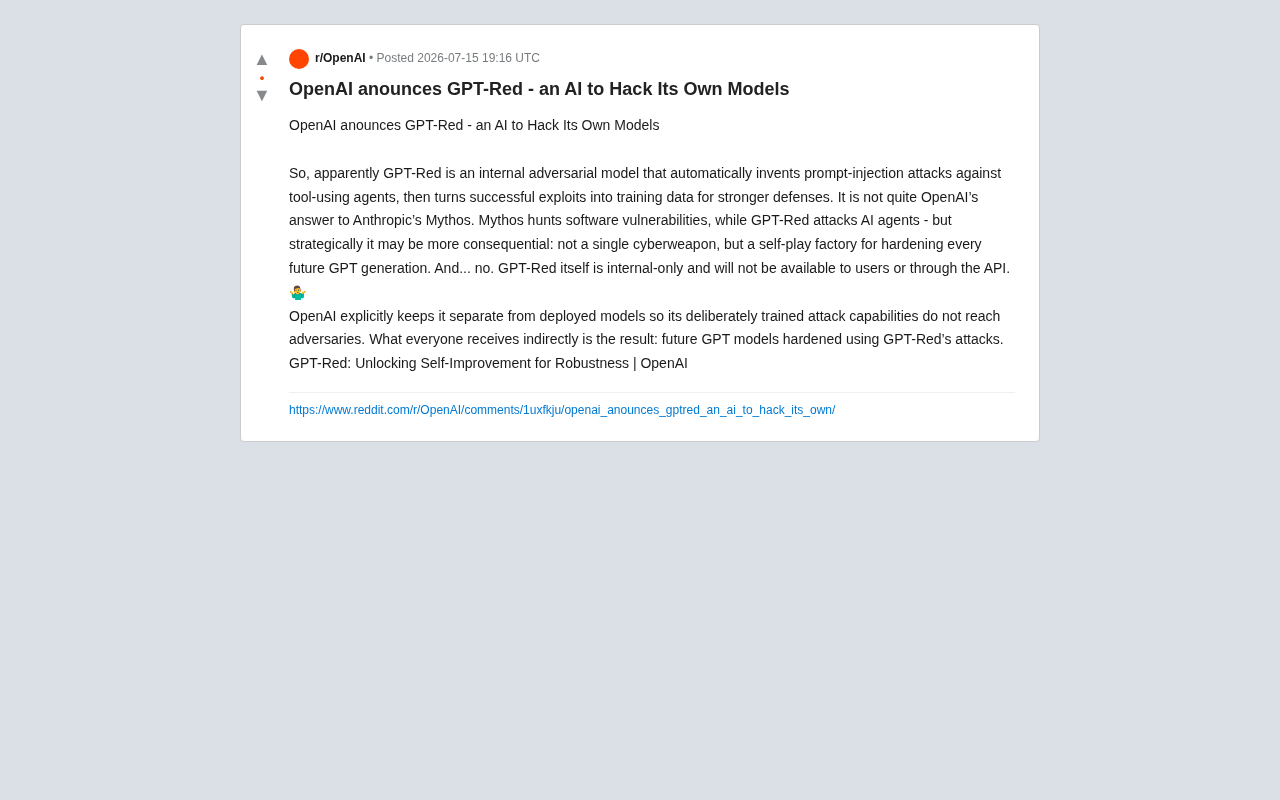
OpenAI's internal GPT-Red tool attacks its own AI agents to make future GPT models more secure.
GPT-Red is an internal adversarial model from OpenAI that automatically crafts prompt-injection attacks against tool-using AI agents and converts successful attacks into training data for future models. Unlike Anthropic's Mythos — which hunts traditional software vulnerabilities — GPT-Red targets AI behavior-level security boundaries. It remains strictly internal and isolated from deployed models to prevent its attack capabilities from being misused.
What Is GPT-Red
OpenAI has recently disclosed an internal adversarial model called GPT-Red. Contrary to outside speculation, it is not yet another general-purpose large model for end users — it is a red-team security tool purpose-built to "attack" AI agents.
In short, GPT-Red automatically crafts prompt-injection attacks targeting tool-using agents, then converts successful attack cases into training data to harden future models' defenses. This is a classic "offense informs defense" approach — teaching AI how it can be broken so it becomes harder to break.
Technical background on prompt injection attacks: Prompt injection is a class of attacks unique to large language models. Attackers embed carefully crafted instructions into input content to trick the model into ignoring its original system prompt or safety constraints and executing malicious commands instead. This threat is especially severe in tool-using agent scenarios, where the agent doesn't just generate text — it can call search engines, execute code, manipulate file systems, and even make network requests. A successful injection hijack can lead to anything from data leakage to the autonomous execution of malicious operations. Since 2023, with the widespread adoption of agent frameworks like AutoGPT and LangChain, prompt injection has been ranked by security researchers as one of the highest-priority security threats facing AI systems.
Notably, OpenAI has made clear that GPT-Red is a purely internal tool — it will not be made available to users or exposed via API. The only indirect benefit users can expect is future GPT models made more robust through GPT-Red's "battle testing."
How GPT-Red Differs from Anthropic's Mythos
Many observers instinctively compare GPT-Red to Anthropic's Mythos project, but the two differ fundamentally in their core objectives.
Different Attack Targets
Mythos focuses on hunting software vulnerabilities — it targets code and systems in the traditional security sense. GPT-Red, by contrast, targets AI agents themselves, zeroing in on the security boundaries where models can be manipulated or hijacked while executing tasks and calling tools.
Anthropic Mythos — technical positioning: Anthropic's Mythos project sits at the intersection of traditional cybersecurity and AI capability, with a core goal of using large language models' code comprehension and reasoning abilities to automatically discover security vulnerabilities in software systems (e.g., buffer overflows, SQL injection, logic flaws). In essence, it deploys AI as a "super penetration tester" against existing software infrastructure. The fundamental difference from GPT-Red is this: Mythos attacks static code, while GPT-Red attacks dynamic AI behavior at runtime. The former's threat model is closer to traditional security research; the latter is specifically designed to counter AI-native threats — a distinction that reflects the different strategic priorities each company places on security.
Put simply, Mythos defends against code-level vulnerabilities, while GPT-Red defends against AI behavior-level vulnerabilities. As AI agents scale up and begin autonomously executing real-world tasks, the latter is rapidly growing in importance.
Deeper Strategic Value
GPT-Red is not a "single cyber weapon" — it functions more like a self-play security hardening factory. By continuously launching attacks, validating defenses, and iterating on training, it can theoretically supply an endless stream of adversarial training material for each new generation of GPT models. Improving model robustness no longer depends on the finite bandwidth of human red teams; it can be advanced at scale, automatically.
The evolution of red-teaming and AI security: Red team testing originated in military war-gaming exercises and was later widely adopted by the cybersecurity industry, referring to dedicated teams that play the role of attackers to proactively identify defensive gaps. In the AI domain, the concept has expanded: red-teaming now includes not just code-level vulnerabilities, but also probing model behavioral boundaries — including harmful content generation, jailbreaks, and hallucination triggers. The limitation of traditional human red teams lies in scale and speed: human experts can only produce a limited number of test cases and struggle to systematically cover the vast input distributions models encounter in real-world deployment. The automated red-teaming approach that GPT-Red represents essentially hands the task of generating attack samples to AI itself, scaling the number of test cases from the hundreds to the billions.
Why "Internal Use Only"
One of the most notable aspects of GPT-Red is that OpenAI has kept it completely isolated from deployed models.
The reasoning is straightforward: GPT-Red has been specifically trained with attack capabilities. If those capabilities were to leak or be made publicly available, it would essentially hand a powerful tool for attacking AI systems directly to potential adversaries. OpenAI has therefore chosen to retain only the "output" — safer models — while locking down the "attack capability" itself.
The governance logic behind isolating attack tools: Strictly isolating high-risk capability tools from external environments is a classic principle in cybersecurity — analogous to keeping a zero-day exploit database in a physically air-gapped internal network. In the AI era, this principle faces new challenges: the "capabilities" of an offensive AI model are difficult to fully physically contain, and its attack logic could potentially leak through training data, model weights, or API interfaces. OpenAI's choice to fully isolate GPT-Red from deployed models and refuse API access is a pragmatic compromise between utility and risk control. This also echoes ongoing discussions in the AI safety community around governing "dual-use AI" — where the same capability can serve both defensive and offensive purposes — and how to draw the line between open innovation and risk management, which remains a core challenge for current regulatory frameworks.
This reflects a careful balance between capability and safety: leveraging the defensive gains of adversarial training while avoiding the risk of attack tools proliferating. It also mirrors the increasingly rigorous approach to safety governance emerging across leading AI labs.
Self-Play: An Emerging Paradigm for AI Security
GPT-Red represents an emerging AI security paradigm — using AI to fight AI.
Traditional red-team testing relies on human experts to manually design attack scenarios: expensive, limited in coverage, and unable to keep pace with the speed of model iteration. By using a dedicated attack model to automatically generate massive volumes of attack samples, defenders gain test scale and diversity far beyond what human effort can achieve.
The technical origins of self-play: Self-play as an AI training paradigm is perhaps best known from DeepMind's AlphaGo Zero, which achieved superhuman Go performance without any human game records by having the model play against historical versions of itself. The core insight is that as the opponent's strength grows in sync with training progress, it provides continuously effective training signals and avoids overfitting by "bullying" weak opponents. GPT-Red transplants this logic into the security domain: the attack model evolves continuously, forcing future GPT models to withstand ever-escalating adversarial pressure. This also resonates with the concept of Curriculum Learning in reinforcement learning — where training difficulty automatically scales with capability growth, creating a spiraling upward curve of security capability.
Potential Value and Risks to Watch
On the positive side, this self-play mechanism has the potential to ensure that a model's security defenses scale in step with its growing capabilities, creating a virtuous cycle of "more capable means more secure."
But concerns remain: as the attack model continuously learns more powerful attack techniques during training, questions about how to constrain its capability boundaries and whether isolation measures are sufficiently robust are legitimate areas of ongoing scrutiny. OpenAI's choice of "internal use only + isolated deployment" is a direct response to exactly these risks.
Conclusion
GPT-Red is not a new product for users — it is an AI security infrastructure layer operating entirely behind the scenes. Its significance lies in shifting AI security from "patching after the fact" toward proactive hardening at the training stage.
Ordinary users will never directly perceive GPT-Red's existence. But every generation of GPT models we use in the future may have already been repeatedly stress-tested through its attack drills. This is a small but telling sign of how security capability is becoming an increasingly critical competitive moat in the frontier AI race.
Note: This article is based on discussions circulating in the Reddit community. For specific details, refer to official communications from OpenAI.
Related articles

Apple HomeView Hands-On Review: Is the $300 Smart Home Hub Worth It?
Apple HomeView hands-on: a $300 smart home hub with facial recognition for quick account switching, but no App Store or voice recognition. Is the wall-mounted version worth it? Should you buy the first generation?

Meta Muse Wonder Launch: What It Means for Meta's Return to the Frontier AI Race
Meta releases Muse Wonder and WonderFull, benchmarks reach the frontier, community feedback is polarized. An in-depth look at Meta's return to the frontier AI race, its personal agent strategy, and Zuckerberg's different path.

Apple Home Smart Home Lineup Leaked: LG and Schneider Team Up, UWB Door Lock on Board
Apple Home ecosystem gains new LG and Schneider devices: UWB smart lock with proximity unlock, 2.5K dual-camera doorbell, privacy indoor camera, and AirPods-like seamless pairing.