GPT Tree Index Revisited: A Tweet That Sparked Reflection Among Tech Pioneers
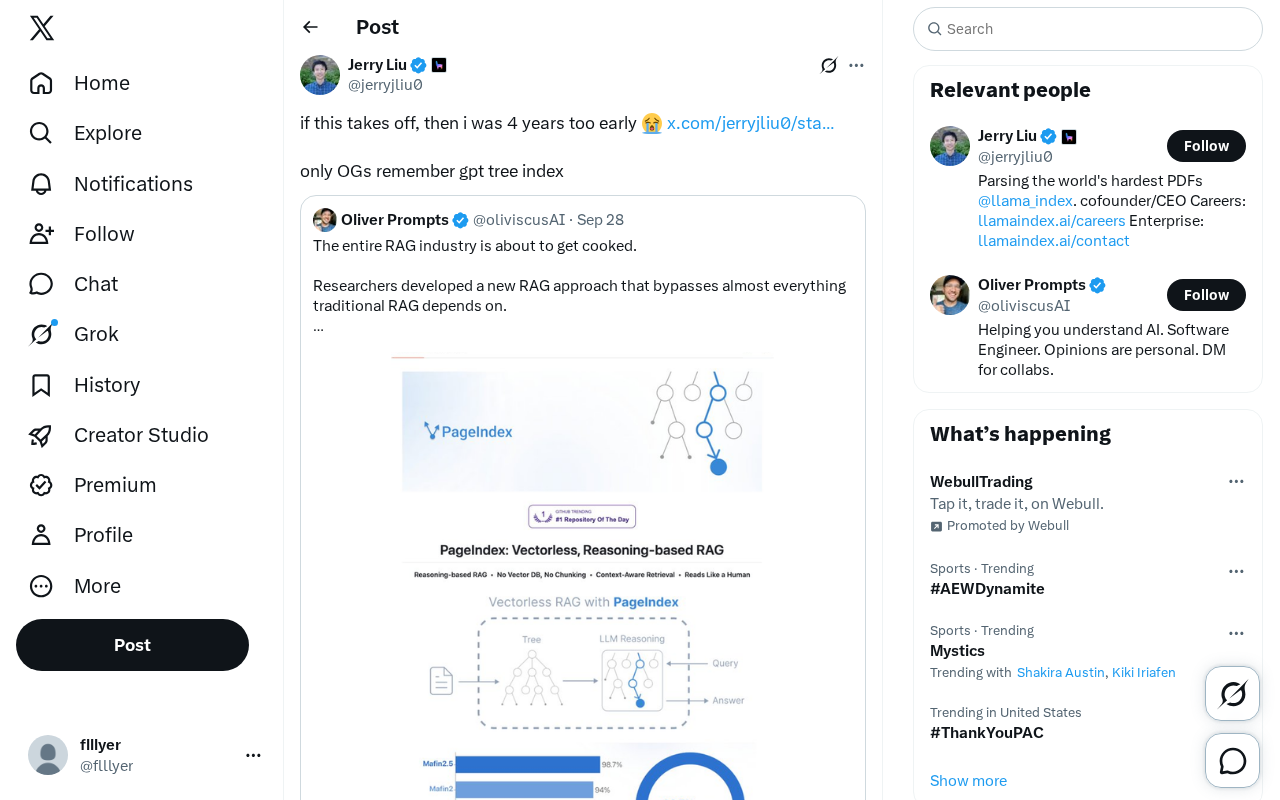
A tweet about GPT Tree Index captures the tech industry's timeless dilemma: right direction, wrong timing.
A tech practitioner's self-deprecating tweet about being "four years too early" reignited memories of GPT Tree Index, an early attempt to combine LLMs with hierarchical document indexing — an idea closely aligned with today's RAG (Retrieval-Augmented Generation) paradigm. The article uses this as a springboard to explore a recurring pattern in tech innovation: early movers bear the costs of experimentation and market education, while latecomers with better timing often capture the rewards. Yet the intellectual value of early exploration endures, as these pioneering efforts laid the foundation for the thriving RAG ecosystem of today.
A Tweet That Spoke for the Early Movers
A brief tweet recently sparked discussion in tech circles. The author wrote with a hint of self-deprecation: "If this direction really takes off, then I was just four years too early," adding, "Only the OGs remember GPT Tree Index."
The tweet didn't say much, yet it captured a theme that plays out repeatedly in the tech industry — between the timing of innovation and its ultimate success, there often lies a gap that's nearly impossible to bridge. The "GPT Tree Index" the author mentioned was an early attempt to combine large language models with data indexing structures, and today, similar ideas are re-entering the mainstream through the explosion of technologies like RAG (Retrieval-Augmented Generation).
What Is GPT Tree Index
GPT Tree Index was one of the early explorations into building data index structures around large language models. Its core idea was to organize large volumes of documents into a tree-like hierarchical structure — through layered summarization and indexing — enabling language models to effectively search and answer questions across massive amounts of text, even when that text far exceeded the context window limit.
This was a remarkably forward-thinking design for its time. Back then, LLM context windows were extremely limited, and figuring out how to make a model "understand" documents far beyond its window capacity was a thorny engineering problem. The tree-based index used hierarchical aggregation to structurally compensate for the model's inherent memory limitations.
It's worth noting that the original tweet was extremely brief, so specific implementation details and the reception this technology received at the time weren't discussed. The interpretation here is based on the general technical direction the name points to.
The concrete implementation of GPT Tree Index can be traced back to the early versions of the LlamaIndex project (originally called GPT Index), released by Jerry Liu in late 2022 — before ChatGPT existed, and before most developers had even considered "letting an LLM read private documents" a mainstream need. The tree index worked roughly as follows: long documents were split into leaf nodes; adjacent leaf nodes were summarized to generate parent nodes; this aggregation continued upward layer by layer, forming a summary tree. During retrieval, the model traversed top-down from the root, using the summary at each layer to determine which branch was most relevant to the query, ultimately pinpointing the specific text segment. The elegance of this design lay in the fact that it didn't rely on vector similarity search — it depended entirely on the language model's own comprehension to navigate the document structure. However, this also meant significant bottlenecks in inference cost and latency, which was one of the main reasons it couldn't be deployed at scale at the time.
The Industry Pattern Behind "Four Years Too Early"
The phrase "four years too early" in the tweet points to a classic pain point in tech innovation: the direction was right, but the timing wasn't.
Examples like this are plentiful throughout the history of technology. An idea proposed at the wrong time may lack the supporting infrastructure, computing power, or market demand to succeed — so it fades away. Then, years later, when external conditions have matured, the same idea pursued by a different group of people takes off. The early explorers absorb the cost of trial and error, but rarely share in the rewards when the idea finally explodes.
The need that GPT Tree Index represented — "letting large models handle extremely long documents" — has since evolved into a central challenge for the entire RAG technology stack. Vector databases, document chunking, hierarchical summarization, retrieval augmentation — these concepts are now standard fare in AI application development. That early exploratory path was indeed pointed in the right direction. It was just a few steps ahead of its time.
RAG (Retrieval-Augmented Generation) is the dominant paradigm today for extending LLM knowledge, formally introduced in a 2020 paper by the Meta AI research team. Its core idea is to retrieve relevant document segments from an external knowledge base before the model generates a response, feeding them as context alongside the query — allowing the model to "see" information beyond its training data. Unlike GPT Tree Index's tree traversal approach, modern RAG pipelines typically rely on vector databases (such as Pinecone, Weaviate, or Chroma) to encode documents as high-dimensional vectors, then use approximate nearest-neighbor search to quickly locate relevant content. The two approaches differ philosophically: tree-based indexing leans more heavily on the model's language understanding, while vector retrieval shifts the burden of semantic matching onto the embedding model and index structure. Today's RAG ecosystem is quite mature, and the idea of hierarchical summary indexing has re-emerged in mainstream frameworks under variations like "HyDE" and "parent-child document retrieval."
The Value and Dilemma of Being an Early Mover
The early mover's dilemma is far from unique. From a business perspective, entering a market before it has matured often means bearing the high costs of market education and infrastructure-building on your own. The ones who ultimately reap the rewards are typically the "latecomers" who arrive just as the wave crests.
But from the perspective of technical accumulation, the value of early exploration cannot be understated. It is precisely these pioneering attempts that validate the feasibility of a direction and pave the way for those who follow. Early experiments like GPT Tree Index, even if they never became mainstream, laid the intellectual groundwork for the thriving RAG ecosystem we see today.
The reason this tweet resonated so widely is that it gave voice to something countless people in tech have felt — in the fast-moving world of AI, identifying the right direction is only the first step. Whether you can time it right is often the critical variable that separates success from obscurity.
Closing Thoughts
A short tweet carried the weight of a collective reflection on one of technology's eternal questions: timing. The story of GPT Tree Index reminds us that in today's rapidly evolving AI landscape, many ideas that seem novel often have roots that earlier pioneers already explored. Looking back at these early attempts is not only a form of respect for the history of technology — it can also help practitioners see more clearly the delicate relationship between innovation and timing.
Related articles

Cursor AI Programming in Practice: Build a Student Management System from Scratch in 30 Minutes
A Bilibili creator demonstrates Cursor AI programming: generating a student management system in 30 minutes with natural language. Details on Agent mode, Claude selection, prompt techniques, and thresholds.

Top 20 AI Coding Tools Ranking: From Rock-Solid to Lackluster, a Scored Matrix
Bilibili creator releases top 20 AI coding tools ranking, tiered T0–T4 from rock-solid to lackluster, with Claude Code and Codex tied at T0. This article details the scoring dimensions (capability, reliability, robustness, durability, cost, domestic availability) and tool performances to help developers choose the right AI coding assistant.

Vibe Coding Systematic Tutorial: Master AI-Assisted Programming from Zero
A three-month Vibe Coding tutorial from a Bilibili creator covering Codex, ClaudeCode, and Cursor, from core logic to commercial project practice for beginners.