GPT6 vs Fable5.1: Who Wins at Fixing Legacy Nightmare Bugs?

GPT6 aces all legacy bugs with a perfect score; Gemini is fastest but finishes last.
A Bilibili creator tested GPT6, Fable5.1, and Gemini 3.8 Flash on three tiers of real-world legacy bugs. All three cleared the Gold Bug in one round, but gaps emerged fast: GPT6 solved every bug on the first attempt for a perfect 8 points, Fable5.1 recovered in later rounds to score 5, and Gemini — despite being the fastest — failed all rounds above Gold to finish with just 2 points. The key takeaway: standard coding tasks have converged across flagship models, but complex coupled architectures remain the true test of AI engineering depth.
When AI models get codenames like "Starfall" and "Prophecy," how much real engineering muscle actually backs those grand titles? A Bilibili creator known as "Legacy Code Duels" set out to answer that question with a suite of inherited, real-world bugs. In what the creator dubbed a "summit of legacy chaos," GPT6, Fable5.1, and Gemini 3.8 Flash were thrown onto the same battlefield to face the kind of ancient, gnarly code that haunts engineers' nightmares. The verdict: in genuinely complex bug-fixing scenarios, the gaps between models are far more brutal than any benchmark leaderboard suggests.
The Three Contestants and the Rules
The three models each came with their own flair: GPT6 carries the codename "Starfall," Fable5.1 goes by "Prophecy," and Gemini had just been updated from 3.7 to 3.8 Flash — though, notably, a Pro version has yet to appear. The creator's evaluation framework was no joke. Legacy bugs were split into three difficulty tiers, mirroring the real-world technical debt found at different levels of project complexity.
The Gold Bug (G002) is an entry-level challenge: error logic buried inside an AOP aspect, tricky to locate but not a dealbreaker for top-tier models. The Diamond Bug (D001) involves tightly coupled cache and business logic, demanding deeper architectural understanding. The King Bug (K005) is the ultimate gauntlet — cache, concurrency, and 11 intertwined business logic layers all at once. According to the creator, this one had "held the summit for an entire month, undefeated."
Each bug allowed three repair attempts. Solving it in the first round earned 3 points (2 points for Gold), with fewer points awarded in subsequent rounds. This design cleverly tests one-shot problem-solving ability rather than luck through repeated trial and error.
Gold Bug: All Three Start Strong
Facing the most basic Gold Bug, all three contestants showed solid fundamentals. Their approaches revealed distinct "personalities": Fable5.1 characteristically deployed two sub-agents in parallel to investigate; Gemini 3.8 Flash sharply zeroed in on cache-related code files; GPT6 worked from similar clues to the other two.
In terms of speed, Gemini led by a clear margin — finishing in just 6 minutes 30 seconds, compared to GPT6's 8 minutes 20 seconds and Fable5.1's slowest time of 11 minutes 02 seconds.
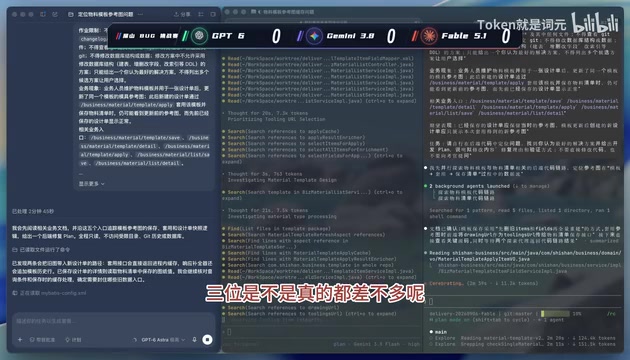
All three passed on the first attempt, each earning 2 points. The creator called it "the best opening in recorded history." Worth noting: Gemini has had near-perfect accuracy on Gold-tier bugs since version 3.7, suggesting that at the level of standard programming tasks, flagship models from major labs have largely converged. Real differentiation only emerges at higher difficulty.
AOP (Aspect-Oriented Programming) is a programming paradigm that separates cross-cutting concerns — such as logging, permission checks, and transaction management — from core business logic. Developers define "aspects" that inject additional behavior before or after specific method executions without modifying the original code. This is precisely why bugs hidden in AOP aspects are so hard to catch through standard code review: the erroneous behavior doesn't appear in the business code itself, but in the dynamically woven interception layer. For large language models, pinpointing an AOP bug requires understanding the runtime method call chain rather than just reading static source code — which is exactly what the Gold Bug was designed to test for basic architectural comprehension.
Diamond Bug: The Gap Starts to Show
The Diamond Bug marked the first real turning point. GPT6 was the slowest — taking 16 minutes to locate and fix — but hit the mark on the very first attempt, scoring a full 3 points. The creator noted that GPT6 had "knocked out Diamond Bugs in one round multiple times back in the GPT-5.5 era," a testament to consistent, accumulated capability.

Gemini 3.8 Flash exposed a clear weakness: it failed the first-round check. In fact, it has never solved a Diamond Bug on the first try. More surprisingly, Fable5.1 — which had previously cracked Diamond Bug D004 in one round — stumbled on D001 in round one.
In round two, a more focused Fable5.1 deployed three sub-agents, identified that the issue involved cache, AOP aspects, and interceptors, and resolved it in 12 minutes, recovering 2 points. Gemini had a rougher ride: round two consumed 40 minutes without success, and round three failed again due to improper handling of special character compatibility in a CQL query.
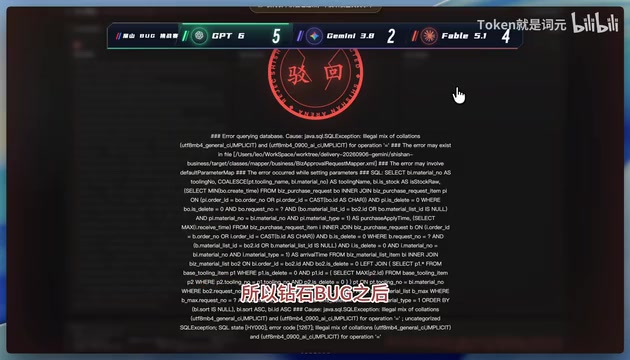
After the Diamond Bug, GPT6 led with 5 points, Fable5.1 had 4, and Gemini trailed at just 2. This round confirmed a pattern: the more tightly coupled a bug, the more it tests a model's holistic architectural understanding rather than point-in-time fix capability.
Cache-business logic coupling is one of the most common forms of technical debt in enterprise projects. A typical scenario: business logic updates a database record but fails to invalidate the corresponding cache, causing subsequent reads to return stale data. Or the cache granularity doesn't align with transaction boundaries, triggering data consistency issues. It gets even more complex when the cache logic itself is triggered via AOP aspects or interceptors, creating multi-layered implicit dependencies. Fixing this class of bug requires a global view of the entire data flow — from incoming request, through interceptor processing, cache read/write, all the way to database commit — not just a localized fix. This is the core reason Gemini failed all three rounds on D001. CQL (Cypher Query Language) is the query language used by the graph database Neo4j; its syntax has specific escaping requirements for special characters like colons and slashes. Improper handling leads to silently failing queries — a subtle compatibility trap that's easy to overlook.
King Bug: GPT6's Crowning Moment
The real climax came with King Bug K005 — a problem involving cache, concurrency, and 11 intertwined business logic layers that had gone undefeated for a month.
GPT6's run was nothing short of dramatic. It started with a comprehensive sweep, identified aspect-related issues, and proposed a solution within 5 minutes — then hit a usage rate limit that forced a 5-hour pause. In the final stretch, it completed the fix in 25 minutes. The result: solved on the first attempt, a full 3 points. The creator reflected that this bug, which had "dominated the summit for a month," had "suddenly lost its luster" — and announced plans to "unlock four more King Bugs and open the next chapter."

Fable5.1's journey was more turbulent. Rounds one and two both failed. It wasn't until round three — 16 minutes of focused effort — that it finally got it right, earning 1 point and saving face. The creator suggested this might be "the last rodeo for the American dark horse," and noted that holding on to score anything at all under that pressure was itself an achievement.
Gemini 3.8 Flash, on the other hand, completely fell apart. In round two, it went full throttle and modified over 20 files — only to introduce circular dependencies. As the creator put it bluntly, "its brain couldn't keep up with the complexity of its own changes." Even after resolving the circular dependencies in round three, it still couldn't pass.
Concurrency bugs are widely considered the hardest category of defects to reproduce and diagnose in software engineering. The root cause is the inherent non-determinism of multi-threaded execution — problems only surface under specific timing conditions, and single-threaded debugging or low-concurrency testing often shows nothing wrong at all. When concurrency issues are layered on top of cache invalidation and multiple business logic branches, the diagnostic complexity grows exponentially: fixing one location can break the timing assumptions of another, creating a "the more you fix, the worse it gets" spiral. Fable5.1's two failed rounds and Gemini's round-two spiral of 20+ file changes that introduced circular dependencies are both textbook examples of this complexity. A circular dependency occurs when module A depends on module B and module B depends on module A; in dependency injection frameworks like Spring, this causes application startup failures — a structural error that typically signals the initial fix direction was fundamentally wrong.
Final Scores and Takeaways
The final standings: GPT6 passed every round on the first attempt, achieving a perfect score of 8 points. Fable5.1 scored points on both the Diamond and King Bugs to finish with 5 points. Gemini 3.8 Flash was held to 2 points — basically untouchable at Gold level and below, but clearly needing work above Diamond difficulty. The creator openly called out: "Just ship the Pro version already."
The value of this test lies in going beyond standardized benchmarks and using genuine, complex technical debt from real projects. A few conclusions stand out for practitioners:
- Basic capabilities have converged: All three passed the Gold Bug on the first try, confirming that major flagship models are roughly on par for routine programming tasks.
- Complex coupling is where it counts: Multi-logic coupling at Diamond and King level is the real differentiator. GPT6's consistency and depth of architectural understanding stood clearly ahead.
- Speed ≠ quality: Gemini was the fastest yet scored the lowest. Fable5.1 and GPT6 were slower but far more reliable, suggesting that reasoning depth and prompt quality matter more than raw response speed.
At the end of the video, the creator also had GPT6 generate an interactive animation in HTML and SVG — a bird riding a bicycle along the beach at sunset, complete with interaction and speed controls — showcasing the model's creative range beyond pure bug-fixing. Legacy bugs need fixing, sure. But as the creator put it: don't miss the sunset on the beach either.
Related articles
FlyEnv Plugin Review: Visually Running llama.cpp and Managing GGUF Models
FlyEnv launches the official llama.cpp plugin with side-by-side Metal runtime management, public GGUF repository indexing with file type labels, and visual configuration of context, threads, and GPU layers—saving templates and speculative decoding with each model for one-click local LLM inference.

How Can Frontend Developers Advance into AI Agent Development? Deconstructing System-Level Agent Architecture from OpenClaw
Starting from the OpenClaw demo in a Bilibili open class, this article breaks down the three-layer architecture and universal formula of system-level AI agents, and analyzes the path for frontend developers to enter agent development based on TypeScript, including plugin-based design and security/memory layer challenges, with an interview answer framework.

WorkBuddy in Action: How AI Agents Automate Batch File Conversion and Archiving
Bilibili creator Teacher Shanyao tests WorkBuddy vs. Doubao on batch file conversion, showing how AI Agents move from "giving solutions" to "direct execution," with a full workflow and credit cost reference.