Greek PM Admits the Truth: No Government Is Ready for the AI Disruption

Greek PM admits no government is truly prepared for AI disruption, exposing a structural governance lag.
Greek Prime Minister Mitsotakis made a rare candid admission during a trade visit: no government is truly ready for the transformations AI will bring, summing up the disconnect with the phrase 'we're already fighting yesterday's battle.' The article analyzes three structural challenges in AI governance — the non-linear pace of capability advances, the limited enforcement power of traditional regulatory tools against cross-border AI systems, and the risk of a 'race to the bottom' if any single nation over-regulates. The author argues that Mitsotakis's choice to voice these concerns in a trade context reflects strategic realism, and that the path forward lies in building adaptive governance institutions, not perfect regulations.
A Leader's Rare Admission
During trade visits, most political leaders stick closely to rehearsed talking points, repeatedly emphasizing their country's investment appeal and policy advantages. But Greek Prime Minister Kyriakos Mitsotakis broke from that pattern in a recent interview — openly acknowledging that no government is truly prepared for the transformative changes artificial intelligence is about to bring.
This kind of candor is uncommon in today's political climate. As governments around the world roll out sweeping AI strategies, establish regulatory bodies, and convene international summits, a sitting prime minister publicly expressing uncertainty about governance capacity actually reflects a more grounded read of reality: the pace of technological evolution has far outrun the response capacity of traditional governance frameworks.
"We're Already Fighting Yesterday's Battle"
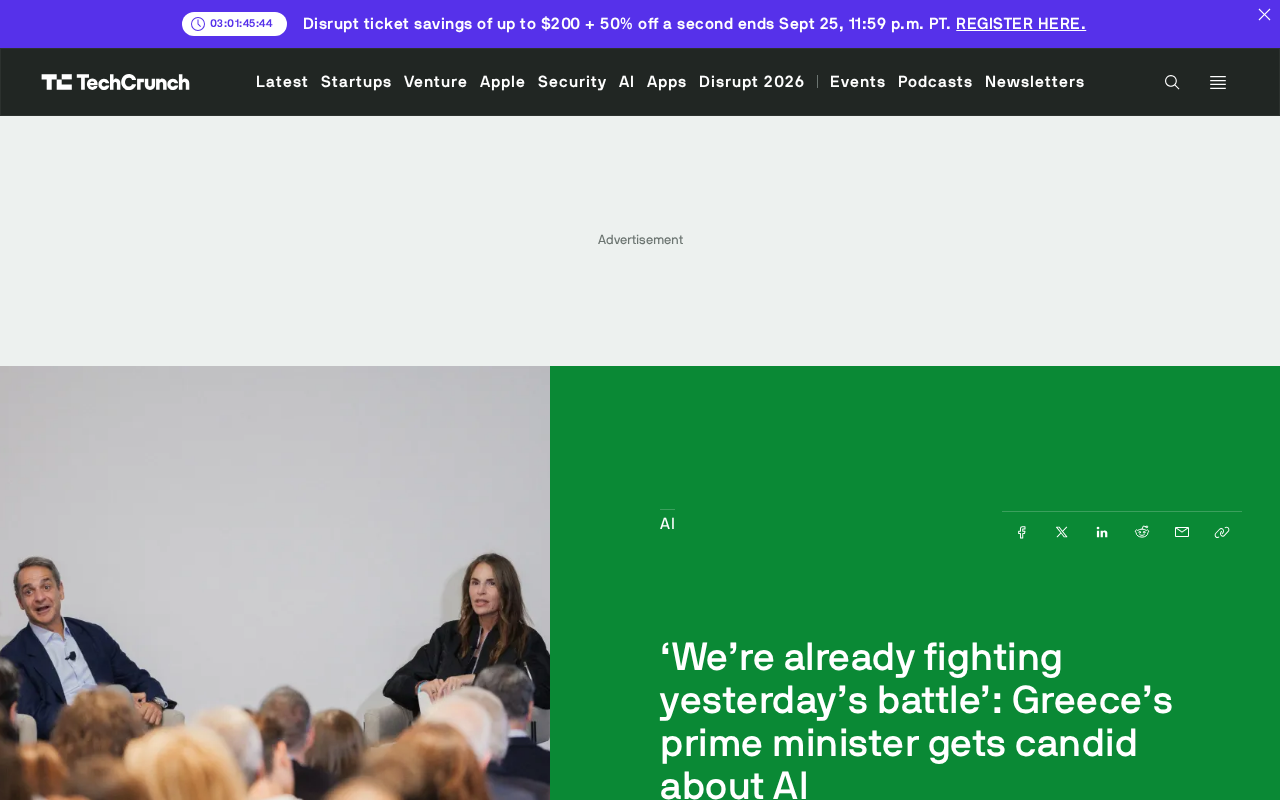
Mitsotakis used the phrase "We're already fighting yesterday's battle" to describe the situation governments face when confronting AI. The line cuts to the core of a fundamental misalignment between public governance and technological development.
Policy tends to be formulated around problems that have already emerged — data privacy, algorithmic bias, platform monopolies. By the time regulators turn their attention to these issues, the technology itself has typically iterated to the next stage. While legislatures are still debating the rules for the previous generation of technology, generative AI, autonomous agents, and other new forms have already entered real-world deployment. This "time lag" means that even the most proactive regulatory efforts may be outdated by the time they take effect.
For a mid-sized economy like Greece, the challenges are particularly concrete. It lacks the computing power and capital scale of the United States or China, and doesn't have the industrial depth of the EU's core economies — yet it faces the same AI-driven disruptions to employment structures, public services, and national competitiveness.
Why No Government Is "Ready"
Mitsotakis's assessment is not an isolated view — it reflects a widespread structural dilemma. AI governance faces several deeply embedded challenges:
Technological Uncertainty
No one can accurately predict the trajectory of AI capabilities. Leaps in model performance tend to be non-linear, which makes long-term policies built on current understanding highly prone to obsolescence. Governments are accustomed to tiered risk management for known threats, but AI introduces an abundance of "unknown unknowns."
The "non-linear leaps" described here have concrete historical precedents in AI. The release of ChatGPT in late 2022 and GPT-4's demonstration of multi-step reasoning in 2023 both invalidated capability prediction curves that had been broadly accepted by the research community. Researchers refer to these phenomena as "emergent capabilities" — where models, upon crossing a certain scale threshold, suddenly show qualitative improvements on tasks where they previously performed poorly, with those thresholds being difficult to predict in advance. The concept of "unknown unknowns" originates in risk management and refers to things that decision-makers don't even know they don't know — unlike "known unknowns" (such as a technology's safety risks) that can be placed on a regulatory agenda, "unknown unknowns" lack even the conceptual framework to formulate the right questions, leaving traditional risk assessment models largely powerless.
The Lag of Governance Tools
Existing regulatory instruments — licensing, review, penalties — were designed for the industrial era and the early internet. Faced with AI systems that can rapidly self-update and be deployed across borders, these tools lose much of their enforcement power.
The Tension Between Competition and Regulation
If any single country tightens regulation too aggressively, it risks pushing talent and investment toward jurisdictions with looser rules. This fear of a "race to the bottom" leaves governments oscillating between protecting the public interest and maintaining competitiveness.
"Race to the bottom" is a classic concept in international political economy, referring to the dynamic where countries compete for mobile capital or businesses by lowering regulatory standards, tax rates, or labor protections — ultimately dragging overall standards downward. This phenomenon is well-documented in financial regulation, where offshore financial centers have long eroded sovereign states' ability to manage financial risks. Similar concerns exist in AI: if a country tightens rules on training data usage, model deployment, or automated decision-making, companies can simply move their servers to more permissive jurisdictions — a form of "regulatory arbitrage." The EU's AI Act attempts to counter this by using market access as leverage — requiring that AI systems sold or used within the EU comply with its regulations — but its practical enforcement still faces significant challenges from cross-border technology deployment.
The Political Significance of Candor
Worth reflecting on is why Mitsotakis chose a trade visit — an occasion typically meant for "selling the country" — to express this kind of concern. It may reflect a form of strategic realism: rather than promising an "AI-readiness" he cannot deliver, acknowledging limitations and seeking collaboration.
For Greece, attracting AI-related investment, building digital infrastructure, and cultivating technical talent all require international partners. Admitting "we're not ready" is, in a sense, a more honest pitch to investors — it puts the real challenges on the table and invites partners to address them together, rather than unilaterally promising an unrealistic roadmap.
Greece's concrete situation in the AI policy landscape provides important context for understanding this stance. In 2023, Greece released a national AI strategy that explicitly prioritized tourism, shipping, and public services digitization as key application scenarios. But compared to European tech hubs like Ireland and the Netherlands, Greece still lags noticeably in digital infrastructure density, R&D spending as a share of GDP, and tech talent retention rates. In recent years, the Greek government has actively courted overseas tech companies — both Microsoft and Google have announced data center investments in Greece — making this "acknowledge limits, invite collaboration" framing strategically meaningful in both diplomatic and commercial terms. It positions Greece as a "pragmatic partner" rather than a competitor claiming full readiness, carving out a differentiated space for cooperation within the EU's AI governance framework.
Lessons for Other Countries
The core question raised by this interview extends well beyond Greece: in an era where technological change moves far faster than institutional evolution, how should governments conduct themselves?
The answer likely lies not in crafting a "perfect" set of AI regulations, but in building more adaptive governance mechanisms — institutions capable of rapid learning, iterative adjustment, and honest acknowledgment of the boundaries of their own understanding. Admitting "we're already fighting yesterday's battle" is itself the first step out of that predicament. Only by clearly recognizing the gap can policymakers realistically begin to close it.
For observers tracking AI policy, Mitsotakis's remarks carry a meaningful signal: beyond the grand narratives of technological optimism, a growing number of decision-makers are beginning to honestly confront the real shortcomings of their governance capacity. This shift from "talking points" to "candid dialogue" may be the true starting point for responsible AI governance.
Related articles

LLaMA-Factory in Practice: A Complete No-Code Guide to Fine-Tuning Large Models
An introduction to LLaMA-Factory, the open-source fine-tuning tool: its 60.1K-star background, supported models and algorithms, local vs. cloud deployment, and CUDA setup steps.

Zeng Ming's Deep Retrospective: Why OpenAI May Not Be the Ultimate Winner — and Why the Corporate System Will Disappear
Zeng Ming's deep retrospective on the AI endgame: model companies are just infrastructure, OpenAI and Anthropic won't be the final winners; the next battle is the Agent entry point standard; the corporate system will disappear as AI restructures collaboration, and only mission-driven companies can survive the cycle.

OpenHands v1.28.0: OpenCode and PI Added as Built-in Agents, API Keys Requestable In-Conversation
OpenHands ships 5 releases in 21 days: v1.27.0 adds OpenCode and PI as built-in agents, v1.28.0 enables in-chat key requests. ACP integration, credential reuse, model list changes, and upgrade advice.