Grok 4.5 vs Composer 2.5: Real-World Code Benchmark — Who Wins?

Composer 2.5 beats Grok 4.5 High on real Terraform/AWS bug fixes in a rigorous developer test.
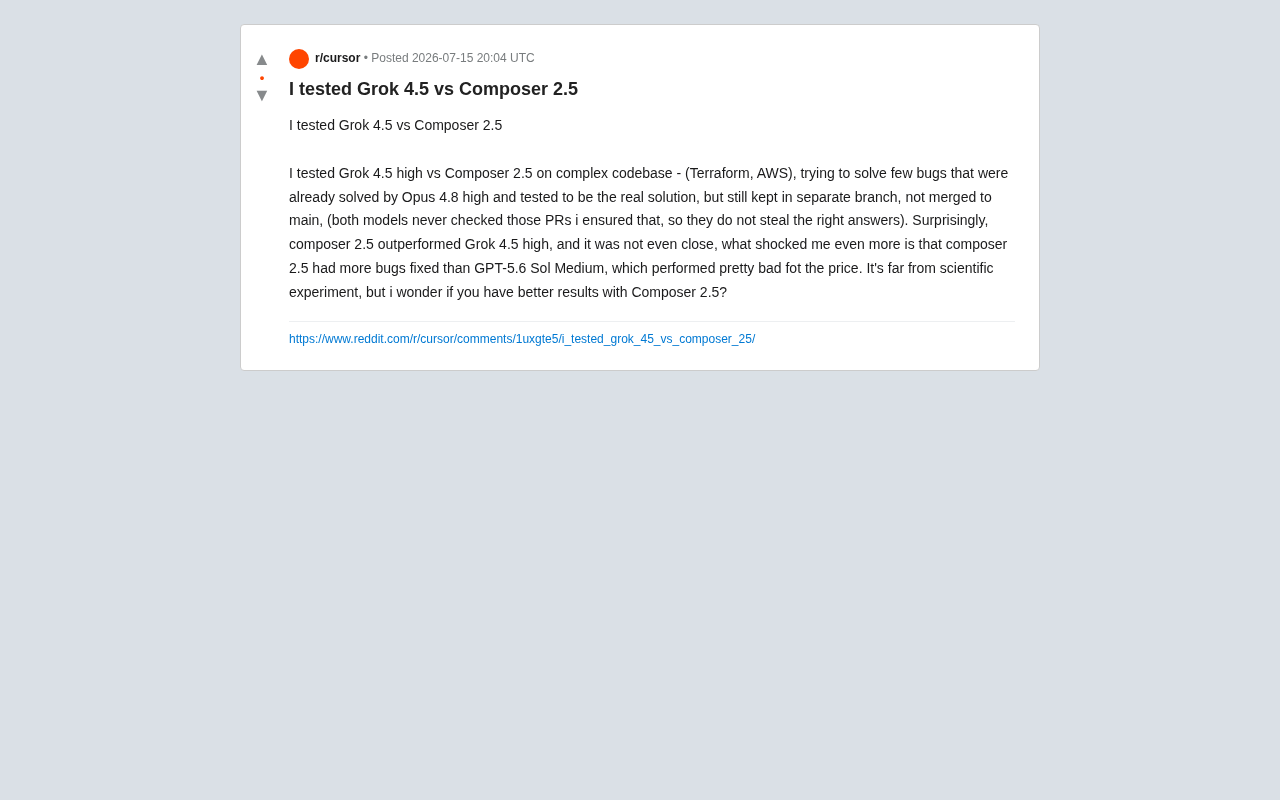
A Reddit developer ran a real-world bug-fixing benchmark on a Terraform/AWS codebase, using Opus 4.8 High's verified solutions as ground truth and keeping answers in isolated branches to prevent data leakage. The results: Composer 2.5 comprehensively outperformed Grok 4.5 High — and even fixed more bugs than the much pricier GPT-5.6 Sol Medium, raising important questions about cost-effectiveness in AI coding tools.
An Unconventional AI Coding Benchmark
As AI coding assistants evolve at a breakneck pace, developers are increasingly turning to real-world projects — rather than leaderboard scores — to validate actual model capabilities. A Reddit developer recently shared a hands-on comparison of several leading models on a complex codebase, and the results were surprising: the highly anticipated Grok 4.5 High was clearly outperformed on real bug-fixing tasks by Cursor's Composer 2.5.
What makes this test worth paying attention to is not just the conclusion itself, but the clever validation methodology the tester designed — one that goes to great lengths to eliminate the possibility of models "cheating."
Testing Methodology: How to Ensure Credibility
Using Verified "Ground Truth" as a Baseline
The developer tested against a complex infrastructure codebase built on Terraform and AWS — this type of Infrastructure-as-Code (IaC) project is typically dense with configuration, tangled dependencies, and extremely high demands on a model's contextual understanding.
It's worth noting that the Terraform/AWS combination represents the mainstream paradigm for modern cloud infrastructure management. Terraform is an open-source IaC tool developed by HashiCorp that lets developers define and manage cloud resources using a declarative configuration language (HCL). Terraform projects on AWS often involve dozens or even hundreds of interdependent resource modules, with variable references, module nesting, and provider configurations all intertwined — a single misconfiguration can cause a deployment to fail. This kind of codebase poses a unique challenge to AI models: they must not only understand single-file logic, but also track cross-file dependencies, understand the behavioral constraints of cloud service APIs, and identify discrepancies between Terraform state files and actual resources. This high degree of contextual complexity makes it an ideal test environment for evaluating an AI's code comprehension capabilities.
Critically, the bugs selected for the test had already been successfully resolved by Opus 4.8 High and confirmed through actual testing as "genuine solutions." In other words, each bug had a known, verified correct answer as a reference point — providing a clear standard for judging other models' performance, rather than relying on vague subjective impressions.
Preventing Models from "Peeking at the Answers"
One of the most commendable aspects of the test design was the strict control over data leakage. The solutions produced by Opus were intentionally kept in a separate branch and never merged into main, with confirmation that none of the models being compared had access to the related PRs (Pull Requests).
This detail is crucial, as it addresses a serious methodological issue in AI evaluation known as "data contamination." If a model has already seen the fix for a particular bug during training (for example, from a public GitHub PR), then its "reasoning" during the test is essentially memory recall rather than genuine problem-solving. Keeping the correct answers in unmerged, isolated branches and confirming that models could not access the relevant PRs effectively mitigates this risk. This aligns with the "strict train/test set separation" principle common in academia, and is a fundamental prerequisite for evaluating a model's actual reasoning ability rather than its memorization capacity. By physically isolating the correct answers, the tester ensured that each model was reasoning independently — truly "solving the problem from scratch."
The Surprising Results
Composer 2.5 Dominates Grok 4.5 Across the Board
Conventional wisdom would suggest that Grok 4.5 High — positioned as a premium model from xAI — should have an edge on complex tasks. The actual results told the opposite story: Composer 2.5 comprehensively outperformed Grok 4.5 High, and the gap was "not close."
In the tester's own words, the result was quite unexpected. To understand why Composer 2.5 was able to win, it helps to understand its technical positioning: Cursor is a code editor built around AI as its core design philosophy, deeply rebuilt on top of VS Code. Its Composer feature is specifically designed for multi-file, multi-step code editing workflows, capable of executing cross-file modifications across the entire codebase context, automatically running commands, and iteratively refining changes based on feedback. Composer 2.5 is its specially optimized version for programming scenarios, with deep tuning in areas like codebase indexing, symbol reference understanding, and diff generation. This vertically integrated "tool + model" approach stands in sharp contrast to the horizontal scaling strategy of general-purpose LLM providers — which also explains why specialized coding models can outperform larger general-purpose flagship models on specific tasks.
The Cost-Effectiveness Dilemma of Premium Models
Even more striking to the tester was another data point: Composer 2.5 fixed more bugs than GPT-5.6 Sol Medium, which "performed quite poorly considering its price."
This touches on a core tension in choosing AI coding tools today — price and actual effectiveness don't always correlate. The current AI coding tool market is clearly tiered by price: flagship models like GPT-5.6 Sol charge per token, with the cost of a single complex task potentially running into cents or even dimes; while specialized models integrated into IDEs typically use subscription pricing with much lower marginal costs. For development teams that frequently rely on AI assistance, API call costs can quickly accumulate to hundreds or even thousands of dollars per month. This has given rise to the practice of "model routing" — using lightweight models for simple code completion and only calling premium models for complex multi-file refactoring — to strike a dynamic balance between quality and cost. A high-priced model may not deliver proportional value on specific tasks, while a purpose-built model optimized for a specific scenario can stand out in vertical use cases. For development teams that need to manage costs, findings like this have considerable practical value.
How to Interpret Real-World Test Results
The Limitations of a Single Test
The tester himself acknowledges that this is "far from a scientific experiment." Limited sample size, narrow task type, and lack of repeated validation are all limitations that need to be recognized. A single developer's experience on a specific codebase cannot be directly generalized into a universal model capability ranking.
Different models tend to have different strengths on different types of tasks. Grok 4.5 may perform excellently in reasoning, general conversation, multilingual processing, and other scenarios — but on this specific type of infrastructure code repair task involving Terraform/AWS, Composer 2.5 happened to be the better fit.
The Value of Real-World Testing
Despite being less "scientific," real-project benchmarks are actually more useful as a reference than standardized benchmarks. There is a well-known "distortion" problem with standardized AI benchmarks (such as HumanEval, SWE-bench, etc.): once benchmark datasets are widely published, model vendors may intentionally or unintentionally incorporate related data during training, causing scores to be inflated and disconnected from real-world capability. This phenomenon is known as "benchmark overfitting" — a classic manifestation of Goodhart's Law in the AI domain: when a metric itself becomes the optimization target, it ceases to be a good metric. By contrast, real bugs in a private codebase have a natural "anti-cheating" property: unpublished, highly context-dependent, and without a single correct solution — these are the true benchmarks for evaluating the real-world capability of AI coding assistants.
The tester concluded with an open invitation to the community: "Are you getting better results with Composer 2.5?" This kind of open crowdsourced validation is the most pragmatic way to evaluate AI coding tools. When enough developers report consistent experiences across their own real projects, the conclusions become truly reliable.
Practical Takeaways for Developers
This informal comparison test offers at least three points worth reflecting on:
First, don't blindly chase the "newest," "strongest," or "most expensive" model. For specific coding tasks, a purpose-built model optimized for that scenario will often outperform a general-purpose flagship.
Second, build your own test baseline. Like this developer did — evaluate models using your team's real bugs and verified correct answers rather than relying on public leaderboards. The natural isolation of a private codebase makes it an ideal evaluation environment for avoiding data contamination.
Third, pay attention to cost-effectiveness. The "high price, low output" performance of GPT-5.6 Sol Medium is a reminder that for bulk code tasks, a model's cost-to-performance ratio should be an important selection criterion. Teams with the resources to do so might consider adopting a model routing strategy — dynamically dispatching different tiers of models based on task complexity — to find the optimal balance between effectiveness and cost.
As competition among AI coding assistants heats up, real-world performance and word-of-mouth from actual use will increasingly become the primary basis on which developers choose their tools.
Key Takeaways
Related articles
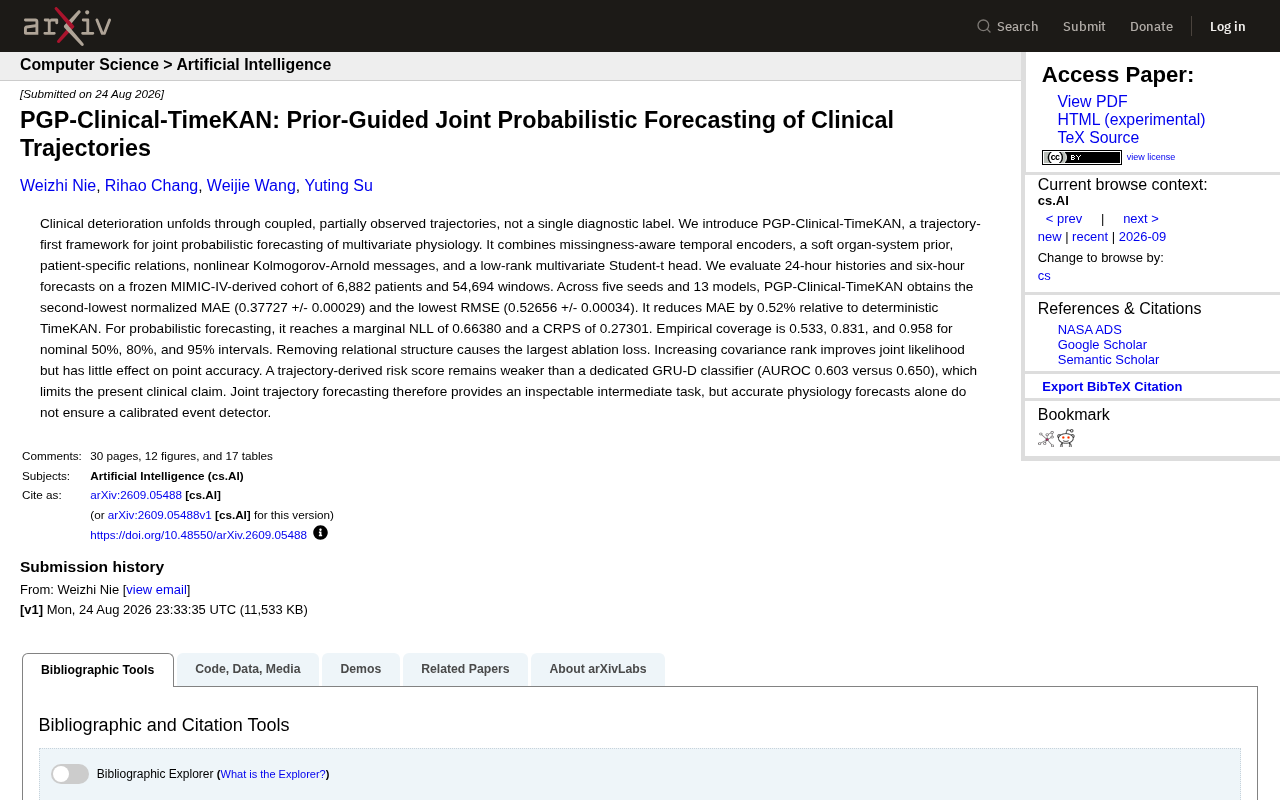
PGP-Clinical-TimeKAN: A Detailed Guide to the Multivariate Physiological Indicator Joint Prediction Framework
An in-depth analysis of the PGP-Clinical-TimeKAN framework for joint probabilistic prediction of multivariate physiological indicators, covering trajectory-first paradigm, KAN message passing, MIMIC-IV validation, and ablation studies.
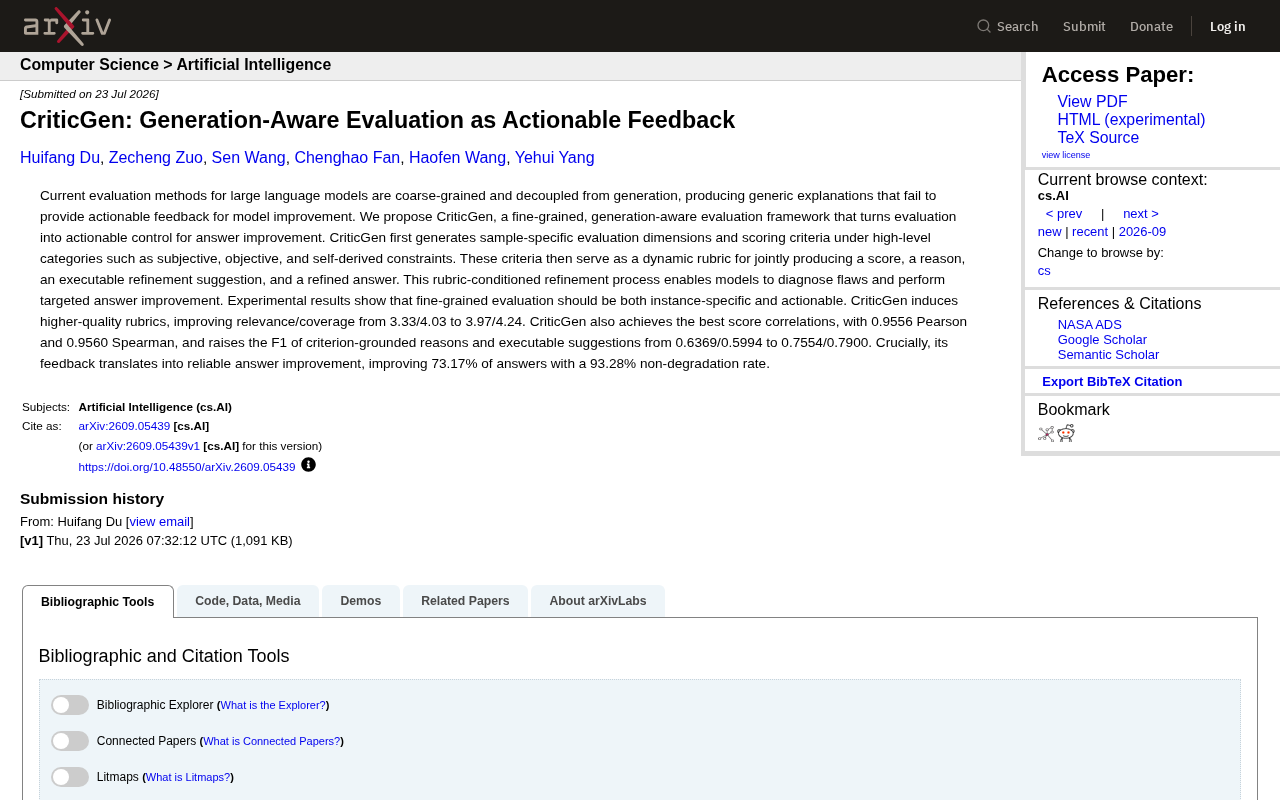
CriticGen: A New Framework That Transforms AI Evaluation into Actionable Improvement Feedback
CriticGen proposes a generation-aware evaluation framework that transforms AI assessment from passive scoring to an active optimization loop, achieving 73.17% answer improvement and 93.28% non-degradation rate.
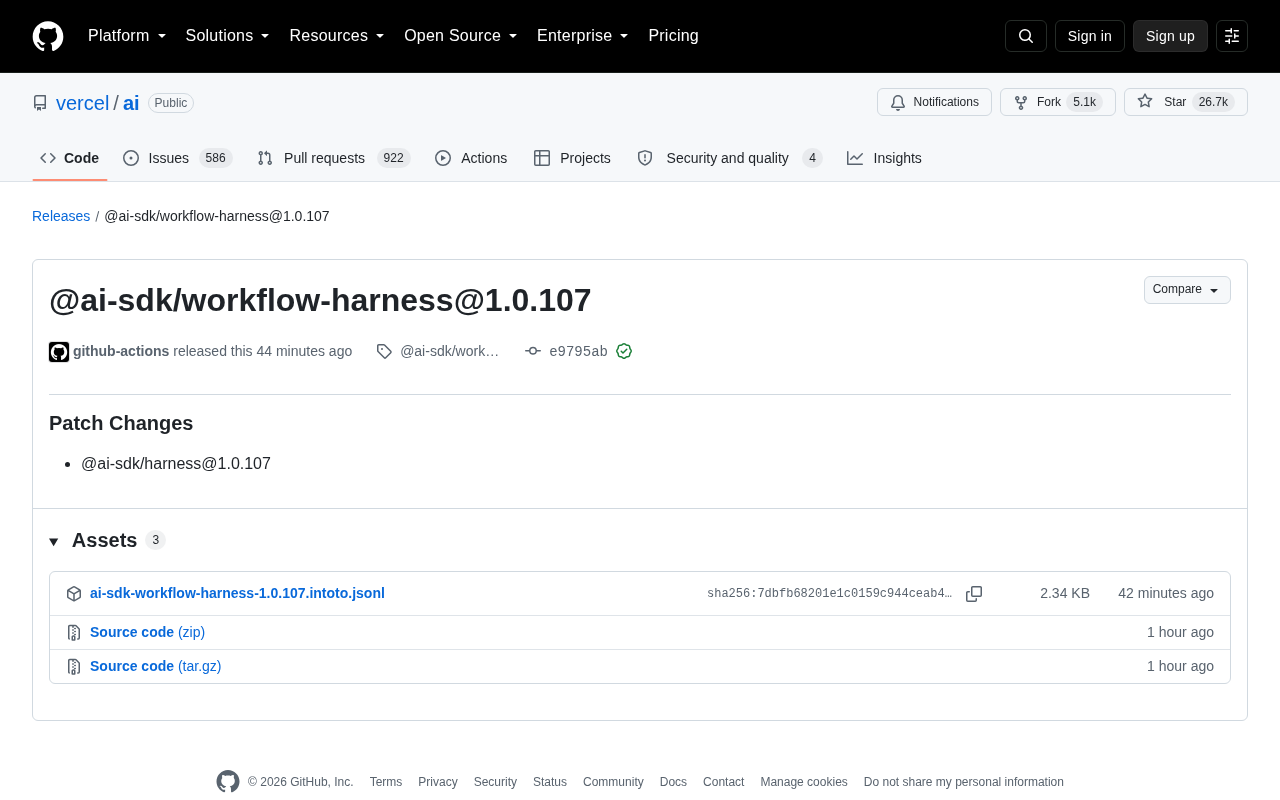
Vercel AI SDK workflow-harness Update Analysis
Deep analysis of Vercel AI SDK workflow-harness 1.0.107 update: architecture design, engineering practices, and developer value for building reliable AI apps.