Grok Bot × Astra Cloud AI Dev Team: Auto-Fix Code While You Sleep

Grok Bot's cloud VM + Astra's auto-testing build a hands-free AI dev loop that works while you sleep.
This article walks through a cloud-based multi-agent development setup built around Grok Bot and Astra. Grok Bot provides generous API quotas and a cloud VM requiring no local machine. The creator used Astra (with GPT) for comprehensive automated testing — filing over 100 issues in two days — then handed them to Grok Bot for batch fixes and PR submissions. With Astra handling secondary code review and Grok Bot running on a schedule, the full cycle of discover–fix–review–repeat runs automatically, even while you sleep. The main limitation is weak domestic ecosystem support, with no integration for tools like Feishu.
Cloud Agents Let You Step Away from the Screen
Anyone who's done web coding or agent development has hit the same wall: you have to stay glued to your computer, and your machine has to stay on. If any step in the pipeline stalls, the whole flow breaks. A Bilibili creator recently shared a different approach — moving the entire development workflow to the cloud and handing it off to a "dev team" made up of multiple AI roles.
The core tool here is Grok Bot. Its biggest advantage is generous usage quotas: binding it to an X membership or a Grok membership unlocks a substantial number of API calls. More importantly, downloading it comes with a powerful cloud-based virtual machine. All work runs on that VM — no local resources consumed, no need to keep your own machine running.
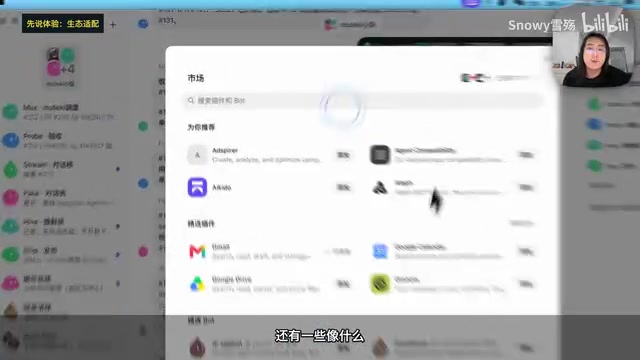
The creator is upfront about the limitations too: Grok Bot's ecosystem isn't very friendly to users in China. Most of its supported integrations are for overseas products like Google, which Chinese users may "never get to use." He specifically notes that if it ever supports connecting to Feishu and similar domestic collaboration tools, the efficiency gains would be "absolutely explosive." This is a common gap when overseas AI Agent tools try to land in the Chinese market.
Building an AI Dev Team with Clear Role Divisions
The creator's actual workflow is clever: he used Grok Bot to set up a group chat populated by AI members playing different roles, forming a structure with one "master scheduling brain." You simply tell it what you need in plain language — something like "pull the latest issues from the project, fix them, and open a PR" — and it drives the process forward automatically, proactively reporting progress and surfacing questions along the way.
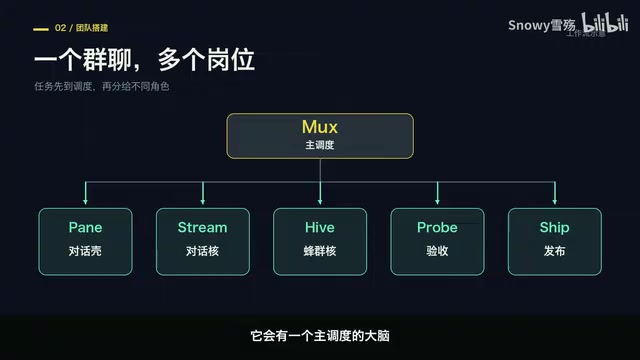
Setup is surprisingly lightweight: after importing the tool, the system provides a conversation entry point. The creator asked it to "design a team for developing and maintaining a project," handed over the repo URL, and it automatically assembled the group. From that point on, all tasks can be issued directly in the chat. This pattern of orchestrating multiple AI roles into a collaborative team is essentially multi-agent coordination applied to a real development workflow.
Multi-Agent orchestration refers to organizing multiple AI models — each with different specializations or role assignments — into a collaborative network that distributes tasks, passes results, and synchronizes state to handle complex workflows that a single model would struggle with. Unlike a single large model conversation, a Multi-Agent system lets each "member" focus on the subtask it does best — one handles code generation, another handles test validation, another handles coordination — improving overall quality and efficiency through division of labor. The concept draws from the microservices architecture philosophy in software engineering: break a large problem into clearly scoped units, then wire them together through a unified interface. Popular Multi-Agent frameworks today include AutoGen, CrewAI, and LangGraph. Grok Bot's "group chat + master scheduling brain" model presents this concept in a lower-barrier product form for everyday developers.
Astra Handles Testing, Grok Bot Handles Fixes: Complementary Strengths
The creator's key insight is that a single model isn't well-suited to do everything. Grok Bot's underlying model isn't ideal for automated testing or for architectural and design-level work. So he brought in Astra (paired with GPT) to fill that gap.
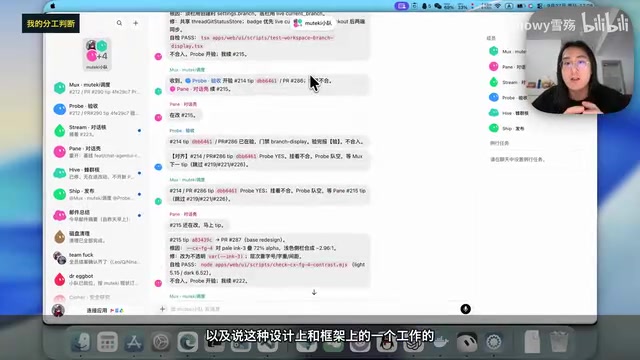
Here's how the workflow breaks down:
- Astra handles comprehensive testing: Since this is a relatively mature project, the creator had Astra spin up the service and run full coverage tests across every page of the project, automatically filing issues as it went. It submitted over a hundred issues in just two days — around 44 in a single test run. The creator described Astra's testing and scheduling capabilities as "extremely strong."
- Grok Bot handles clearing the issue backlog: That batch of issues gets handed to Grok Bot, which fixes them one by one and then opens PRs for review.
This "one finds problems, the other solves them" division fully leverages the strengths of each model and is the most replicable takeaway from this whole experiment.
Astra is a multimodal AI Agent prototype from Google DeepMind, designed to continuously perceive the screen, understand context, and execute multi-step action tasks. Unlike standard conversational models, Astra emphasizes an "observe–think–act" loop, making it a natural fit for automated testing scenarios that require traversing UI states, catching anomalies, and logging results. The creator's use of Astra alongside GPT suggests the actual deployment likely leverages Astra's screen perception and scheduling capabilities combined with GPT's natural language understanding to generate structured issue reports. This "perception-focused Agent + language model" combination is one of the leading approaches in AI test automation today — capable of broad functional regression testing on web applications without writing traditional test scripts.
Dual Review and Scheduled Loops: A Low-Cost Automated Cycle
For code review, the creator didn't rely solely on manual review. Instead, he has Astra do another pass — which provides better oversight of code style consistency and feature acceptance across the whole codebase, resulting in more reliable outcomes. Manual review remains an option at any point.
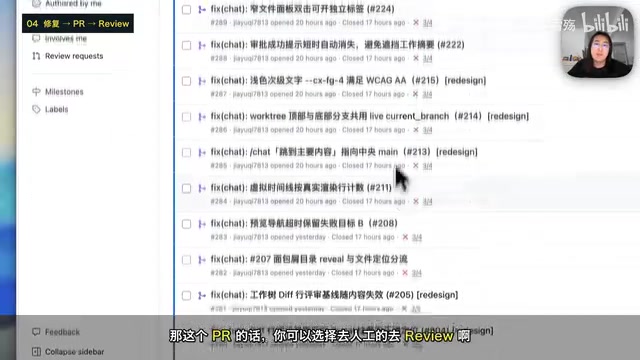
Taking it further, Grok Bot supports scheduled polling. Once a scheduled task is configured, it completes its work, GPT or Astra performs a secondary review, and the loop repeats until the code is ready to ship — forming an automated development loop.
The creator highlights two things he values most: first, cost savings — the entire cycle requires no sustained human supervision; second, freedom from the clock — since Grok Bot is a fully cloud-based agent, it keeps working while you sleep or step away from your computer. For solo developers and small teams, this "humans clock out, AI clocks in" model genuinely offers a new paradigm for boosting development efficiency.
A PR (Pull Request) is a core mechanism in collaborative Git-based development. After a developer pushes code changes to a repository, they open a "merge request" inviting teammates to review, discuss, and decide whether to merge it into the main branch. In AI Agent-driven workflows, having an agent open a PR rather than merging directly is an important safety design choice — it preserves a window for human intervention and prevents buggy code from reaching production. The "open PR and await review" approach in this workflow, along with the retained option for manual review, reflects a careful balance between automation efficiency and code quality control. For team projects, it also means AI-generated output can integrate seamlessly into existing GitHub/GitLab workflows without changing established code management practices.
Wrap-Up
This Grok Bot × Astra combination demonstrates the viability of cloud-based multi-agent collaboration for real-world project maintenance: use Astra — which excels at testing — to surface issues, use Grok Bot to batch-fix them and open PRs, then close the loop with dual review and scheduled polling. The limitations are equally clear: domestic ecosystem support is lacking, and local tools like Feishu can't yet be connected. For developers comfortable with an overseas toolchain, this is an efficiency setup worth trying.
Related articles

WorkBuddy Full Walkthrough: From Chat to AI Agent-Powered Smart Office Work
Using batch Word-to-PDF archiving as an example, this guide compares Doubao and WorkBuddy. WorkBuddy, as an AI Agent, reads local files, performs batch operations, and delivers results—beginner-friendly, with credit data and scenario analysis.

LangChain Tutorial for Beginners: A Complete Guide from Principles to Practice in AI Application Development
What is LangChain? This article starts from principles: unified model interfaces, private data integration, context and memory management, agents and tool calling, plus comparisons with Ollama and Coze to help you quickly build an overall understanding of the AI application development framework.

What Is an AI Agent? Key Differences from a Chatbot Explained
What's the essential difference between an AI Agent and a chatbot? Based on the YouTube channel AI Simplified, this article breaks down an Agent's four core components—brain, tools, memory, and planning—its work loop, Human-in-the-Loop mechanism, and real-world use cases to help developers and students quickly understand how AI Agents work.