LangChain Tutorial for Beginners: A Complete Guide from Principles to Practice in AI Application Development

LangChain is an AI application development framework that encapsulates model calling, private data integration, and conversation state management
LangChain is a framework for developing AI applications. Its core value isn't in making models smarter, but in solving engineering problems beyond the model. Through a unified interface, it wraps the APIs of different providers such as OpenAI, DeepSeek, and Anthropic, so model replacement only requires configuration changes. It also provides private data integration and context and memory management for multi-turn conversations, preventing developers from spending energy on repetitive code. Its features include a modular architecture, Prompt templates, chains and agents, tool calling, and memory management, and it has already introduced DeepAgent based on the Harness architecture. The article also clarifies that Ollama is a private deployment framework and Coze is a drag-and-drop platform, not on the same level as LangChain, which is a code framework. LangChain plus LangGraph is enough to complete an entire enterprise-level AI project.
Large language models are becoming increasingly capable, but actually putting them to work in enterprise business takes far more than just knowing how to call an API. Switch model providers once, change an interface once, and your code has to be rewritten. If private enterprise data can't be connected, the model can only answer based on the old knowledge from its training. And once multi-turn conversations go beyond a few rounds, context state management becomes a nightmare. Frameworks like LangChain exist precisely to solve these "beyond-the-model" engineering problems. This article, based on a hand-holding tutorial from a Bilibili creator, explains clearly what LangChain is, what it can do, and how it differs from Ollama and Coze.
What Problem Does LangChain Actually Solve?
Let's start with the most essential layer: LangChain is a framework for developing AI applications.
Today, almost every major model provider—OpenAI, DeepSeekAd, Anthropic, and others—offers its own API for developers to call. The problem is that each one's API works differently. If you write code using A today, switch to B tomorrow, and C the day after, you'll need to prepare multiple sets of calling logic, and maintenance costs will be high.
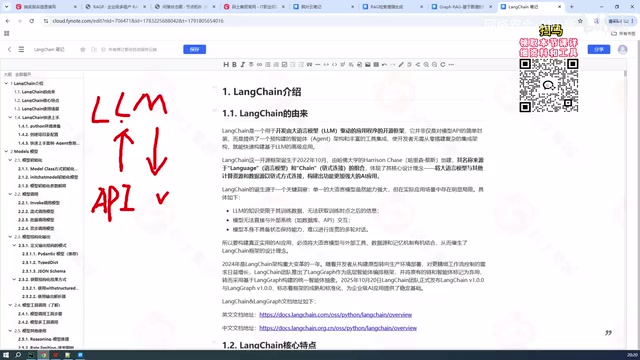
LangChain's approach is to "wrap a layer around it": you use its unified interface to call large models, the underlying code doesn't need to change, and on the upper layer you only need to swap out the model provider. This is what's called a "unified model interface," and it's the most intuitive value it offers.
The fragmentation of large language model APIs is the backdrop for understanding the value of a unified interface. Although providers like OpenAI, Anthropic, and DeepSeek all offer HTTP interfaces, they differ in authentication methods, request body fields, streaming return formats, Function Calling protocols, and error code semantics. For example, even for streaming output, some use SSE's data: events, some name the field delta, and some use content. If a developer binds directly to one vendor's SDK, then once the business requires switching models or doing multi-model routing, the entire call chain needs to be rewritten. LangChain uses the ChatModel abstraction layer to converge these differences into unified methods (such as invoke, stream, batch), reducing model replacement to a configuration change.
Model context windows and knowledge boundaries are another layer of background. A large model's parametric knowledge only covers content up to the cutoff of its training corpus, and does not include internal enterprise documents, databases, or tickets. The context window (such as 8K or 128K tokens) determines how much information can be packed into a single call; anything beyond that gets truncated. Therefore, for enterprises to have models answer private questions, they usually need a "retrieve—concatenate—generate" process, injecting external data into the context in the form of prompts. This is exactly the responsibility carried by LangChain's various Retriever, Document Loader, and VectorStore integrations.
More Than Just Calling Models: Private Data and Context Management
When a model answers a question on its own, it can only rely on what's in its training data—if it's not in the training data, it won't know. What enterprises actually need to use is often internal private data. How to let the model securely connect to this data is the first threshold when it comes to implementation.
LangChain has already encapsulated these kinds of integration and development tools. You don't need to hand-write an entire set of calling code from scratch; you can connect to internal enterprise data directly through configuration.
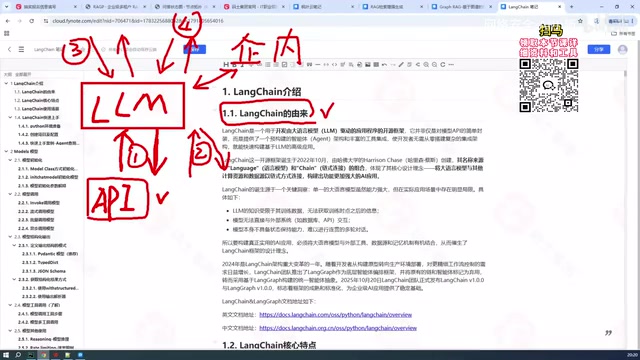
Another point that's easily underestimated is context and state management. In multi-turn conversations, the more turns there are, the more likely later questions are to involve things discussed earlier—this falls under memory management. If you rely entirely on writing your own code to maintain this, all your energy gets spent on conversation handling, and you can't focus on the business. LangChain has this kind of capability built in, so you can automatically maintain conversation state through upper-layer operations.
Several Core Features of LangChain
Unified model interface: Model providers can be freely swapped out—this is the framework's most fundamental capability.
Modular architecture: Includes Prompt templates, pluggable model configurations, memory management, Chain, Agent, tools, and other modules. The creator specifically mentions that LangChain now also has DeepAgent based on the Harness architecture, which is "pretty hot right now—if you have a project like this in an interview, your chances of passing are very high."
Agent and tool calling: Supports building complex agents, including sub-agents, multi-agent nesting, and nesting with agents in graph structures, while also providing tool development and encapsulation capabilities.
Memory management: How to manage context as conversation turns increase involves quite a few techniques, but the creator says this part won't be expanded on for now.
The difference between Chain and Agent deserves a separate explanation. A Chain is a pre-orchestrated fixed pipeline, for example "template filling → call model → parse output," where the execution path is determined when the code is written. An Agent, on the other hand, hands "what to do next" over to the model itself: based on the current goal and the list of available tools, the model outputs a tool call request, the framework executes it, and then feeds the result back to the model, repeating until the task is complete. The former is controllable and predictable; the latter is flexible but harder to debug.
Harness architecture and DeepAgent can be understood this way: Harness refers to the runtime skeleton wrapped around the model, responsible for tool registration, loop control, state persistence, and error recovery. DeepAgent is a higher-level encapsulation introduced by LangChain under this approach, with built-in capabilities such as planning, sub-agent delegation, and long-term memory, so developers don't have to build complex Agent loops from scratch. What's often asked in interviews is precisely "how do you design an Agent's tool boundaries and failure fallbacks," which is also why it's considered high-value.
Application Scenarios: One Ecosystem Handles It All
According to the creator, for any AI application an enterprise wants to build, LangChain can "handle almost all of it, without needing other frameworks." More strictly speaking, using just this one ecosystem—LangChain plus LangGraph—is enough to complete an entire project. The project case he's about to explain is implemented with this ecosystem.
What Is Ollama? How Is It Different from Coze?
During a live Q&A, the creator answered several frequently asked questions, which are worth highlighting separately here.
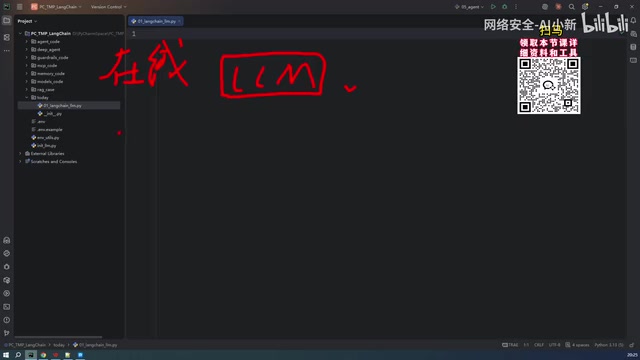
What is Ollama: It's a deployment framework. Large models follow two paths: online and private deployment. Online includes DeepSeek, OpenAI, and Claude; private deployment means deploying open-source models (such as the open-source DeepSeek) onto your own servers, which requires frameworks like Ollama, vLLM, and LM Studio.
Is it another Coze: No. Coze can be understood as a tool for building simple personal applications or workflows through drag-and-drop. Internally it can also do workflows, multi-agent or single-agent setups, but it's drag-and-drop based. LangChain, by contrast, is a code framework—"with LangChain I can build a Coze platform." The difference between the two is one of level and form.
How about security: Security depends on how you control the large model. At the model level things are relatively safe now, but when it comes to operational control involving internal enterprise data, you still need to set permissions and fallback operations yourself.
Can it handle multi-agent setups: Yes, that's exactly its strong suit.
Differences among private deployment frameworks are worth comparing further. Ollama focuses on being lightweight and ready out of the box—one command pulls and runs a quantized open-source model, making it suitable for local development and small-to-medium-scale inference. vLLM emphasizes high-throughput batch inference, optimizing memory utilization through PagedAttention, making it more suitable for concurrent services in production environments. LM Studio is a desktop tool with a graphical interface, oriented more toward individual experience. All three solve the problem of "getting open-source weights running"; the differences lie in performance, ease of use, and deployment form.
Choosing between online APIs and private deployment usually depends on data compliance, cost, and controllability. Online APIs require no operations, and model capabilities are often stronger, but data must leave the enterprise boundary and billing is by token. Private deployment keeps data within the intranet, can run offline, but requires your own GPUs, incurs inference latency, and model capabilities are limited by the chosen open-source weights. In real projects, hybrid approaches are common: sensitive data goes through private models, general Q&A goes through online APIs, and LangChain's unified interface schedules them in the same codebase.
Summary
LangChain's value isn't in "making models smarter," but in encapsulating the repetitive, tedious, and error-prone engineering steps involved in connecting models to business: unified interfaces, private data integration, conversation state management, and orchestration of agents and tools. Once you understand this positioning, looking at concepts like LangGraph, MCP, and Agent makes it easier to find where each one fits.
One-line Summary
LangChain is an AI application development framework that encapsulates model calling, private data integration, and conversation state management
Related articles

Software Factory in Practice: Building an Evaluable Self-Evolving Development Pipeline with Codex and Claude Code
Deconstructing a Codex and Claude Code software factory: control/data plane separation, foreman prompts for consistency, automatic triggers, and data-driven evaluation.

WorkBuddy Full Guide: How an AI Coworker Takes Over Workplace Automation
What is WorkBuddy? This article analyzes the core capabilities of this full-scenario AI agent: autonomous execution with deliverable results, local file processing, multi-agent parallelism, and workplace automation workflows, helping you judge its essential difference from ordinary AI chat tools.

The Truth About AI Agents: A Hundred Lines of Code + an LLM, Deconstructing the Agent's Underlying Logic
AI agents aren't a new AI species—just a language model plus tools, a loop, and a goal. Here's the underlying logic: how 100 lines of Python hit a 75% fix rate, why the harness beats the model, and Gartner's "agent washing."