What Is an AI Agent? Key Differences from a Chatbot Explained

Chatbots only give answers, while Agents autonomously execute multi-step tasks—but human control over key checkpoints must be retained.
Using a weekend trip to Mysore as an example, the article distinguishes Chatbots from AI Agents: the former answers passively, while the latter autonomously breaks down tasks, calls tools, and iterates toward a goal. An Agent consists of four components—the language model brain, tools (connectable via MCP), memory, and planning—and operates on the Perceive-Plan-Act-Observe loop (the ReAct pattern). Because more steps mean higher cost and Agents can err, the Human-in-the-Loop mechanism requires pausing before irreversible operations. Key deployment advice: clear goals, limited permissions, and human approval for critical actions.
Starting with a Travel Planning Scenario
You tell a chatbot: "Help me plan a weekend trip to Mysore." It gives you a nice list—train schedules, hotel recommendations, attraction routes. And then? You still have to open the booking app yourself, compare hotels yourself, and add the itinerary to your calendar yourself.
That's a Chatbot. It answers questions, and that's it.
But what if you were talking to an AI Agent? It would search for trains on its own, compare hotels, write the itinerary into your calendar, and then ask you before booking: "The total comes to about 8,000 rupees—should I go ahead and book it?"
According to the YouTube channel AI Simplified, the gap between these two is essentially the leap from "giving answers" to "getting things done."
The Essential Difference Between Chatbots and Agents
A Chatbot operates in a passive mode: you ask, it answers. Each round of conversation is independent—it won't proactively call external tools, and it won't push things forward just because you didn't follow up with another question.
An Agent is different. You give it a goal, not step-by-step instructions. It breaks down the task itself, selects tools, checks intermediate results, and keeps iterating until the goal is achieved.
A simple test: if you need to execute the follow-up steps yourself, you're using a Chatbot; if the system can carry the entire process through for you, that's an Agent.
The Four Core Components of an Agent
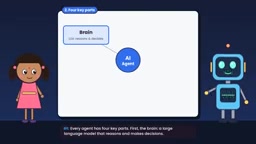
AI Simplified breaks down an Agent's architecture into four key parts.
The Brain: The Language Model
The large language model serves as the center of reasoning and decision-making. It understands the goal, assesses the current state, and decides what to do next. Without this "brain," an Agent is just an ordinary automation script.
Tools: The Ability to Connect to the Outside World
Search, calendars, email, code executors, or any application that can be connected via MCP (Model Context Protocol). Tools determine how far an Agent can "reach" when it comes to taking action.

MCP (Model Context Protocol) is a standard protocol proposed and open-sourced by Anthropic in late 2024, with the goal of unifying how large language models connect to external tools and data sources. Before MCP, each time a new tool was integrated (such as a calendar, database, or search API), developers often needed to write specialized adapter code for a specific model, resulting in high integration costs and poor reusability. Drawing on the idea of USB-C, MCP defines a universal client-server interface: tool providers only need to implement an MCP Server once, and any model or Agent framework that supports MCP can call it directly. It typically includes three types of capabilities—Resources (readable data), Tools (executable operations), and Prompts (preset prompt templates). For Agents, the significance of MCP lies in greatly lowering the barrier to expanding the tool ecosystem, enabling Agents to quickly connect to a large number of ready-made applications.
Memory: Within-Task and Cross-Session
An Agent needs to remember the context of the current task—which train options it has already checked, which hotels it has ruled out. Some Agents can also remember your preferences across sessions, such as the fact that you always choose a window seat.
Planning: From Big Goals to Small Steps
Breaking "plan a weekend trip to Mysore" into "search trains → compare hotels → check calendar → confirm booking" is the job of the planning module. The bigger the goal, the more critical planning capability becomes.
The Agent's Work Loop: Perceive-Plan-Act-Observe
An Agent doesn't complete a task in one shot; it operates repeatedly in a loop.
First, Perceive—understand what the goal is and what state it's currently in. Then Plan—decide what to do next. Then Act—call a tool to execute. Finally, Observe—check the execution result and judge whether it's getting closer to the goal.
This loop repeats until the task is complete or the Agent determines it cannot continue. AI Simplified points out that this is exactly the core idea of the ReAct pattern—reasoning and acting alternate.
One detail worth noting: each cycle of this loop consumes time and cost. The more steps there are, the greater the overhead—which is also a trade-off Agents currently face in real-world deployment.
ReAct is a combination of Reasoning and Acting, proposed in 2022 by researchers from Princeton University and Google. Its core idea is to have the language model alternate between "thinking" and "acting" at each step: first output a piece of reasoning (Thought) explaining the current judgment and the next intention; then output a specific action (Action), such as calling a tool; then receive the observation result (Observation) returned by the tool and use it to enter the next round of reasoning. The advantage of this alternating mechanism is that the model's reasoning process is explicitly visible, making it easier to debug and correct errors, and it can dynamically adjust strategy based on real-time feedback—unlike the traditional "generate the complete plan all at once" approach, which tends to go wrong all the way down after an error in an intermediate step. ReAct is the underlying paradigm adopted by most current Agent frameworks (such as LangChain and AutoGPT).
Human-in-the-Loop: Why Agents Shouldn't Be Fully Autonomous
In the travel planning example, the Agent proactively asked the user before booking. This isn't a lack of capability—it's a deliberate design choice.
For irreversible operations such as payments, sending emails, or modifying production environment code, a good Agent will pause and request human confirmation. This mechanism is called Human-in-the-Loop.
It addresses a core contradiction: the more autonomous an Agent is, the greater the cost when it makes a mistake. Reserving key decision-making authority for humans is currently the most pragmatic risk control measure.
In engineering practice, Human-in-the-Loop is usually implemented through a Checkpoint mechanism. Before an Agent is about to perform a high-risk action, it packages the current state, the operation it intends to perform, and the rationale into a pending-approval request, pauses the loop, and waits for a human response. Human feedback generally takes three forms: approve (continue execution), modify (adjust parameters and then execute), or reject (abort and roll back to the previous safe state). In terms of degree of autonomy, this mechanism corresponds to a "semi-autonomous Agent"—between traditional software fully operated by humans and a fully autonomous Agent. A related concept is Human-on-the-Loop, in which humans do not approve items one by one but instead monitor in real time and intervene when anomalies occur. Together, the two form the mainstream approach to today's Agent risk control systems.
What Real Work Agents Are Already Doing
According to AI Simplified's summary, Agents have already entered practical use in multiple fields.
Coding Agents can write code and run tests, customer service Agents can automatically handle and close tickets, research Agents read materials and generate reports, and personal assistant Agents manage email, calendars, and travel arrangements.
What these scenarios have in common is: the tasks have clear goals, require multi-step operations, and the intermediate results can be verified.
Risks and Deployment Recommendations
Agents are not perfect. They may misunderstand goals, get stuck in loops, or call the wrong tools. The more steps there are, the higher the latency and cost.
AI Simplified's advice is: start with clear goals, give the Agent limited permissions, and retain human approval for important operations. These three principles essentially seek a balance between "capability" and "controllability."
The value of an Agent is not in replacing humans in doing everything, but in freeing people from repetitive multi-step operations while allowing them to retain control over key checkpoints.
One-line Summary
Chatbots only give answers, while Agents autonomously execute multi-step tasks goal by goal—but human control over key checkpoints must be retained.
Paragraph Summary
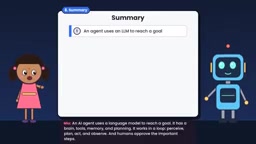
Using "planning a weekend trip to Mysore" as an example, the article distinguishes Chatbots from AI Agents: the former answers passively with each round of conversation independent, while the latter accepts a goal and then autonomously breaks down tasks, calls tools, and iteratively executes. An Agent consists of four core components—the language model "brain" responsible for reasoning and decision-making, tools that connect to the outside world (which can be integrated via MCP), memory within tasks and across sessions, and a planning module that breaks big goals into small steps. Its operation follows the Perceive-Plan-Act-Observe loop, which is the core idea of the ReAct pattern. Because more steps mean higher time and cost, and because an Agent may misunderstand goals or get stuck in loops, the article emphasizes the importance of the Human-in-the-Loop mechanism: pausing before irreversible operations such as payments or sending emails and requesting human confirmation. Coding, customer service, research, and personal assistance are currently the main deployment scenarios, and the recommendations for deployment are to balance capability and controllability through clear goals, limited permissions, and human approval for key operations.
Related articles

Uber Deploys ChatGPT Work Company-Wide: AI in the Workplace Enters the Scaled Implementation Phase
Uber deploys ChatGPT Work to 30,000+ employees, extending it from engineering to all roles. We analyze its expert-engineer pairing, end-to-end automation, and questions of AI control and power concentration—insights for scaling AI in the workplace.

Shift at Midnight Hands-On: When "ID Verification" Becomes Alien Hunting
Shift at Midnight blends ID verification with horror survival in a four-player co-op game. We break down its inspection mechanics and chaotic humor.

Zelensky Recounts the Outbreak of War: I Need Ammunition, Not a Ride
Zelensky recalls the first day of war in a YouTube interview: farewell to family, rejecting Biden's evacuation offer with "I need ammunition, not a ride," and how Bucha shaped his stance on compromise and peace talks.