Grokbot Hands-On: Building 8 Board-Level AI Assistants in 5 Minutes

Grokbot lets non-technical users deploy a board-level AI agent team in five minutes using templates and MCP.
Grokbot is a multi-agent collaboration platform built for non-technical users, promising full setup in under five minutes. By installing the app, connecting to an MCP server, and entering a single natural-language command, users can automatically deploy 8 specialized agents and 1 coordinator for Board Prep and Risk Review scenarios. The product uses a classic orchestration architecture and lowers the barrier to entry through job-role templates. However, since the source material is a promotional demo, actual output quality, data security, and reliability in high-stakes decisions remain unverified — AI suggestions should supplement, not replace, professional judgment.
AI Teams for Board-Level Work
Board members carry a demanding and highly specialized workload: reviewing financial statements, setting strategic priorities, and assessing corporate risk. The traditional approach is either to shoulder all the analysis alone or rely on a costly team of specialists. Grokbot's answer is a group of rapidly configurable AI Agents designed to simulate exactly that kind of team.
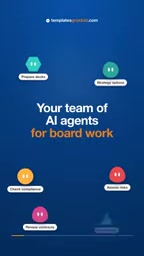
According to a demonstration video on YouTube, Grokbot's core selling point is simplicity and speed. Users with no technical background can stand up a collaborative team of specialized agents in five minutes, covering two key scenarios: Board Prep and Risk Reviews.
Setup Flow: Configuring Eight Expert Agents in Five Minutes
The demo breaks the entire setup down into a handful of clear steps. First, install the Grokbot main application — the foundation on which all agents run. Next, add a Template Creator Bot and connect it to Grokbot's MCP server (the templates Grokbot MCP server). MCP acts as the standard protocol for connecting tools and data sources, handling the orchestration of template resources here.

Once configured, all the user needs to do is enter a single natural-language instruction — something like "I'm a board member, find and install all relevant bots" — and the system automatically discovers and deploys every specialized agent relevant to that role.

MCP (Model Context Protocol) is an open standard proposed and open-sourced by Anthropic in late 2024. It was designed to address the fragmentation problem in integrating AI models with external tools and data sources. Before MCP, each AI application typically had to build custom interfaces for every tool it used. MCP essentially defines a universal connector for AI-to-world interactions, allowing models to access file systems, databases, APIs, and other resources through a unified interface. Within Grokbot's architecture, the MCP server functions as a tool registry — agents connect to it to discover and invoke pre-built templates and feature modules, eliminating the need for users to manually configure each interface. This is the underlying reason why a single natural-language command can trigger the automatic deployment of multiple agents.
Coordination: One Coordinator to Manage the Whole Team
The challenge in multi-agent systems is rarely the capability of any individual agent — it's how they work together. Grokbot's solution is a Coordinator Bot that allows the entire team to function as a cohesive unit rather than a collection of independent components.
According to the video, the end result is a setup of eight expert agents plus one coordinator. This "specialists + coordinator" architecture is a well-established pattern in the multi-agent space: each expert agent handles a vertical task (such as financial review, risk identification, or strategic analysis), while the coordinator manages task distribution and result aggregation to ensure consistent output.

This "expert agents + coordinator" pattern is commonly referred to as Multi-Agent Orchestration in the AI Agent field. Its core concept draws from the "divide and conquer" principle in software engineering: decompose a complex task into sub-tasks, assign each to a specialized module for parallel processing, and have the orchestration layer consolidate the results. The Orchestrator's responsibilities go beyond simple task assignment — they include managing dependencies between agents (where one analysis step needs another's output as input), resolving conflicting outputs, and maintaining overall context consistency. Compared to a single large model handling everything independently, this architecture allows each sub-agent to be optimized for its specific task while reducing the context length pressure on any single call. The tradeoff is that the decision quality of the coordination layer itself becomes the bottleneck for the system's overall performance.
Template-Driven Design: Ready-to-Use Solutions by Job Role
Another core design philosophy in Grokbot is templating. The video emphasizes that "every job has a matching template," with users able to find role-appropriate configurations at templates.grokbot.com/for-my-job. This means board members are just one of many supported use cases — the product aims to bring multi-agent collaboration capabilities to a wide range of professional roles.
This job-role-centric approach to template distribution lowers the barrier to entry for everyday users. They don't need to design agent workflows from scratch; they simply pick the right template and get a ready-to-run collaborative team out of the box.
A Brief Assessment: Key Caveats Behind the Convenience
From what the demo shows, Grokbot is targeting a real pain point: helping non-technical users get up and running with multi-agent collaboration quickly. Five-minute setup, natural-language installation, and template-driven deployment are all practical design choices aimed at reducing friction.
That said, it's worth noting that this material comes from a promotional demo video, which naturally presents an idealized workflow. It does not address actual output quality, data security measures, or the accuracy of agent recommendations in real-world financial and risk analysis tasks. Board-level decisions involve sensitive data and high-stakes judgment calls — AI agent suggestions should serve as a supplementary reference, not a replacement for the final judgment of qualified professionals. Anyone considering trying the platform is advised to first validate its reliability on non-critical tasks.
Related articles

Cursor AI Programming in Practice: Build a Student Management System from Scratch in 30 Minutes
A Bilibili creator demonstrates Cursor AI programming: generating a student management system in 30 minutes with natural language. Details on Agent mode, Claude selection, prompt techniques, and thresholds.

Top 20 AI Coding Tools Ranking: From Rock-Solid to Lackluster, a Scored Matrix
Bilibili creator releases top 20 AI coding tools ranking, tiered T0–T4 from rock-solid to lackluster, with Claude Code and Codex tied at T0. This article details the scoring dimensions (capability, reliability, robustness, durability, cost, domestic availability) and tool performances to help developers choose the right AI coding assistant.

Vibe Coding Systematic Tutorial: Master AI-Assisted Programming from Zero
A three-month Vibe Coding tutorial from a Bilibili creator covering Codex, ClaudeCode, and Cursor, from core logic to commercial project practice for beginners.