GrokBot Hands-On: Deploy 11 Backend Dev AI Agents in 5 Minutes

GrokBot uses MCP and role templates to spin up 11 coordinated AI agents for backend devs in 5 minutes.
GrokBot is a multi-agent coding tool for backend developers that claims to auto-install and assemble a team of 11 specialized AI agents plus one coordinator in five minutes using a single natural language command. Built on MCP (Model Context Protocol), it packages complex agent orchestration into role-based templates covering API endpoints, schema design, and third-party integrations. The article also cautions that the content comes from official marketing material, and that code quality, multi-agent stability, and the true scope of the "5-minute" promise all lack independent verification.
The Repetitive Grind of Backend Development Is Being Handed Off to AI Agents
Writing API endpoints by hand, designing database schemas, wiring up third-party services — these tasks eat up a huge chunk of a backend developer's day. They're tedious, repetitive, and yet unavoidable. According to a product walkthrough shared on YouTube, GrokBot aims to take over exactly this kind of work using a system of AI Agents.
The pitch is straightforward: instead of writing boilerplate code line by line, you spin up a "development team" of specialized agents in five minutes using pre-built templates. Tools like this reflect a broader shift in AI-assisted coding — from autocomplete toward full task orchestration.
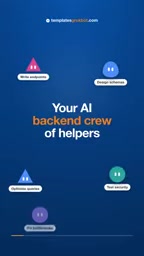
Breaking Down the 5-Minute Setup
According to the official demo, the entire deployment flow is compressed into just a few steps.
Installation and Template Creation
The first step is installing GrokBot itself, then adding a "template creator bot" and connecting it to the GrokBot MCP server dedicated to templates. MCP — the Model Context Protocol — is a standardized protocol that has been gaining traction in the AI tooling ecosystem. It establishes a unified communication channel between agents and external data sources or tools. By using an MCP server as the foundation for template distribution and agent collaboration, GrokBot is positioning itself within the broader agent interoperability ecosystem.
MCP (Model Context Protocol) was proposed and open-sourced by Anthropic in late 2024 to address the fragmented, one-off integrations that plagued AI agents trying to communicate with external tools and data sources. Before MCP, every AI application needed its own custom adapter for each data source — databases, APIs, file systems — making maintenance a nightmare. MCP defines a standardized client-server communication spec so that any MCP-compatible agent can plug into any MCP-compatible tool out of the box, much like how USB standardized the hardware peripheral ecosystem. Major AI development tools including Cursor and Claude Desktop already support MCP, and a nascent tool ecosystem has formed around the protocol. GrokBot's choice to build on an MCP Server means its templates are theoretically interoperable with any other MCP-compatible client — not just GrokBot's own interface.
Natural Language Triggers Bulk Installation
Once configured, you simply type a natural language command — "I'm a backend developer, find and install all relevant bots" — and the system automatically matches and installs every specialized agent suited to your role.

This "describe your role, auto-assemble your team" interaction model lowers the configuration barrier significantly, letting developers who have no experience with agent orchestration get up and running fast.

11 Specialized Agents + 1 Coordinator
The end result of this setup is 11 specialized agents plus one coordinator bot.
Each specialist handles a distinct area — writing API endpoints, designing schemas, integrating third-party services, and other common backend tasks. The coordinator is the linchpin: it keeps the entire "team" working in sync and prevents agents from operating in isolation.
Multi-agent collaboration is one of the hardest unsolved problems in production AI engineering. Getting a single agent to handle an isolated task is straightforward enough. The real challenge is enabling multiple agents to divide work, hand off context, and avoid conflicts within the same project. GrokBot's decision to introduce a dedicated coordinator role is a direct response to this pain point — and it aligns with the "orchestration layer" approach that has become standard thinking in the field.
In multi-agent system architecture, the orchestration layer is the key variable that distinguishes different approaches. Two patterns dominate: centralized orchestration, where a single coordinator (like GrokBot's coordinator bot) manages task dispatch and context passing across sub-agents; and decentralized peer collaboration, where agents communicate and negotiate directly with one another. The centralized approach makes it easier to maintain state consistency and debug the task chain, but the coordinator itself becomes a single point of failure — if it hallucinates or misinterprets an instruction, the entire pipeline can break down. Mainstream multi-agent frameworks including LangGraph, AutoGen, and CrewAI all offer similar orchestration abstractions. GrokBot's design aligns with this direction, though the specifics of its implementation — context window management, rollback mechanisms on task failure — remain opaque.
A Template Ecosystem for Every Role
Notably, GrokBot isn't limited to backend development. The company emphasizes that "every role has a corresponding template," and users can browse role-specific agent combinations at templatesgrokbot.com.
This "role template" product model is essentially about packaging complex agent orchestration into reusable, ready-to-deploy presets. For developers without hands-on agent-building experience — or for non-technical users — this is a far more approachable distribution format. You don't need to understand how each agent is built; you just pick the template that matches your work and start using it.
A Grounded Take: The Gap Between Pitch and Reality
Worth noting: the material for this article comes from GrokBot's official product demo. It is single-source marketing content with no independent third-party evaluation to back it up. Several critical questions remain unanswered:
- Code quality: Whether the auto-generated API endpoints and schemas meet production standards is never demonstrated.
- Coordination reliability: The actual stability, error rate, and debugging difficulty when 11 agents operate together is exactly the kind of question that marketing copy can't answer.
- The fine print on "5 minutes": The installation and configuration might take five minutes, but the time and manual review effort required to produce genuinely usable, maintainable code tends to get glossed over in this kind of promotion.
For backend developers, tools like this deliver real value in accelerating boilerplate and scaffolding work — not in replacing engineering judgment entirely. Before committing, it's worth testing the output quality on a small, non-critical project before deciding whether to fold it into a serious workflow.
Takeaway
GrokBot represents a clear direction for AI coding tools: moving from single-point code assistance toward multi-agent task orchestration, with MCP and role-based templates reducing the barrier to entry. The "11-agent team in 5 minutes" pitch does speak directly to the repetitive-work pain point that defines backend development. How it actually performs in production, however, is something each developer will need to verify for themselves. Interested readers can explore role-matched templates at templatesgrokbot.com.
Related articles

Free Unlimited Claude Code Solution: Agnes AI + CC Switch Setup Guide
No paid subscription needed — pair the free AI platform Agnes AI with the open-source tool CC Switch to provide a backend for Claude Code, enabling unlimited free calls to text, image, and video models. This guide covers the full setup, test results, and usage boundaries.

A Complete Zero-Cost Guide to Getting Started with Claude Code for Beginners in China
A beginner's guide to Claude Code for users in China: two installation methods (command line and IDE plugin), full configuration steps for replacing the official API with the free domestic LongCat model, and a hands-on demo of building a small tool with natural language, plus tips.

When the NSA Gets Involved: The AI Supply Chain Crisis Behind Open-Source CVEs and API Key Hijacking
Multiple open-source projects disclosed severe CVEs in one day, PHP flaws alarmed the FBI, and Railway and OpenCode were breached with API keys stolen. This article breaks down the vulnerability window, AI-accelerated exploitation, and the AI supply chain crisis behind the API key black market, with a developer defense checklist.