Grokbot in Action: How 11 AI Agents Take Over a Bank Branch Manager's Paperwork
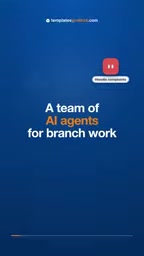
Grokbot demos 11 AI agents for bank managers via MCP templates in 5 minutes — but compliance and real-world effectiveness remain unverified.
Grokbot is a low-barrier AI agent tool that combines an MCP server with a template library, letting users batch-install role-specific agents with a single natural language prompt. Its demo uses a bank branch manager as a case study, showing how 11 specialist agents and 1 coordinator bot can be spun up in five minutes to handle loan reviews, complaint processing, and other repetitive paperwork. While the templated multi-agent architecture is technically compelling, all claims come from the vendor, the five-minute setup excludes compliance overhead, and agent capabilities have not been independently verified — making caution essential in regulated financial environments.
Bank branch managers spend their days buried in loan reviews, customer complaints, and sales targets — leaving little time to actually manage and lead their teams. A YouTube demo offers one potential solution: using Grokbot to quickly assemble a team of AI agents that takes repetitive administrative work off their plate.
The Core Concept: Build an AI Agent Team in Five Minutes
Grokbot positions itself as a platform for "easy AI agents," emphasizing a low barrier to entry and rapid deployment. According to the demo, the process works roughly like this: install Grokbot, add a template creator bot, and connect it to Grokbot's MCP server.

Once the basic setup is complete, users simply type a natural language instruction — for example, "I'm a bank branch manager, find and install all relevant bots" — and the system automatically matches and installs the agents suited to that role.
This relies on MCP (Model Context Protocol), a standard that has been generating significant discussion in AI toolchains lately. It enables agents to interface with external data sources and tool services. Through the MCP server, Grokbot's template library can be dynamically queried, enabling "batch installation by job role."
What is MCP? The Model Context Protocol was proposed and open-sourced by Anthropic in November 2024, with the goal of establishing a unified standard for how AI agents interact with external systems. Before MCP, every AI application that wanted to connect to a database, call an API, or access a filesystem required developers to write custom integration code from scratch — costly and hard to reuse. MCP works like a standardized USB interface: as long as a tool implements an MCP server, any MCP-compatible AI client can call it directly without additional development. In Grokbot's case, the MCP server acts as a "template directory" and "agent installer" — when a user enters a job description, the agent queries the template library via MCP, fetches the configuration, and completes deployment, all transparently. Major platforms currently supporting MCP include Claude and Cursor, and the ecosystem is expanding rapidly.
11 Specialist Agents Plus 1 Coordinator
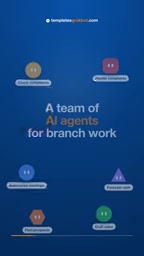
The most concrete figure in the demo: for the bank branch manager role, the system generates 11 specialist agents and adds 1 coordinator bot.

The coordinator deserves special mention. Individual agents operating in silos tend to create information gaps, so the coordinator bot is responsible for making the entire "crew" work together. This architecture — specialist agents plus a coordination layer — is essentially a practical implementation of a multi-agent system (MAS): breaking a complex role into multiple independently-handled sub-tasks, then orchestrating them through a scheduling layer.
For a branch manager, these 11 agents could theoretically handle distinct workflows like loan review, customer complaint processing, and sales data tracking — freeing the manager from mechanical document shuffling.
What is a Multi-Agent System? Multi-Agent Systems (MAS) is a well-established area of AI research. The core idea is to decompose complex tasks among multiple independent agents with specialized capabilities, then integrate their outputs through a coordination mechanism. In the large language model era, this architecture has seen a revival: a single LLM has limited context and focus, but assigning tasks to "specialist" agents and using a "coordinator" to distribute work, aggregate results, and resolve conflicts often yields more reliable outputs. Two common coordination patterns exist: centralized scheduling (one primary agent directing subordinate agents) and decentralized negotiation (agents coordinating through message passing). Grokbot's "coordinator bot" follows the former model. It's worth noting that the coordination layer itself introduces additional latency and potential failure points — factors worth weighing when evaluating real-world performance.
Template-Based: A Scalable Approach for Any Role
Grokbot emphasizes that its template library covers "templates for any job," with the bank branch manager being just one example scenario. Users can browse role-matched templates at templates.grokbot.com.
This template-driven approach lowers the barrier to using AI agents significantly. Building a functional agent workflow used to require expertise in prompt engineering, API integration, and orchestration logic. The template model encapsulates that complexity, letting non-technical professionals get a working solution up and running in minutes.
A Measured Take: This Is a Marketing Demo, Not an Independent Review
It's important to be transparent: the content described above comes from Grokbot's own product demo video. All figures and performance claims originate from the vendor and have not been independently verified.
A few questions worth asking before drawing conclusions:
- Does the five-minute deployment account for upfront account configuration, data integration, and permissions approval? In a real banking environment, compliance and data security are typically the biggest time costs.
- What are the actual capability boundaries of the 11 agents? The demo doesn't show what each agent specifically handles or what the output quality looks like.
- Regulatory thresholds in financial contexts: Bank paperwork involves customer privacy and regulatory requirements. AI agents participating in core processes like loan review require rigorous risk management and compliance evaluation — they are not plug-and-play.
In other words, this demo showcases an appealing product paradigm — assembling a multi-agent team via natural language and templates — but its real-world usability, accuracy, and compliance in actual financial operations remain to be proven in practice.
Conclusion
From a technology trends perspective, Grokbot's approach — templated multi-agent systems combined with MCP integration — does address a genuine pain point: knowledge workers bogged down by repetitive administrative work. For practitioners curious about tools like this, the sensible approach is to experiment on non-critical, non-sensitive tasks first, then evaluate whether the tool earns a place in your workflow. For heavily regulated industries like banking, the path forward requires careful navigation within compliance frameworks.
Related articles

AI Digital Twin in Action: Using DOT to Automatically Track Bugs and User Feedback
DOTS engineers demonstrate how AI digital twin DOT collects cross-platform user feedback, categorizes issue themes, opens threads to investigate bug root causes, and submits PRs—showcasing a complete AI agent workflow for defect triage with auditable design.

Why Transistors Are No Longer Flat: The Evolution from Planar to Gate-All-Around
Transistor evolution from planar to FinFET to gate-all-around: why gates went from three-sided to four-sided wrapping to suppress short-channel effects and leakage current, extending Moore's Law.

Swarm Intelligence = a Single RL Agent? A Proof of Multi-Armed Bandit Equivalence
A paper proves that collective decision-making through local imitation in swarms is mathematically equivalent to single-agent reinforcement learning: N blind imitators act as N parallel environment samples, with an effective learning rate of 1/N. This article explains the derivation and implications of the Maynard-Cross Learning algorithm.