GrowthBook 5.0: Deep Dive into the AI-Native All-in-One A/B Experimentation & Growth Platform

GrowthBook 5.0 merges feature flags, A/B testing, and analytics into one AI-native, warehouse-native growth platform.
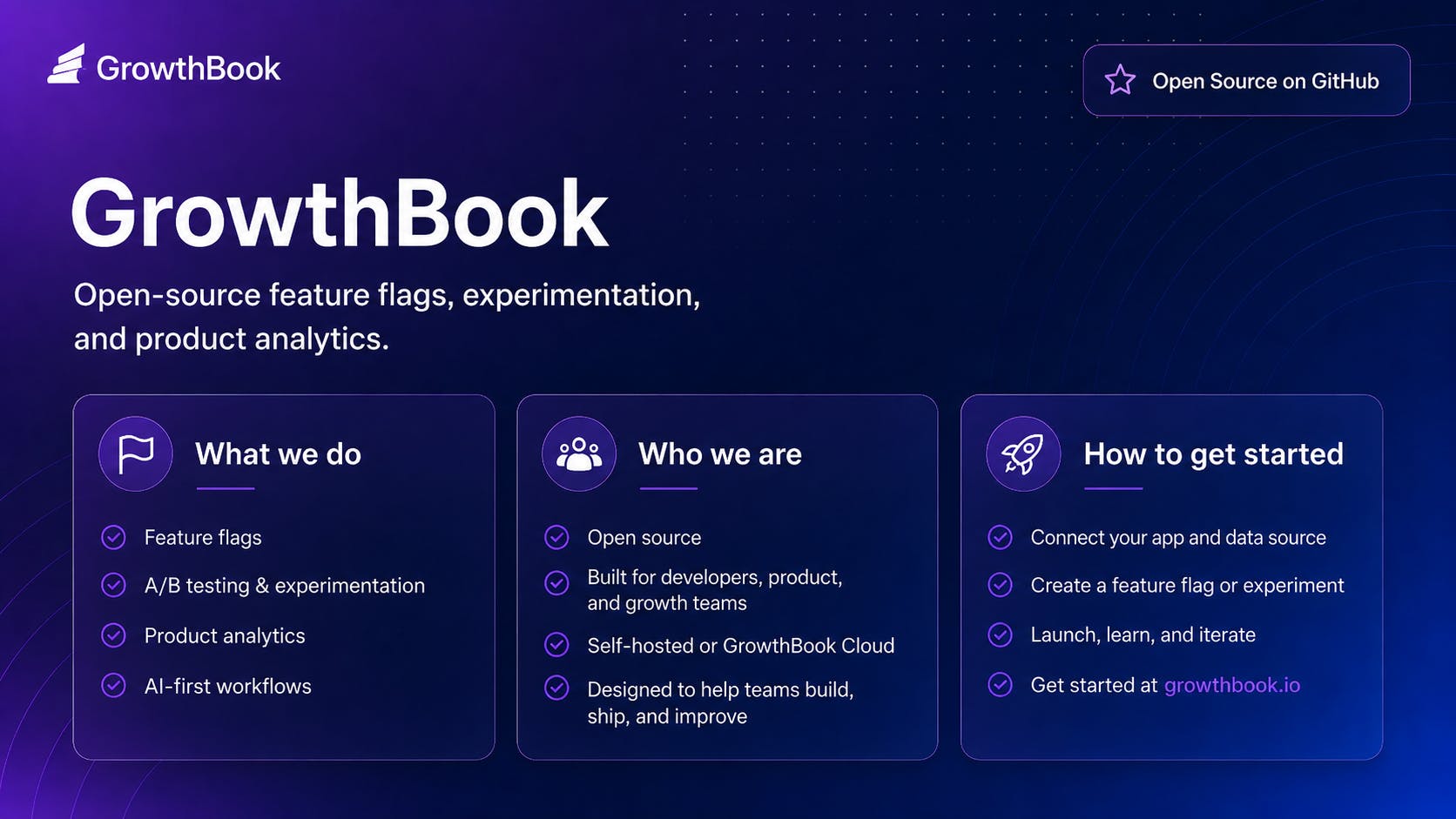
GrowthBook 5.0 consolidates feature flags, A/B experimentation, and product analytics into a unified AI-native, warehouse-native open-source platform. Key innovations include an AI Visual Editor for zero-code experiment creation, an Agent system with 25 open-source Skills for automated workflow execution, and an in-app AI assistant for natural language data exploration. Enhanced governance and query performance round out a release that positions GrowthBook uniquely against fragmented competitors.
The Evolution of an All-in-One Growth Experimentation Platform
In the product growth space, Feature Flags, A/B Experimentation, and Product Analytics are typically scattered across different tools, forcing teams to constantly switch between platforms—resulting in fragmented data and inefficient collaboration. The release of GrowthBook 5.0 aims to break this fragmented landscape by integrating these three core capabilities into a unified AI-native, warehouse-native platform.
As an open-source tool, GrowthBook reached #13 on ProductHunt with 84 votes, spanning categories including A/B Testing, Developer Tools, Artificial Intelligence, and GitHub. The core narrative of this 5.0 release is crystal clear: enable every team to move from idea to insight with less friction.
Feature Flags: The Infrastructure of Modern Software Delivery
Feature flags are a software development technique that allows teams to enable or disable specific features through configuration toggles without redeploying code. Their core value lies in decoupling code deployment from feature release—engineers can merge incomplete feature code into the main branch while keeping it invisible to users through toggles until the product team decides to officially launch. Feature flags are typically categorized into Release Toggles, Experiment Toggles, Ops Toggles, and Permission Toggles. In modern DevOps practices, feature flags have become core infrastructure for Progressive Delivery, supporting strategies like canary releases and gradual rollouts. GrowthBook deeply couples feature flags with experimentation capabilities, making each toggle itself a potential data collection point.
What is Warehouse-Native Architecture
GrowthBook's "warehouse-native" architecture deserves special attention. Unlike many analytics tools that require syncing data to third-party services, GrowthBook connects directly to an organization's existing data warehouse (such as Snowflake, BigQuery, Redshift, etc.) for query computation. This means data never needs to leave the company's own environment, ensuring both data security and compliance while keeping analysis results consistent with actual business data. This design is particularly attractive for mid-to-large teams that prioritize data sovereignty.
From a technical perspective, warehouse-native architecture represents a paradigm shift in modern data tool design. Traditional SaaS analytics tools typically require enterprises to import data into their proprietary platforms for processing, which not only creates data redundancy and sync latency issues but also raises data security and compliance risks. Warehouse-native architecture adopts the philosophy of "pushing computation to where the data lives"—the tool itself doesn't store user data but completes calculations directly in the enterprise's own data warehouse through SQL queries. Cloud data warehouses like Snowflake, BigQuery, and Redshift inherently possess powerful distributed computing capabilities and columnar storage optimizations, enabling efficient aggregate analysis of massive datasets. This architectural design also aligns with the Modern Data Stack development trend in recent years, forming a synergistic ecosystem with tools like dbt, Census, and Hightouch.
Deep Integration of AI Capabilities: From Assistance to Execution
The biggest highlight of GrowthBook 5.0 is the deep integration of AI capabilities, which is the core embodiment of its "AI-native" positioning.
AI Visual Editor: Zero-Code Experiment Building
The newly launched AI Visual Editor allows users to build experiments in a no-code manner directly in the browser. Setting up an A/B test previously often required engineer involvement to modify frontend code, but now product managers or operations staff can visually edit directly on the page, quickly define variants, and dramatically lower the barrier to launching experiments.
To understand the value of this feature, one needs to understand the statistical foundations of A/B experimentation. An A/B experiment is essentially a Randomized Controlled Trial, with its statistical foundation rooted in hypothesis testing theory. The experiment randomly divides users into control and treatment groups, comparing differences in key metrics between the two groups to determine whether a change has produced a significant effect. Core challenges include: determining appropriate sample sizes to ensure Statistical Power, controlling False Positive Rate from multiple comparisons, and handling interference effects between experiments. GrowthBook implements a Bayesian statistics engine on the backend, automatically calculating confidence intervals and posterior probabilities to help teams scientifically judge whether experimental results have statistical significance and practical business meaning. The significance of the visual editor is this: it enables team members without engineering or statistical backgrounds to participate in this rigorous scientific decision-making process.
25 Open-Source Skills and Agent Collaboration
Going further, GrowthBook introduces an Agent mechanism paired with 25 open-source Skills, enabling AI to automatically create feature flags and draft experiment plans. This represents a concrete attempt at bringing AI Agents into growth workflows—no longer just answering questions, but serving as automated assistants capable of executing actual operations. The open-source Skills design also means the community can extend and customize these capabilities, forming an ecosystem.
AI Agents are fundamentally different from traditional AI chat assistants. Chat assistants can typically only provide information and suggestions, while Agents possess closed-loop "perceive-reason-act" capabilities and can autonomously invoke tools and execute multi-step tasks. In terms of technical implementation, Agents typically use large language models (LLMs) as reasoning engines, interacting with external systems through Function Calling or Tool Use interfaces. The Skills concept in GrowthBook is similar to a toolkit that Agents can invoke—each Skill encapsulates a specific capability (such as creating feature flags, querying experiment data, analyzing metric trends, etc.), and the Agent selects and combines these Skills based on user intent to complete complex tasks. This design pattern is increasingly common in enterprise AI products during 2024-2025, such as Salesforce's Agentforce and ServiceNow's AI Agents, reflecting industry consensus on AI's evolution from "conversational" to "action-oriented."
In-App AI Assistant: Natural Language-Driven Data Exploration
Additionally, the platform's built-in AI Assistant enables users to explore product data through natural language. For team members unfamiliar with SQL or complex queries, this lowers the technical barrier to data analysis, making "letting data speak" more accessible. Text-to-SQL technology has matured significantly in recent years with advances in large language models, but still faces challenges in practical applications such as multi-table join comprehension, business semantic mapping, and query result validation. GrowthBook's warehouse-native architecture provides a natural advantage here—the AI assistant can directly understand the table structures and data models of the enterprise data warehouse, generating more accurate query statements.
Dual Reinforcement of Governance and Performance
Beyond AI features, GrowthBook 5.0 also delivers substantial improvements at the engineering level.
Governance Capabilities at Scale
As the number of feature flags and experiments grows, management complexity escalates rapidly. Version 5.0 strengthens governance functionality, helping teams release changes more safely and avoid production incidents caused by configuration chaos. This is critical for scaled usage scenarios—when team size expands and experiments run in parallel, permission controls and approval workflows effectively reduce risk.
In real production environments, feature flag governance is an underestimated challenge. Large organizations may simultaneously maintain hundreds or even thousands of feature flags, and without effective management, "toggle debt" easily accumulates—expired flags left uncleaned, unexpected interactions between multiple flags, and unauthorized changes due to permission chaos. The 2012 Knight Capital incident, where a software configuration error caused $440 million in losses within 45 minutes, remains a classic industry case study on the importance of configuration governance. GrowthBook 5.0's enhanced governance features, including change approval workflows, environment isolation, and audit logs, are systematic responses to these scaling risks.
Query Performance Optimization and Workflow Streamlining
The official announcement specifically highlights faster query speeds and streamlined experiment workflows. Under a warehouse-native architecture, query performance directly impacts analysis efficiency. Performance improvements mean teams can see experiment results faster, shortening decision cycles. Specifically, query latency in a warehouse-native platform depends on multiple factors: the data warehouse's own compute resource configuration, SQL query optimization levels, data partitioning and indexing strategies, etc. GrowthBook can optimize overall response speed at the application layer through techniques such as intelligent query caching, incremental computation, and query precompilation, reducing experiment result retrieval from the minutes level down to seconds.
Implications and Reflections for the Growth Tools Industry
The release of GrowthBook 5.0 reflects several trends worth noting:
First is the inevitability of tool consolidation. Feature flags, experimentation, and analytics fundamentally serve the same goal—data-driven product iteration. Unifying them in a single platform reduces tool-switching costs and data silo issues, representing a logical direction for product growth tool evolution.
Second is AI Agents moving from concept to implementation. GrowthBook enables AI to not only answer questions but actually create experiments and draft plans, embodying the trend of AI evolving from "copilot" to "executor." Of course, the quality and reliability of Agent-created experiments still needs validation through actual usage.
Finally, there's the enduring value of the open-source model. As an open-source tool, GrowthBook attracts community participation through an open Skills ecosystem while meeting enterprise-grade data compliance needs through its warehouse-native architecture, balancing flexibility with control.
From a competitive landscape perspective, the product growth tools market currently exhibits significant fragmentation. In the feature flags space, LaunchDarkly is the commercial leader, with Unleash and Flagsmith as primary open-source alternatives; in A/B experimentation, Optimizely, VWO, and AB Tasty dominate the commercial market, with Statsig and Eppo rising as emerging players; in product analytics, Amplitude, Mixpanel, PostHog, and others each have their focus areas. GrowthBook's differentiated positioning lies in simultaneously covering all three domains with an open-source + warehouse-native combination, which is relatively unique in the competitive landscape. PostHog is the closest competitor, also open-source and offering an integrated solution, but its data architecture leans toward self-hosted ClickHouse rather than being purely warehouse-native. GrowthBook 5.0 further widens its differentiation from similar open-source tools through AI-native capabilities.
For teams seeking an all-in-one growth experimentation platform, GrowthBook 5.0 offers an option worth evaluating—especially for organizations that both prioritize data sovereignty and want to leverage AI to improve experimentation efficiency.
Key Takeaways
Related articles

Apple HomeView Hands-On Review: Is the $300 Smart Home Hub Worth It?
Apple HomeView hands-on: a $300 smart home hub with facial recognition for quick account switching, but no App Store or voice recognition. Is the wall-mounted version worth it? Should you buy the first generation?

Meta Muse Wonder Launch: What It Means for Meta's Return to the Frontier AI Race
Meta releases Muse Wonder and WonderFull, benchmarks reach the frontier, community feedback is polarized. An in-depth look at Meta's return to the frontier AI race, its personal agent strategy, and Zuckerberg's different path.

Apple Home Smart Home Lineup Leaked: LG and Schneider Team Up, UWB Door Lock on Board
Apple Home ecosystem gains new LG and Schneider devices: UWB smart lock with proximity unlock, 2.5K dual-camera doorbell, privacy indoor camera, and AirPods-like seamless pairing.