GRP-Obliteration: Unaligning LLMs with a Single Unlabeled Prompt

GRP-Obliteration claims a single unlabeled prompt can strip safety alignment from open-source LLMs.
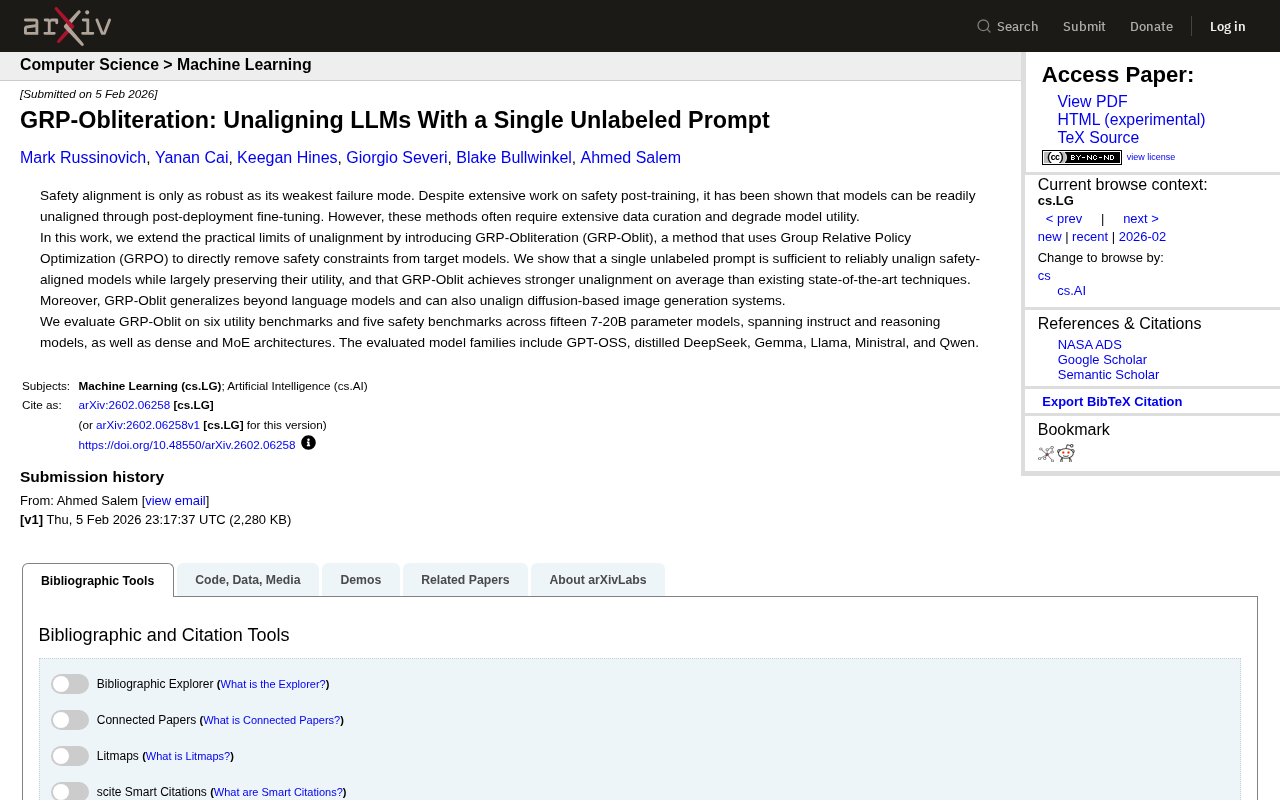
GRP-Obliteration is a technique claiming to unalign LLMs using just a single unlabeled prompt, drawing attention on Hacker News. It builds on the abliteration approach — locating and removing refusal-related directional vectors from model weights — but reduces the required data to an absolute minimum. This exposes a fundamental challenge for open-source model security: any protection applied at the weight level can theoretically be reversed. The work currently has minimal community discussion or verification, so it should be treated as a research direction worth tracking rather than a proven threat. The core takeaway for practitioners: alignment fine-tuning cannot be the only safety layer; multi-layered defenses covering data filtering, capability restrictions, and distribution governance are essential.
Can a Single Prompt Break Through an LLM's Safety Defenses?
A technique called GRP-Obliteration recently surfaced on Hacker News with a striking subtitle: "Unaligning LLMs with a Single Unlabeled Prompt." This work strikes at one of the most fundamental vulnerabilities in current large language model (LLM) safety — just how robust is "safety alignment" in practice?
Alignment refers to the process of using training techniques like RLHF and DPO to teach models to refuse harmful requests and adhere to human values. "Unalignment" (or obliteration) research attempts to reveal that this seemingly solid layer of protection may be little more than a thin coat of paint applied over the model's underlying capabilities.
The Core Idea Behind GRP-Obliteration
The name itself contains two key terms: GRP (likely referring to Group Relative Policy, a reinforcement learning optimization paradigm) and Obliteration. The latter echoes the widely discussed "abliteration" method in the research community — identifying and removing specific directional vectors within the model related to "refusal behavior," thereby preventing the model from triggering safety rejections.
What makes this particularly striking is the claimed threshold: a single unlabeled prompt. Traditional jailbreaking or unalignment methods typically require paired harmful/benign datasets, large numbers of contrastive samples, or carefully crafted adversarial prefixes. If this technique can genuinely remove alignment with just one unlabeled prompt, the cost of attack has been compressed to an extraordinarily low level.
Why "Single Prompt" Matters So Much
In security research, the degree of data dependency often determines the real-world threat level of an attack. Methods requiring thousands of labeled samples have high implementation barriers and poor reproducibility. A method requiring no labeling and no large-scale data, if validated, means that virtually anyone with access to open-source weights could reproduce it. This is precisely why such research draws attention — it measures not just whether defenses can be broken, but how easily.
The Abliteration method, popularized by researchers including Maxime Labonne in 2024, works by identifying a "refusal direction" in the model's residual stream — a linear direction that captures the maximum systematic difference in activations between harmful and benign prompts — and then orthogonally projecting that direction out of the model's weight matrices. In practice, researchers collect a small set of harmful and benign prompts, extract activation differences across layers, fit this directional vector, then modify Attention and MLP weights to make the model "blind" to that direction. The entire process requires no retraining — only weight editing. Experiments showed that abliterated models suffered almost no degradation on standard capability benchmarks, while their probability of refusing harmful requests dropped dramatically. This suggests that "alignment" may be stored primarily in a small number of dimensions in weight space, rather than distributed throughout the entire model. If GRP-Obliteration can compress this entire pipeline down to a single unlabeled prompt, it eliminates even the step of "collecting harmful/benign contrastive samples," lowering the attack barrier even further.
In LLM safety evaluation frameworks, attack methods are typically classified by access level: black-box attacks (API calls only), gray-box attacks (access to logits or embeddings), and white-box attacks (full weight access). GRP-Obliteration falls into the white-box category, targeting open-source models with publicly available weights (such as the LLaMA and Mistral families). It's worth noting that white-box attacks are not new — but their threat level depends on operational complexity. Early adversarial attacks like GCG (Greedy Coordinate Gradient) required thousands of gradient optimization steps, while weight-editing methods have pushed the barrier down to something ordinary users can operate. If GRP-Obliteration truly achieves single-prompt-driven unalignment, it means even users without deep learning engineering skills could potentially complete the unalignment process with a single call — a critical escalation in threat level.
A Deeper Challenge to Open-Source Model Security
This type of research repeatedly confirms an industry-wide consensus: safety alignment in open-weight models is reversible. Once model weights are public, any safety constraints applied at the weight level can theoretically be targeted and stripped away. If GRP-Obliteration holds up, it will further compress the resources and technical expertise required to remove alignment.
This raises an unavoidable tension: open-source development promotes transparency, auditability, and innovation — but it also makes the assumption that "alignment equals safety" increasingly fragile. For model publishers, alignment fine-tuning alone cannot prevent malicious actors from restoring a model's original capabilities. Real protection may require shifting focus toward filtering at the data source, restricting capabilities themselves, and governance at the distribution layer.
The Double-Edged Nature of Attack Research
It's worth noting that this type of work typically appears in academic contexts under the banner of red-teaming and security evaluation. Researchers expose vulnerabilities with the goal of driving more robust defensive mechanisms. Understanding the attack surface is a prerequisite for building targeted defenses. That said, publicly available low-cost unalignment methods also constitute a potential misuse risk — an ethical tension that consistently runs through community discussions of such results.
From a defensive standpoint, the field has proposed several approaches to address the malicious modification of open-source weights. The first is capability distillation and separation: filtering truly dangerous atomic capabilities (such as detailed instructions for synthesizing bioweapons) at the pre-training data stage rather than "suppressing" them during fine-tuning — because suppression can be reversed, but knowledge that was never learned cannot be "unlocked." The second is digital watermarking and provenance tracking: embedding hard-to-remove fingerprints in weights so that malicious modifications can be traced. The third is tiered release: releasing only quantized or pruned inference weights rather than full-precision weights, increasing the difficulty of weight-level attacks. However, each approach comes with trade-offs: data filtering may harm legitimate uses; watermarking research remains immature; tiered release is in fundamental tension with the open-source ethos. This also illustrates that purely technical measures cannot fully resolve the security dilemma of open-source models — governance at the policy and community norms level is equally indispensable.
Rational Perspective Under Limited Information
It's important to note objectively that the information available from this Hacker News post is very limited — the submission had only 3 upvotes and 0 comments at the time, with essentially no community discussion or validation. The specific implementation details of GRP-Obliteration, the range of applicable models, quantitative metrics for actual effectiveness, and its genuine improvements over existing abliteration methods all await further substantiation from an original paper or codebase.
Therefore, in the absence of peer review and independent replication, it is appropriate to treat this as a noteworthy research direction worth tracking, rather than a proven and mature threat. For practitioners, the recommendation is: continue monitoring progress on weight-level security attacks, and do not treat alignment fine-tuning as the sole security barrier when deploying open-source models.
Summary
GRP-Obliteration once again puts the question of "how robust is LLM safety alignment" front and center. Regardless of its ultimate effectiveness, the problem it points to is real: when model weights are accessible, meaningful security protection requires a more systematic, multi-layered design. For the open-source ecosystem, striking the right balance between openness and safety remains a challenge with no standard answer.
Related articles

Complete Guide to Running Your Own Local DeepSeek: Web Access, Knowledge Base & Privacy
Step-by-step guide to deploying a private DeepSeek locally using Ollama, Chatbox, and AnythingLLM — with web access, RAG knowledge base, and full privacy.

AI Agent Development: A 4-Stage Learning Roadmap from Beginner to Enterprise-Level Practice
A complete AI Agent learning roadmap from zero to enterprise-level: covering ReAct, multi-agent collaboration, Prompt tuning, RAG, MCP, and real-world projects.

A New DeepSeek Harness Experiment: Agent Supervising Agent for Self-Evolution
A developer built an "Agent supervising Agent" self-evolution system using DeepSeek Harness, with a ledger mechanism enabling near-unattended overnight software iteration.