GTA VI Is Finally Here: A New Benchmark for Rockstar's Open Worlds

After thirteen years, Rockstar returns with GTA VI to redefine the genre with a high-density open world.
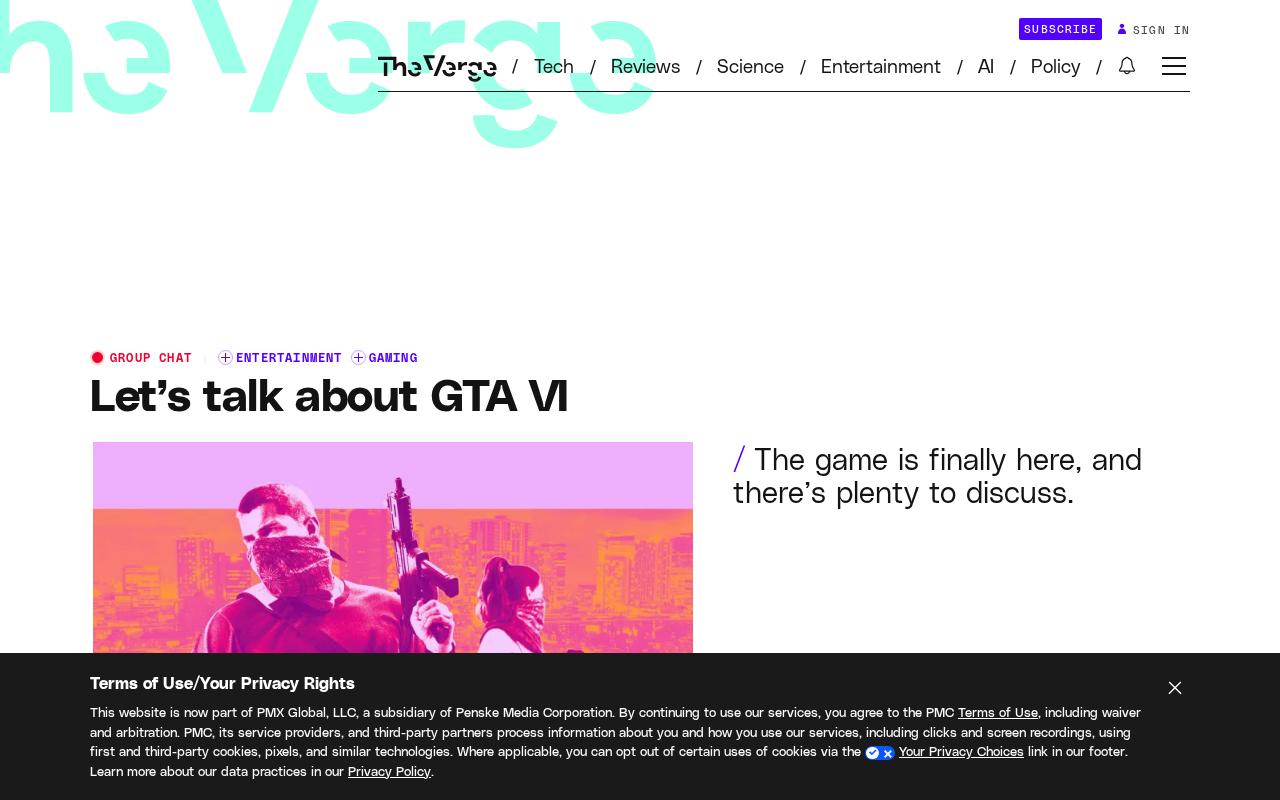
GTA VI is the proper sequel to GTA V thirteen years later and Rockstar's first new title in eight years since Red Dead Redemption 2. Described as a sprawling, extravagant open world, its core appeal lies in content density rather than map size alone. Rockstar must balance scale and detail to avoid an empty map, and with thirteen years having reshaped the open-world genre and player expectations, GTA VI cannot win on size alone.
Thirteen years have passed since GTA V launched, and eight since Red Dead Redemption 2. Rockstar is back with GTA VI, a sprawling, extravagant open world that is now genuinely in front of players.
A Long Wait and a Return
Rockstar's release cadence has always been known for "slow work, fine results." After GTA V, fans waited thirteen years for a proper sequel; even Red Dead Redemption 2 is now eight years old. Behind this long cycle is Rockstar's relentless pursuit of scale and detail in its open worlds.
GTA VI has been described as a "sprawling, extravagant" open world—two words that almost sum up Rockstar's long-standing design philosophy: the map must be big, the content must be packed, and the details must be so plentiful that players forget about the main story. From the information revealed so far, this entry has certainly not disappointed on scale.
A New Height for Open Worlds
"There's a lot to experience, and a lot to talk about." That is the most direct summary of GTA VI. Rockstar's open worlds have never been just a contest of map size, but an accumulation of density and interaction.
Based on past titles, Rockstar excels at burying a wealth of side quests, random events, and environmental storytelling beyond the main narrative. GTA VI clearly continues this tradition, and thanks to more powerful hardware, it pushes the boundaries of "playable content" even further. After entering the game, players will likely find themselves drawn to all sorts of non-main content, leaving the main story progress on hold.
Balancing Scale and Detail
"Sprawling" implies the breadth of the map, while "extravagant" hints at lavish content. For Rockstar, both must hold true at the same time—a big map alone can feel empty, while piling on details alone can exhaust players. GTA VI needs to find a balance between the two, and this is precisely one of the most hotly debated topics in the player community.
Environmental Storytelling is one of the core techniques in Rockstar's open-world design. It refers to conveying information, hinting at events, or shaping atmosphere through environmental elements such as scene layout, prop placement, and spatial structure, rather than relying on cutscenes or dialogue text. For example, scattered items and bloodstains in an abandoned camp in Red Dead Redemption 2 allow players to piece together an unspoken story on their own. This design encourages players to actively observe and interpret, enhancing immersion and the desire to explore. In GTA VI, with more refined assets and more complex scene systems, environmental storytelling is expected to level up further and become an important part of supporting the promise that there is "a lot to experience."
What the Player Community Is Talking About
The phrase "a lot to talk about" itself shows that the content density of GTA VI is enough to sustain long-term community discussion. From gameplay mechanics to story direction, from map design to easter egg details, every layer could become a talking point.
For a sequel released thirteen years later, player expectations have been pushed extremely high. What Rockstar needs to prove is not just "we're still making games," but "we can still define the standard for open worlds." Judging by the reception so far, that goal has at least taken its first step.
What Thirteen Years Means
A thirteen-year gap is extremely rare in the gaming industry. During this period, the open-world genre has undergone extensive iteration, and players' tastes and expectations have changed. GTA VI faces a competitive environment completely different from the GTA V era. It cannot win merely by being "bigger and more complete"; it also needs to offer new answers in narrative and interaction.
The iteration of the open-world genre has seen significant changes over these thirteen years. When GTA V launched in 2013, mainstream open worlds still sold themselves primarily on quest-driven design and map size; since then, The Legend of Zelda: Breath of the Wild promoted chemistry engines and free exploration, Elden Ring strengthened guidance-free, high-density points of interest, and Cyberpunk 2077 demonstrated the possibilities of vertical cities and narrative density. At the same time, players' fatigue with the "checklist-style open world" has become increasingly obvious, and demands for interaction depth and narrative agency have risen sharply. GTA VI no longer faces the blue ocean of that earlier era; it must retain Rockstar's traditional strengths while responding to expectations redefined by those who came after.
Is It Worth Getting?
For longtime fans of the series, this is hardly a question that requires hesitation. Rockstar's pedigree plus a thirteen-year wait is itself enough reason to buy. For new players, GTA VI is an opportunity to observe the upper limit of contemporary open-world design—it may not suit everyone, but its very existence pushes the entire genre forward.
"A lot to experience" is both a promise and a reminder: the content volume of this game may far exceed expectations, so be prepared to invest a great deal of time before you boot it up.
One-line Summary
After thirteen years, Rockstar returns with GTA VI, redefining the genre standard with a high-density open world.
Paragraph Summary
GTA VI is the proper sequel to GTA V thirteen years later, and Rockstar's new title eight years after Red Dead Redemption 2. The game is described as a sprawling, extravagant open world, with its core selling point lying in content density rather than mere map size. Rockstar needs to find a balance between scale and detail to avoid an empty big map. The thirteen-year gap has set player expectations extremely high, and the open-world genre has gone through multiple rounds of iteration. GTA VI faces a competitive environment completely different from the GTA V era and cannot win merely by being "bigger and more complete." Community discussion is intense, with gameplay, story, and map design all focal points. For veteran players, it is a no-brainer choice; for new players, it is an opportunity to observe the upper limit of contemporary open-world design.
Related articles

Vibe Coding for Absolute Beginners: A Practical Guide to AI-Assisted Programming
A beginner's practical guide to Vibe Coding: how AI-assisted programming lets people direct AI to write code, covering tools like Claude Code and Cursor, AI collaboration, multi-platform development, and automated operations for the full-chain one-person company.
Gemini 4 Neon Hands-On: Google's Mid-Size Model Takes On Opus 5.5
Hands-on with Gemini 4 Neon: Google's mid-size model rivals Opus 5.5 on coding tasks with strong coherence and long-task performance at lower cost, though 3D generation and architecture analysis remain weak.

Police Transcription Firm Data Leak: Naked Cloud Server Exposes Law Enforcement Sensitive Information
A transcription firm serving police, prosecutors, and tech giants exposed sensitive data like interrogation recordings and bodycam videos due to an unprotected cloud server. This article analyzes the third-party risks and recurring cloud security issues behind the incident.