Vibe Coding for Absolute Beginners: A Practical Guide to AI-Assisted Programming
Vibe Coding lets people direct AI to write code, enabling full-chain product implementation for one-person companies.
This article introduces Bilibili's "Vibe Coding One-Person Company Full-Chain Practical Course." Vibe Coding means humans describe requirements to AI instead of writing code line by line, with AI handling page generation, logic, database integration, testing, and documentation. The course emphasizes industrial-grade implementation through AI + code + agents + engineering, covering the full chain from requirements to operations, using UniApp for multi-platform development and AI for automated content. It notes that Vibe Coding lowers execution barriers but not engineering judgment barriers.
AI is transforming from a "tool" into a "productive force." In the past, developing a product required a product manager, designer, frontend developer, backend developer, tester, and operations specialist working together. Now, a single person can handle the entire chain. This course from Bilibili, "Vibe Coding One-Person Company Full-Chain Practical Course," is built around this trend: it's no longer about humans writing code, but about humans directing AI to write code.
What Is Vibe Coding?
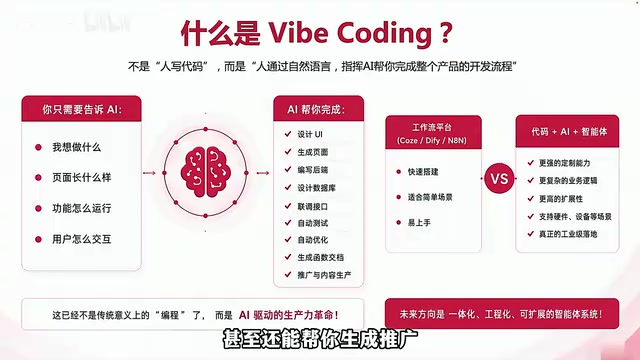
The core idea of Vibe Coding in one sentence: Humans no longer write code line by line; instead, they describe requirements to AI, and AI generates pages, writes logic, connects databases, automatically tests and fixes bugs, produces documentation, and even generates promotional copy and short video scripts.
"Previously, humans adapted to code; now, it's become a language AI understands."
This means the technical barrier is gradually being leveled. Many people don't lack ideas—they lack the ability to implement them; AI is filling that gap. However, the course instructor also points out a common misconception: equating AI development with low-code workflow orchestration (like building nodes in n8n to run processes) is only a basic approach. The real direction for industrial-grade implementation and building complex systems is the system of AI + code + agents + engineering.
Why the "One-Person Company" Is Now Possible
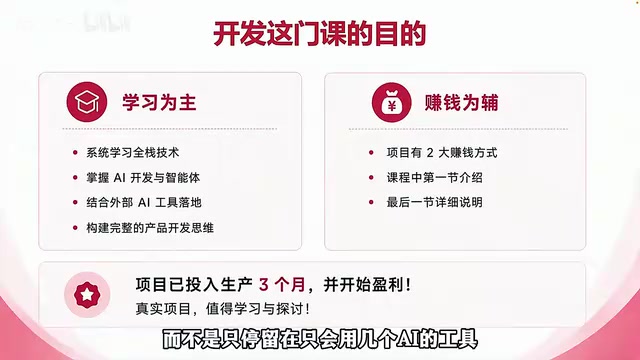
The course states two goals: first, to help learners truly master the engineering product implementation of AI development, rather than just "knowing how to use a few AI tools"; second, to make money—in the future, there will be many one-person companies, AI entrepreneurs, and super-individuals. For many, the path may no longer be job hunting but using AI to build products.
Behind this judgment is concrete engineering support: multi-platform development. In the past, one set for Web, another for App, and yet another for mini-programs—it was very painful. Now AI significantly lowers the multi-platform barrier. The course combines UniApp with AI code generation and component reuse to achieve "develop once, run everywhere."
Full-Chain Closed Loop: From Requirements to Operations
The course's biggest feature is that it doesn't do simple demos but guides students through the complete process of a full product: requirements analysis → UI design → page development → backend logic → database → testing → deployment → operations and promotion.
AI Collaborative Development System
Future software development is no longer about single-point capabilities but AI collaboration: Claude Code, Stitch, MCP, Skills, Figma, and other tools work together. AI is no longer just chatting; it truly participates in design, development, testing, optimization, and operations.
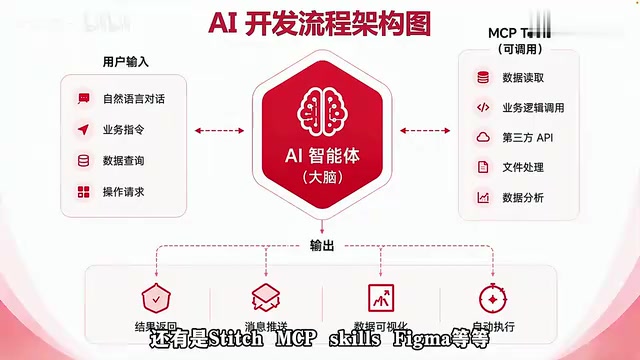
MCP (Model Context Protocol) is an open protocol designed to standardize how AI models connect to external tools and data sources. It allows AI assistants to securely access local files, databases, APIs, and other resources to perform more complex tasks. In AI collaborative development, MCP acts as a bridge between AI and the development environment, enabling AI to read project code, call external services, execute commands, and truly participate in the development process. Skills refer to predefined skill modules that AI can invoke; each Skill encapsulates a specific capability (such as code generation, documentation writing, test execution), and AI can dynamically combine these skills as needed. Claude Code is an AI programming assistant launched by Anthropic that can understand natural language instructions and directly execute modifications in the codebase. Stitch is a UI design tool launched by Google that can generate interface designs from text descriptions. Figma is a widely used collaborative design platform. These tools collaborate through protocols like MCP, forming a closed loop from design to development to testing.
AI Enters the Operations Phase
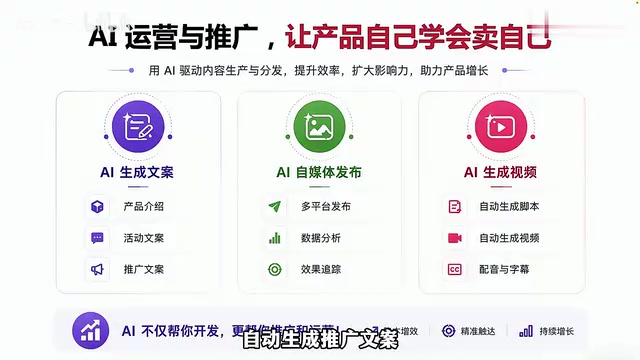
Many people think product development is the end, but the real difficulty is promotion. Now AI has entered the operations field: automatically generating WeChat official account articles, promotional copy, video scripts, and even automatically generating product promotional videos, letting the product "promote itself."
UniApp is a cross-platform application development framework based on Vue.js. Developers can write one set of code and publish it to iOS, Android, Web, and various mini-program platforms. Its core principle is to convert the same source code into native or web applications for each platform through conditional compilation and platform-specific adaptation layers. In AI-assisted development, UniApp's component-based structure makes it easy for AI to understand and generate reusable UI components, while AI can automatically adjust code logic based on platform differences. Combined with AI code generation, developers only need to describe page requirements, and AI can output page code conforming to UniApp specifications and automatically handle multi-platform style adaptation and API call differences, greatly reducing multi-platform development costs and achieving "develop once, run everywhere."
What You Can Gain After Completing the Course
The course promises a list of capabilities: the ability to independently develop products, AI full-chain collaboration capability, AI engineering capability, multi-platform development capability, the ability to automatically generate WeChat official account articles and automated operations, ultimately pointing to one person building products.
Opinions and Judgments
The course's value proposition is clear: AI will eliminate a lot of repetitive labor while giving rise to many super-individuals and one-person companies. But we need to view this rationally—Vibe Coding lowers the "execution barrier," not the "engineering judgment barrier." Requirements decomposition, architecture design, and quality control still depend on human decision-making. The more complex the tool collaboration, the higher the demand for engineering understanding.
As the course says: opportunities belong to those who prepare in advance. For absolute beginners, it's recommended to start with a small runnable product closed loop, then gradually introduce agents and automated operations, rather than pursuing a large and comprehensive system from the start.
One-line Summary
Vibe Coding lets people direct AI to write code, enabling full-chain product implementation for one-person companies.
Paragraph Summary
This article introduces the core content of Bilibili's "Vibe Coding One-Person Company Full-Chain Practical Course." Vibe Coding means humans no longer write code line by line but describe requirements to AI, which then handles page generation, logic writing, database integration, testing and bug fixing, and documentation. The course emphasizes that the industrial-grade direction is AI + code + agents + engineering, not simple low-code workflow orchestration. Centered on the one-person company trend, the course covers the entire closed loop from requirements analysis, UI design, development, testing, deployment to operations and promotion, combined with UniApp for multi-platform development and AI-generated operational content. The article also points out that Vibe Coding lowers the execution barrier but not the engineering judgment barrier; requirements decomposition, architecture design, and quality control still rely on human decisions.
Related articles

Gemini 4 Neon Hands-On: Google's Mid-Size Model Takes On Opus 5.5
Hands-on with Gemini 4 Neon: Google's mid-size model rivals Opus 5.5 on coding tasks with strong coherence and long-task performance at lower cost, though 3D generation and architecture analysis remain weak.

Police Transcription Firm Data Leak: Naked Cloud Server Exposes Law Enforcement Sensitive Information
A transcription firm serving police, prosecutors, and tech giants exposed sensitive data like interrogation recordings and bodycam videos due to an unprotected cloud server. This article analyzes the third-party risks and recurring cloud security issues behind the incident.

AuthKit Custom Subdomains Go Free: Product Identity Starts at the Login Entry
WorkOS launches free custom subdomains for AuthKit, letting developers replace system-generated domains with product-matched authkit.app addresses—no DNS configuration, effective on save. We analyze the impact on brand trust, authentication infrastructure productization, and developer tool competition.