Hai: The AI Assistant That Makes Calls for You, Making Reservations Easy
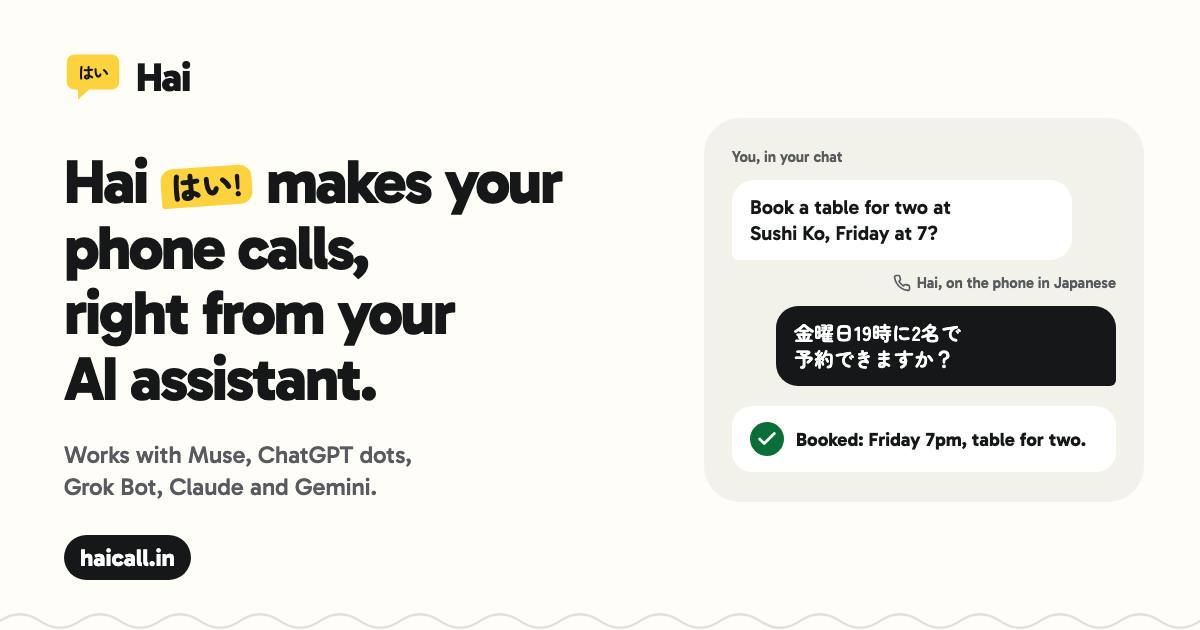
Hai, an AI phone assistant by an independent Japanese developer, calls businesses for users and reports back in text.
Hai is an AI assistant that actually makes phone calls for users. After users describe their needs and confirm a call plan, Hai calls the business in any language to complete a reservation and reports results in text. Born from accessibility needs, it helps deaf, hard-of-hearing, speech-impaired, or socially anxious users overcome phone communication barriers while also serving convenient scenarios like cross-language bookings. Built by an independent Japanese developer, it is free to start and received 87 upvotes on Product Hunt, ranking 6th for the day. The article praises its pragmatic positioning and inclusive value but notes limitations such as unclear merchant coverage and long-term business model, and that it currently handles only reservation calls.
Hai: The AI Assistant That Makes Calls for You, Making Reservations Easy
Why Do We Need an AI That Can Make Phone Calls?
In the digital age, many services can still only be booked by phone. Whether it's a restaurant, a clinic, or a barbershop, a single phone call often becomes an insurmountable obstacle. For people who are deaf, hard of hearing, have speech impairments, or social anxiety, making a phone call can be an impossible task. Hai was created to solve exactly this pain point.
According to its Product Hunt page, Hai is an AI assistant that can actually make phone calls on your behalf. You simply tell it what you need, approve the plan it generates, and Hai will call any business that accepts phone reservations in any language, then report the results back to you in text form.
The digital divide in phone reservations: Although online booking platforms (such as OpenTable, Resy) already cover a large number of restaurants, many local businesses, clinics, and small service providers still rely on phone calls as their only or primary booking channel. This "digital divide" is reflected not only in merchants' technology adoption but also in users' differing abilities—people with hearing impairments cannot use voice calls, those with language barriers struggle to communicate in a non-native language environment, and people with social anxiety may experience intense psychological pressure from phone conversations. According to World Health Organization data, about 430 million people worldwide have disabling hearing loss, while the reach of language barriers and social anxiety is even broader. Hai's value lies in that it does not require merchants to change their existing processes; instead, it fills the "last mile" communication gap from the user side with AI.
How Does Hai Work?
Using Hai is very intuitive: you describe the service you need to book to the assistant (for example, "a table for two at an Italian restaurant tomorrow at 7 p.m."), Hai generates a call plan, and after you confirm it, it automatically calls the business to communicate. The entire process requires no speaking on your part, making it especially suitable for cross-language scenarios—Hai supports any language, meaning you can book a restaurant abroad without worrying about language barriers.
After the call ends, Hai reports the results back to you in text form, including key information such as whether the reservation succeeded, the time, and the location. This "text in, text out" interaction is particularly friendly to users with hearing impairments.
The tech stack of speech synthesis and conversational AI: Hai's core capability is built on a combination of two mature technologies—automatic speech recognition (ASR) and text-to-speech (TTS), along with dialogue management driven by large language models. When Hai places a call, it needs to convert the merchant's speech to text in real time, understand intent, generate responses, and then synthesize the text into natural speech to send back. Supporting "any language" means the system needs to integrate multilingual ASR/TTS models or call multilingual cloud services. The technical challenges in this kind of "AI call-making" scenario include: inconsistent phone audio quality, background noise interference, merchants possibly using dialects or accents, and maintaining context across multi-turn conversations. Currently, similar AI phone assistants on the market (such as the early Google Duplex demo) are mostly limited to specific scenarios and languages. If Hai's claim of "any language" is true, it is relatively rare among small-team products.
Designed for Accessibility, Beyond Convenience
Hai was born from a real need for inclusivity. The Product Hunt description emphasizes that for people who are deaf, hard of hearing, or have language or anxiety disorders, making a phone call may be "impossible." Hai is not only an efficiency tool but also a practice in accessibility technology. It gives those excluded from phone reservations renewed access to services on equal terms.
Interestingly, Hai was built by an independent Japanese developer and is currently free to start. On Product Hunt, it received 87 upvotes and 7 comments, ranking 6th for the day, showing the community's recognition of its practical value.
Accessibility technology and inclusive design: Assistive technology refers to tools and systems designed for people with disabilities to help them complete daily tasks, covering screen readers, speech-to-text, eye tracking, and more. Hai falls into the "communication assistance" category—it does not directly repair the user's hearing or language ability but instead bypasses the barrier through an AI agent, allowing users to participate via text in interactions that originally required voice. Inclusive design emphasizes that products should consider the needs of marginalized users from the outset rather than remedying them afterward; Hai targets deaf and anxious users as its core users, yet it also benefits ordinary users in noisy environments or when it is inconvenient to make calls. This is a typical manifestation of the "curb-cut effect," where accessibility benefits everyone.
The Warmth and Limitations of an Independent Developer
As the work of an independent developer, Hai embodies a small-but-beautiful product approach: focusing on a specific pain point and using AI capabilities to provide a smooth solution. However, independent development also means limited resources, and it is currently unclear which countries it supports, its merchant coverage, and its long-term business model. A free-to-start strategy helps attract early users, but how it will sustain operations going forward is worth watching.
In addition, Hai currently handles only phone reservations and may be insufficient for more complex phone communications (such as customer service inquiries or appointment changes). But regardless, it provides a valuable model for bridging the "last mile" digital divide.
Conclusion: A Pragmatic Direction for AI Assistants
Hai does not chase the grand narrative of general-purpose AI assistants but instead solidly solves a specific problem: making phone calls for you. This pragmatic product positioning, combined with its attention to accessibility needs, makes it a warm presence in the wave of AI applications. For people who are afraid to make calls or unable to make calls, Hai may be exactly the assistant they have long been waiting for.
One-line Summary
Hai, an AI phone assistant built by an independent Japanese developer, makes calls on users' behalf to complete reservations and reports back in text.
Paragraph Summary
Hai is an AI assistant that can actually make phone calls on users' behalf. Users simply describe their needs and confirm a call plan, and Hai calls the business in any language to complete the reservation, then reports the results in text form. It stems from accessibility needs, helping people who are deaf, hard of hearing, have speech impairments, or social anxiety overcome barriers to phone communication, while also being useful for convenient scenarios such as cross-language reservations. The product was built by an independent Japanese developer, is currently free to start, and received 87 upvotes on Product Hunt, ranking 6th for the day. The article affirms its pragmatic product positioning and inclusive value while also pointing out the resource limitations of independent development, such as unclear merchant coverage and long-term business model, and the fact that it currently handles only reservation-type phone communications.
Related articles
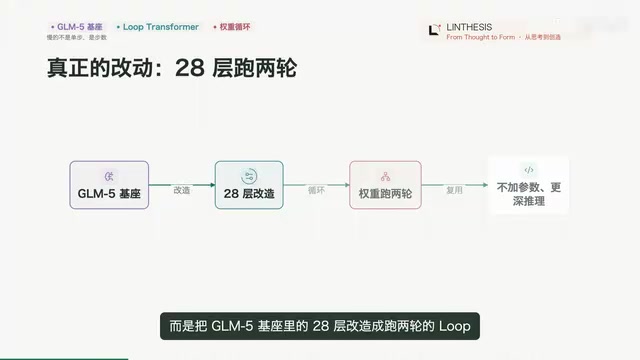
GLM-5.4 Coding Test 4.6x Slower? Unpacking the Loop Transformer Architecture
GLM-5.4 coding test took 431 minutes vs. competitor's 109, 4.6x more steps. We analyze its Loop Transformer architecture, KingBench4 score of 55.3, Max tier's 1.04M token cost, and tier selection advice.

Zhipu GLM-5.4 Quietly Released: A Debut for Loop Transformer Architecture
Zhipu GLM-5.4 quietly lands in coding plans: first Loop Transformer flagship with 750B params, 1M token context, AIM math up from 19.2 to 30.4, and native vision for coding from screenshots.
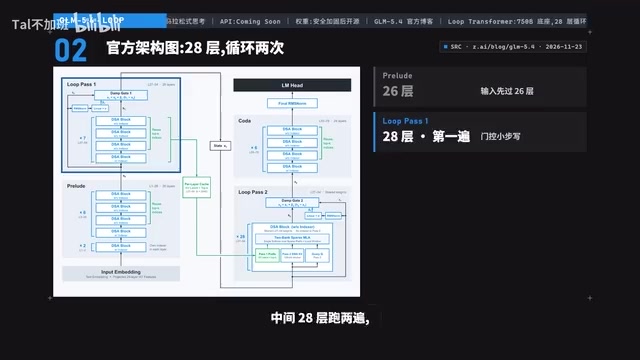
GLM-5.4 Releases 750B Model: Recurrent Transformer Architecture and the 30B Benchmark Controversy
GLM-5.4 releases a 750B model with a recurrent Transformer architecture that runs the same layers twice, claimed to match 2T–3T scale. But the benchmark table tests a 30B small model, not the main model. We break down the architecture changes, benchmark data, four demos, and open-source timeline.