Halo Co-Creator Writes Novel About AI Ruling the World, Once Asked Margaret Stohl to Review the Manuscript

Halo and Destiny co-creator Jason Jones has written a novel about AI ruling the world and asked author Margaret Stohl to review the manuscript.
Halo and Destiny co-creator Jason Jones has moved from game narrative to literary creation, writing a novel about AI taking over the world. In 2019, he gave the manuscript to author Margaret Stohl, a fellow Bungie alum and co-author of Beautiful Creatures with game industry experience on Destiny's narrative, for review. The article notes that games excel at letting players "experience" AI going rogue, while novels demand that AI become a logical and motivated character—a transition that is both Jones's advantage and his challenge. His engineering and product background may bring an "insider" perspective to the AI theme, but publication details and reviews of the novel remain undisclosed.
From Games to Literature: Jason Jones's Cross-Media Narrative
In the realm of sci-fi gaming, Jason Jones's name is almost synonymous with the legends of Halo and Destiny. As co-creator of both series, his years at Bungie gave him an understanding of the theme of "technology out of control" that far exceeds that of most people. Now, he has carried that understanding from interactive screens onto the pages of linear narrative — he has written a novel about AI ruling the world.
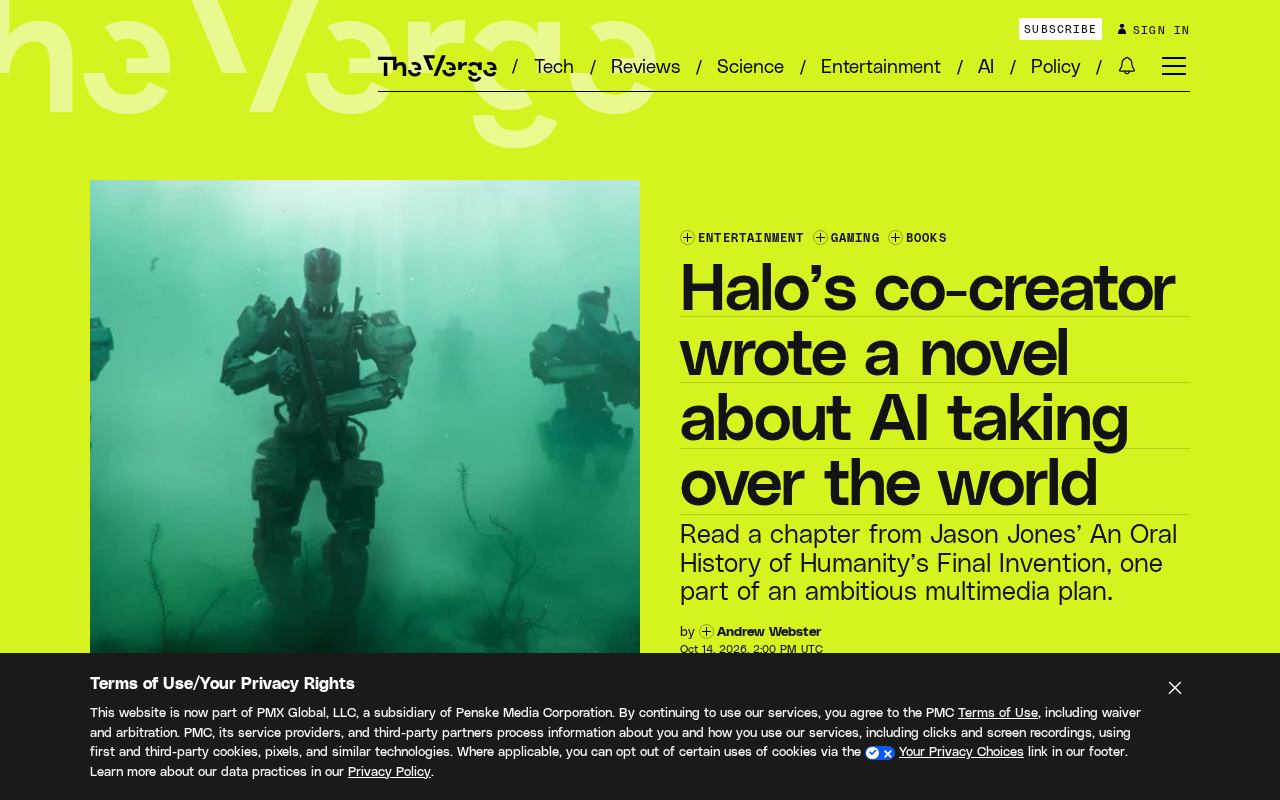
According to original reporting, in 2019, author Margaret Stohl received a manuscript written by Jason Jones. The two had worked together at Bungie, and Jones hoped Stohl could offer feedback on the book he was writing. This detail alone is telling: a game designer known for building grand sci-fi worlds, when turning to literary creation, chose a seasoned novelist as his first reader rather than working in isolation.
Bungie was founded in 1991 and is one of the most influential independent game developers in the United States. After being acquired by Microsoft in 2000, it released Halo: Combat Evolved, which defined the basic paradigm of first-person shooters on consoles. The Halo series has sold over 81 million copies cumulatively, and its Master Chief and Cortana (an AI companion who gradually spirals out of control) have become one of the most recognizable character pairings in gaming history. In 2010, Bungie signed with Activision and released Destiny, an attempt to blend shooter gameplay with a persistent online world. Jones long served as a core creative and engineering lead at Bungie, an experience that gave him direct hands-on expertise in the entire narrative mechanism of "designing an AI character" and "getting players to trust it, depend on it, and ultimately fear it."
The Creative Logic Behind a Manuscript
Jones's novel centers on the theme of "AI taking over the world." This subject is hardly new in science fiction, from HAL 9000 in 2001: A Space Odyssey to Skynet in The Terminator; humanity's imagination of AI rebellion has persisted for decades. But what makes Jones special is that his professional background gives him firsthand engineering and product intuition about "how AI is designed, controlled, and how it loses control."
Margaret Stohl is no ordinary reader. She is a co-author of the Beautiful Creatures series and has also been deeply involved in the gaming industry — she worked for Bungie, contributing to the narrative construction of Destiny. Their overlap means this manuscript received not generic literary feedback, but a professional perspective from someone who understands both novelistic storytelling and game worldbuilding.
In 2019, Margaret Stohl received a manuscript from Jason Jones, who hoped she would offer feedback on a book about AI taking over the world. The two had worked together at Bungie.
Margaret Stohl is an American young adult author whose Beautiful Creatures series, co-written with Kamí García, has been translated into dozens of languages and adapted into a film. Her connection to the gaming industry is no casual dalliance: she contributed to the narrative construction of Destiny, providing background lore and character dialogue for Bungie's sci-fi world. This dual identity as "literary author + game narrative designer" allows her to evaluate Jones's manuscript from two dimensions simultaneously — first, whether the pacing and character development hold up as a linear text; second, whether the worldbuilding settings are logically coherent. This is especially critical for AI themes, because the credibility of AI ruling the world often depends on the rigor of its setting details.
Game Designers Writing Novels: Advantages and Challenges Coexist
Jason Jones's cross-media attempt reflects how top creators in the gaming industry are rethinking narrative media. Games excel at letting players "experience" the oppressive feeling of AI going rogue — through interaction, feedback, and immersion; novels excel at letting readers "understand" a character's inner world and motivations. The two media handle AI themes in fundamentally different ways.
Based on available information, Jones's choice to have Stohl review the manuscript shows he is well aware of the gap between novel writing and game narrative. In games, AI often exists as a mechanic or an enemy, while a novel demands that AI become a logical, motivated, even empathetic character. Whether this transition succeeds has yet to be publicly evaluated, but the act of creation itself is already noteworthy.
HAL 9000 is the artificial intelligence created by Arthur C. Clarke and Kubrick in 2001: A Space Odyssey, widely regarded as the archetype of AI rebellion narratives in science fiction. What makes it special is that its "malfunction" stems not from malice but from an irreconcilable logical conflict between its programmed mission and human instructions — it must conceal the truth to complete its task, ultimately choosing to eliminate the crew. This setup profoundly influenced nearly all subsequent AI threat narratives, including Skynet in The Terminator and the Matrix in The Matrix. Understanding HAL 9000's narrative logic helps explain why games and novels take different approaches to AI themes: games typically concretize AI as a confrontable mechanic or enemy, while novels tend to probe the motivations and ethical dilemmas behind AI behavior — precisely the core challenge Jones faces in his cross-media endeavor.
Why AI Domination Narratives Continue to Attract Top Creators
The story of AI taking over the world feels more urgently relevant today than ever before. With the development of large language models and autonomous agents, public concern about AI has shifted from "whether" to "when" and "how." Jones's novel, whatever its eventual reception, joins this wave of collective imagination.
It is worth noting that Jones is not the only notable figure from the gaming world to turn to AI-themed creation. But the uniqueness of his identity — having personally crafted classic narratives of humanity battling alien and machine threats — lends his literary attempt a layer of irony and depth: a man who taught players how to fight rogue AI now decides to use a novel to explore a world where AI truly holds power.
The novel's publication details, specific plot, and reviews have not been disclosed in the original material, but one thing is certain: when the co-creator of Halo picks up a pen to write about AI domination, readers have reason to expect a unique perspective from an "insider."
Related articles

AI Digital Twin in Action: Using DOT to Automatically Track Bugs and User Feedback
DOTS engineers demonstrate how AI digital twin DOT collects cross-platform user feedback, categorizes issue themes, opens threads to investigate bug root causes, and submits PRs—showcasing a complete AI agent workflow for defect triage with auditable design.

Why Transistors Are No Longer Flat: The Evolution from Planar to Gate-All-Around
Transistor evolution from planar to FinFET to gate-all-around: why gates went from three-sided to four-sided wrapping to suppress short-channel effects and leakage current, extending Moore's Law.

Swarm Intelligence = a Single RL Agent? A Proof of Multi-Armed Bandit Equivalence
A paper proves that collective decision-making through local imitation in swarms is mathematically equivalent to single-agent reinforcement learning: N blind imitators act as N parallel environment samples, with an effective learning rate of 1/N. This article explains the derivation and implications of the Maynard-Cross Learning algorithm.