Hamster Molly Runs 70km Per Week on Strava: The Animal Welfare Reflection Behind the Cuteness

A hamster's viral Strava fame raises uncomfortable questions about whether wheel-running signals stress, not joy.
A Dutch hamster named Molly went viral after her owner connected her running wheel to Strava, revealing she runs ~70km per week. While the internet celebrated her "discipline," animal welfare researchers point out that excessive wheel-running may indicate stress rather than happiness. The story opens broader discussions about hamster mills, captivity ethics, and whether keeping wild-natured animals as pets can ever truly give them a good life.
A Hamster Goes Viral on Strava
In the Netherlands, a pet hamster named Molly may be outrunning most human runners. It all started when her owner connected Molly's running wheel to Strava, the social fitness app designed to track mileage for runners.
Strava is a social fitness platform founded in San Francisco in 2009, now boasting over 100 million registered users. It uses GPS to track running, cycling, and other activity data, motivating users through social leaderboards, segment challenges, and other gamification features. It's precisely this platform's ability to transform solitary exercise into a social experience that allowed a hamster's running data to go viral so quickly.
Connecting a hamster wheel to Strava requires some hardware modification — the typical approach involves installing a magnet and a Hall effect sensor on the wheel (similar to how a bicycle computer works). Each time the wheel completes a rotation, the sensor records it. Combined with the wheel's circumference, the system can precisely calculate the hamster's running distance and speed, then upload the data in a platform-compatible format via a microcontroller.
Through this setup, the owner was surprised to discover that Molly runs about 6 miles every night — close to a 10K distance. Calculated as weekly mileage, Molly currently runs approximately 70 kilometers per week.
"I usually run 40 to 50 kilometers a week, but Molly is doing almost 70 kilometers per week now. To be honest, I'm quite envious of her." — Molly's owner
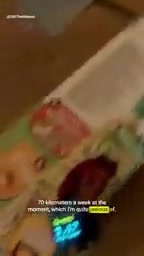
The internet has always had a soft spot for quirky yet heartwarming animal stories, and Molly is no exception. She's been featured in Runner's World magazine and has amassed over 9,000 followers on Strava. A cute hamster diligently "logging her runs" is undeniably shareable content.
The Animal Welfare Concerns Behind Viral Fame
However, behind this lighthearted story lies a fundamental question about small pet ownership.
Hamsters like Molly are actually wild animals, native to Syria. The Syrian hamster (also known as the golden hamster, Mesocricetus auratus) inhabits the arid grasslands around Aleppo. In the wild, a single hamster's territory can span several hundred square meters. They dig complex burrow systems up to 1-2 meters deep, featuring meticulously organized sections including food storage chambers, bedrooms, and toilets. They are solitary, nocturnal animals that may travel 8-13 kilometers each night to forage. Notably, in 1930, zoologist Israel Aharoni captured a litter of hamsters in Syria, and virtually all of the millions of pet hamsters worldwide today are descendants of that small group — meaning they are only about 90 years removed from their wild ancestors, minimally domesticated, with their wild instincts almost entirely intact.
In their natural environment, they evolved to forage, dig deep burrows, and explore widely. But as captive pets, most of these innate behaviors cannot be fulfilled.
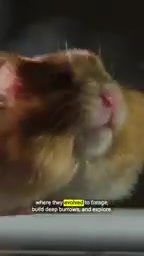
Even more concerning, some animal welfare researchers have raised a counterintuitive point: wheel running may not be an expression of happiness, but rather an indicator of stress. It may reflect the hamster's intense inner drive to escape, to run — an instinct with nowhere to go in a small cage.
In animal behavior science, there's an important concept called "stereotypic behavior" — repetitive, seemingly purposeless behavioral patterns in captive animals, such as large cats pacing back and forth in zoos or elephants swaying their heads. The scientific debate around wheel-running behavior is quite complex: a well-known 2003 study published in the Proceedings of the Royal Society found that even in open environments without cages, wild mice would voluntarily use running wheels, suggesting that wheel-running has intrinsic rewarding properties. On the other hand, a 2014 Swiss study showed that the smaller and less stimulating the cage environment, the more frequently hamsters use their wheels. The tension between these two findings lies at the heart of the current animal welfare science debate over whether wheel-running represents "voluntarily chosen pleasure" or a "stress-coping mechanism."
In other words, Molly's astonishing mileage may not be proof of health and vitality, but rather a sign that she is yearning for a fundamentally different life — one she can never reach.
The Plight of Small Pets Starting at the Breeding Source
The problems extend beyond the keeping of these animals. Undercover investigations into hamster mills — breeding facilities that supply pet stores — have revealed that these animals are often mass-bred by the thousands in extremely poor conditions.
So-called "hamster mills" are similar to the controversial "puppy mills" — large-scale, low-cost commercial animal breeding facilities. In these factories, animals are treated as mass-produced commodities: breeding females are continuously mated until physical exhaustion, pups are weaned and separated at extremely young ages, and housing density far exceeds animal welfare standards. Investigations by the Humane Society of the United States have shown that such facilities dominate the supply chain of small rodents for major pet store chains. Because small pets aren't subject to the same strict regulations under the Animal Welfare Act as cats and dogs, enforcement is woefully inadequate — in the eyes of the law, a hamster sold for a few dollars enjoys virtually no protection.

To be clear, this is not an indictment of Molly's owner. Quite the opposite — he adopted Molly to give her a better home, and he himself is deeply sympathetic to these animal welfare concerns.
The real controversy lies in a deeper ethical question: No matter how much effort we put into improving these small pets' lives, that effort may never add up to what constitutes a genuinely "good life." Some animal ethicists argue that the core issue isn't whether owners are caring enough, but that the very act of keeping these wild animals in captivity is fundamentally incompatible with their nature.
This problem is philosophically known as the "captivity paradox" or the "benevolent imprisonment" dilemma. Utilitarian philosopher Peter Singer argued in Animal Liberation that the standard should be whether animals can experience suffering and pleasure. Animal rights theorist Tom Regan, on the other hand, maintained that every "subject-of-a-life" possesses inviolable inherent value, and that depriving a being of its autonomy is morally problematic regardless of how much we improve captive conditions. If we accept the latter position, the question shifts from "how to properly care for a hamster" to "should we keep hamsters at all" — posing a fundamental ethical challenge to the multi-billion-dollar global small pet industry.
A Cute Story That Raises Serious Questions

Molly's story resonates precisely because it projects "running" — a health behavior familiar to humans — onto a small animal, generating powerful empathy. We cheer her on and applaud her "discipline."
But when we reexamine those astonishing mileage numbers, our perspective might need to shift: the more she runs, the more likely it is that she's desperately chasing a freedom that can never be realized.
This story reminds us that when we're charmed by cute pet content online, it's worth pausing to consider — is what we perceive as "happiness" truly happiness for the animal? For small creatures whose nature belongs to the open wild, a carefully arranged cage may ultimately still be just a more refined cage.
Key Takeaways
Related articles

Qwen3 27B Local Deployment Real-World Test: Frontier-Level Coding Performance on Just 16GB VRAM
Overseas blogger systematically tests Qwen3 27B quantized local deployment across 256K context memory, HumanEval coding, and MCP tool chains. Runs on just 16GB VRAM with code generation quality surpassing all local models in its class.

The Complete Guide to Claude Code Hooks: How the Automation Mechanism Works and Practical Configuration
Deep dive into Claude Code Hooks' three-layer architecture (Event, Matcher, Handler), covering 10 core Events, 5 Handler types, with practical examples for sensitive data checks and AI-writing detection.

AI Programming in Practice: The Right Development Approach — MVP First, Code Second
AI programming experts spend 80% of their time on requirements and design. Learn MVP-first strategy, model tier allocation, and dual-tool workflows for real-world AI development projects.