Hands-On Comparison of Gemini, Claude, and GPT Flagship Models and Subscription Buying Guide
Claude's $20 tier offers the best value; a Seoul server enables low-cost, stable use
Based on Bilibili creator Lawyer Yuan's real usage and hands-on tests, this article compares mainstream AI subscription plans and model capabilities. Claude's $20 tier is the most cost-effective at roughly 46x direct API top-up, but logging in from China risks bans, so a 99-yuan-a-year Seoul lightweight server running Claude Code is the practical path. Claude leads in frontend aesthetics, Gemini sounds most human and works faster, and GPT is most rigorous for compliance review. Buying advice is tiered by budget: trial tiers via low-cost channels, Claude first at $20 (or GPT Plus if you avoid hassle), $100 Claude solo is most enjoyable, and $200 Google Ultra shared among five is most recommended. The author also advocates abandoning the web version in favor of the desktop app and task mode.
1. Subscription Plan Value Comparison: Claude's $20 Tier Is Currently the Strongest
When choosing an AI subscription, there are really only two core questions: is the quota enough, and can you use it reliably? In the latest episode of his AI course, Bilibili creator Lawyer Yuan gave his assessment based on his own recent real usage — among the $20 base tiers, Claude offers the best value, with a large quota that is completely sufficient for daily use.
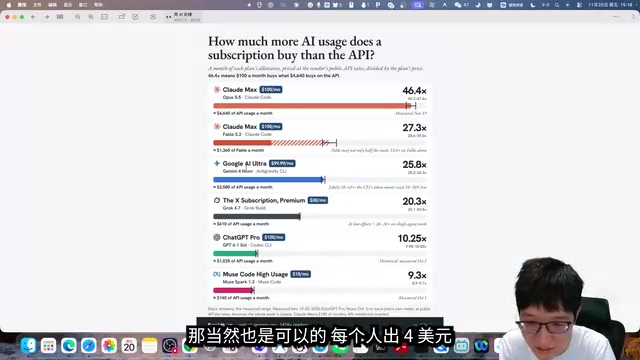
He showed a comparison chart circulating in a group chat and pointed out that, converted into top-up value, Claude's quota is roughly 46 times that of direct API top-up, GPT is about 10 times, and Google sits in the middle at about 25 times. These numbers explain why heavy users prioritize Claude.
But the problem follows: Claude accounts logged in from within China are easily banned. The creator himself uses a remote connection to a Mac mini in a Toronto office, which has run stably for nearly a year without issues — but this approach has too high a barrier for ordinary users. His alternative is to rent a lightweight server in Seoul, deploy Claude Code via the command line, and fully isolate the usage scenario on an overseas server.
Another noteworthy trend is quota consumption. The creator mentioned that last month GPT reset daily with a very large amount, and he took the opportunity to overhaul his website and course logic, feeling that the tokens were inexhaustible; this month, however, GPT quota is down to 31 with only two days left, and Google is down to 19 with five days left, showing clearly increased consumption pressure. This fluctuation shows there is a gap between a plan's "nominal quota" and its "actual usable amount," so you can't judge by sticker price alone when choosing.
2. Hands-On Model Capability Test: Claude Leads in Frontend Aesthetics, Gemini Sounds Most Human, GPT Is Most Rigorous
Claude: Top Tier for Frontend Design and Beat-Synced Animation
For tasks like frontend design and video beat-syncing, the creator believes Claude remains in the top tier. He cited examples of visualization and popular-science videos on Bilibili such as "Dalabengba" and "Tonghua Zhen," noting that most of these precisely beat-synced animated works are made with Claude. When asked to redesign a website footer or an immigration website, Claude both follows the original design language and adds its own understanding — it is ahead of the pack aesthetically. By contrast, GPT's design output is "definitely not as good-looking."
Claude's weakness is not capability but usability — logging in from within China gets you banned within days, and that is its biggest practical obstacle.
The "direct API top-up" mentioned in the article refers to calling a model vendor's application programming interface (API) directly and paying by token usage. Unlike subscriptions, the API has no fixed monthly fee threshold, but every input or output token consumed incurs a cost, usually priced per million tokens. For heavy users, a subscription plan's "quota multiple" is an intuitive comparison benchmark: if the same usage via API would cost 46 times as much, it shows the subscription plan provides substantial subsidies on price — which is also the business logic behind platforms using cheap subscriptions to attract users and then controlling costs through concurrency limits or account bans.
Gemini: Standout Ability to Sound Human, and Faster at Getting Work Done
The creator states plainly that Gemini is currently the model that "sounds most human." He uses Gemini to write immigration-related articles, and he himself can no longer detect AI traces — a very big advantage. Another advantage is efficiency: for the same job, GPT might take a whole evening, while Gemini's Carbon can finish it in two or three hours. He analyzes that, given similar Token TPS, completing a task faster suggests the model uses a stronger reasoning method or a shorter chain of thought.
"Token TPS" refers to tokens generated per second (Tokens Per Second), a metric for a model's output speed, roughly equivalent to the "typing speed" we perceive. But similar TPS does not mean the same total time to complete a task, because task duration also depends on how many tokens the model needs to generate. If a model can achieve the goal with a shorter chain of thought and fewer intermediate steps, the overall completion time will be greatly shortened even if the per-second output speed is the same. The creator finishing in two or three hours with Carbon a job that would take GPT a whole evening essentially reflects differences in reasoning efficiency and task planning ability, not merely output speed.
GPT: Rigor and Reasoning Are Its Moat
GPT's strengths are rigor and reasoning ability — you can trust it to get work done. The creator says he dares to assign tasks to GPT before going to bed and check the results the next morning, without fear that it will crash the server. There are three reasons: it works diligently without stopping midway, it knows how to push the task forward, and it is currently the most cautious model. This caution shows in its habitual hedging expressions — "but it can't be like this," "let me first do such and such" — and while these read awkwardly, and the Chinese expression is awkward enough to spot the AI flavor at a glance, it is precisely this caution that makes it perform best on compliance-review tasks. The creator's advice to lawyers is direct: if you do compliance law, keep using GPT.
3. Budget-Tiered Buying Recommendations
Trial Tier: Get Started for a Few Yuan to a Dozen or So
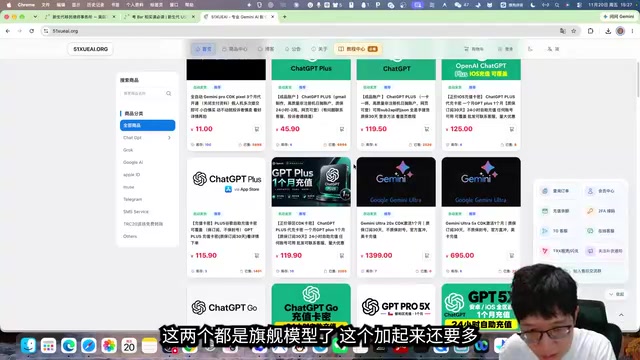
The creator mentions some low-cost channels recently — for around ten yuan, or for users who previously bought 18 months of Pro membership for a few or a dozen-plus yuan, you can at least use Hydrogen, and with luck also Neo. He notes Google recently launched a Computer Use feature that can be used to trial automation tasks at extremely low cost. If you already bought the 18-month membership, you'll have a certain amount of Neo available every week going forward — quite a bargain.
$20 Tier: Claude First, GPT If You Don't Want Hassle
For users willing to spend $20 a month, Claude is currently the best choice — provided you can solve the ban problem. If you don't want the hassle, GPT Plus is a reliable fallback; there are channels on the market for 40-plus yuan, generally usable for a month. The downside is stiff Chinese expression that is obviously AI-written at a glance.
$200 Tier: Google Ultra Family Group Most Recommended
The creator's current top recommendation is the $200 Google Ultra, for very practical reasons: no account bans, and you can even pay with a Chinese credit card (he bought his own Ultra with a Shanghai Pudong Development Bank card without issues). He formed a family account with five colleagues, with five people sharing the quota, plus YouTube Premium membership and storage perks. By his account, a dozen-plus people are actually sharing one $200 account, which works out very cost-effectively.
The cost is coordination overhead. Among five people, inevitably some use more and some use less; how to split the bill, how to keep accounts, and how to build trust are the most troublesome issues with the carpool model. He specifically warns that teams within a company won't complain at each other, but carpools among strangers need the relationships handled upfront.
$100 Tier: Claude Solo Is the Most Enjoyable
If you don't want to share with others, the $100 Claude experience is very enjoyable. According to the creator, $20 Claude is already generous, and with $100 you almost don't know how to use it all up — the Opus 5.5 quota should exceed Gemini's Carbon plus GPT's 6.2 flagship models combined. However, he also notes that Opus 5.5 is not Claude's flagship model — Fable is — but in hands-on testing the gap between them is small, and Opus 5.5 is currently Claude's most presentable model.
Interestingly, the $100 Google plan only offers 5x quota while the $200 plan offers 20x, so if five people split the $100 plan at $20 each, it's actually less cost-effective than each buying the $20 plan separately — unless someone wants to take advantage of the other four.
4. Hands-On: Deploying Claude on a Seoul Server — A Low-Cost Solution at 99 Yuan a Year
For users who want to use Claude without getting banned, the creator's route is to buy a lightweight application server in Seoul. In the video he checked Tencent Cloud's Seoul inventory live and confirmed that a lightweight application server costs 99 yuan a year — a price he considers genuinely reasonable. He compared it with NodeSig, a platform commonly used by programmers, where a plan at 2.95 euros a month works out to twenty-plus yuan — not cheaper. He specifically warns against buying Hong Kong nodes, because Hong Kong can't use these models — at least not Anti-Gravity.

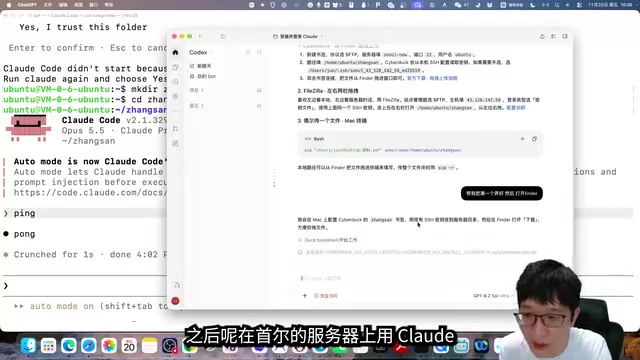
The configuration process itself is also handed to AI. The creator gives the server login information directly to the AI assistant and has it install Claude Code on the server. At the login step, enter the password as prompted by the terminal; if a command errors out midway, just ask the AI again, get a new command, and retry — finally completing login through browser authorization. Then create a new working directory on the server — for example, a folder named Zhang San for a particular case — switch into it, and run Claude, and you can use it normally in an isolated environment.
File transfer likewise doesn't require memorizing commands. The creator's principle is: "now that we have AI, don't trap yourself in the knowledge points the teacher taught" — just ask AI directly what convenient visual transfer methods exist. AI recommended dragging files directly from Finder to the server; he dragged a subtitle file from the desktop as a test, and Claude immediately produced a summary. He adds that even without Codex, any other AI assistant can complete the environment setup — the key is to get the server environment set up, and then run Claude on it.
For top-up, the creator mentions that getting a US debit card and phone number is troublesome and carries a monthly fee; iTunes Apple cards and US-region or Turkey-region gift cards can all be used for top-up. The principle in use: don't run Claude from mainland China or Hong Kong — just let tasks execute on the cloud server. Buying a Windows server with remote desktop may offer a familiar interface, but it has high configuration requirements and costs considerably more; the money-saving approach is still to learn command-line Linux operations.
5. Desktop Version and Task Mode: The Web Version Should Have Been Retired Long Ago
The creator repeatedly stresses that users still using web-based AI assistants should switch as soon as possible. The desktop version runs locally, can operate local files and search locally, minimizes hallucinations to the greatest extent, and can precisely locate what actually needs to be found. As for cloud-based personal assistant products, his attitude is that he doesn't yet see the necessity — remote operation of his own computer is already very convenient, so why must everything be moved to the cloud?
In terms of usage habits, he recommends developing a task-mode habit rather than a conversation-mode one. Claude Code, GPT, and Anti-Gravity all count as task mode, and with the Gemini desktop version remember to click "Task" rather than "Chat." Common slash commands include: model to switch models, plan to make a plan, go to set a goal and keep pushing forward, resume to restore an old conversation, clear to start a new conversation (old conversations aren't lost and can still be found via resume), and compact to compress context. Personally he uses go most often — set a goal and let the AI refuse to stop until it's achieved.
On ban risk, the creator is fairly candid: his account was charged with a Canadian credit card, and he dares to use his own account on the server; if it really gets banned, he'll leave a comment under the video admitting defeat. He also says bluntly that some Chinese users who buy accounts and get banned without refunds objectively contribute revenue to the platform — an unsavory aspect of the business model behind such services.
To summarize his recommendation ranking: the easiest to get started with is the Gemini desktop app — with low-cost Plus or Pro channels you can use Hydrogen or Neo; next is Anti-Gravity — if you're willing to spend $100 or $200, especially $200 split among five people, the experience is great, and in his eyes Carbon is even smarter than Opus 5.5, just with less ample quota; for compliance tasks keep using GPT; and if you're dead set on the $20 Claude, pairing it with a 99-yuan-a-year Seoul server is currently the cheapest practical path.
Background Notes
The difference between "task mode" and "conversation mode" lies in different interaction goals: conversation mode is question-and-answer, waiting for the user's next instruction after each answer; task mode sets a goal first, and the AI autonomously breaks down steps, calls tools, and keeps pushing forward until the goal is completed or it hits an insurmountable obstacle. Slash commands are the control entry points in task mode: model switches the underlying model, plan has the AI output an execution plan before acting, go sets a goal and keeps executing, resume restores a historical session, clear starts a new conversation but keeps old records, and compact compresses overly long context into a summary to save tokens. Only by understanding this mechanism can you use AI as a "trustworthy executor" rather than a "chat tool."
Related articles

Developer Naming Woes: The Technical Names That Drive Us Crazy
Why is technical naming so maddening? From Nginx and Vite to Qt and Sudo, a YouTube creator rants about the chaos of developer naming and pronunciation, revealing the tug-of-war between creators' intentions and community habits, and the cultural roots behind spelling traps like PyPI and GNOME.

Figma Workplace Scandal: Employee Sues CEO for Forcing Confrontation with Harasser
Figma and its CEO are sued by a current employee alleging sexual harassment and discrimination, and forcing the victim to confront her harasser. This article outlines the background, potential impact, and industry reflection.

Jensen Huang and Nvidia: Elite Privilege Behind the Revolving Door of Business and Politics
An opinion piece uses Jensen Huang's reappointment as Nvidia CEO to examine business-government ties and elite impunity, questioning free-market ideals and AI industry governance.