Harbinger Secures Financing Support from Palmer Luckey's Erebor Bank
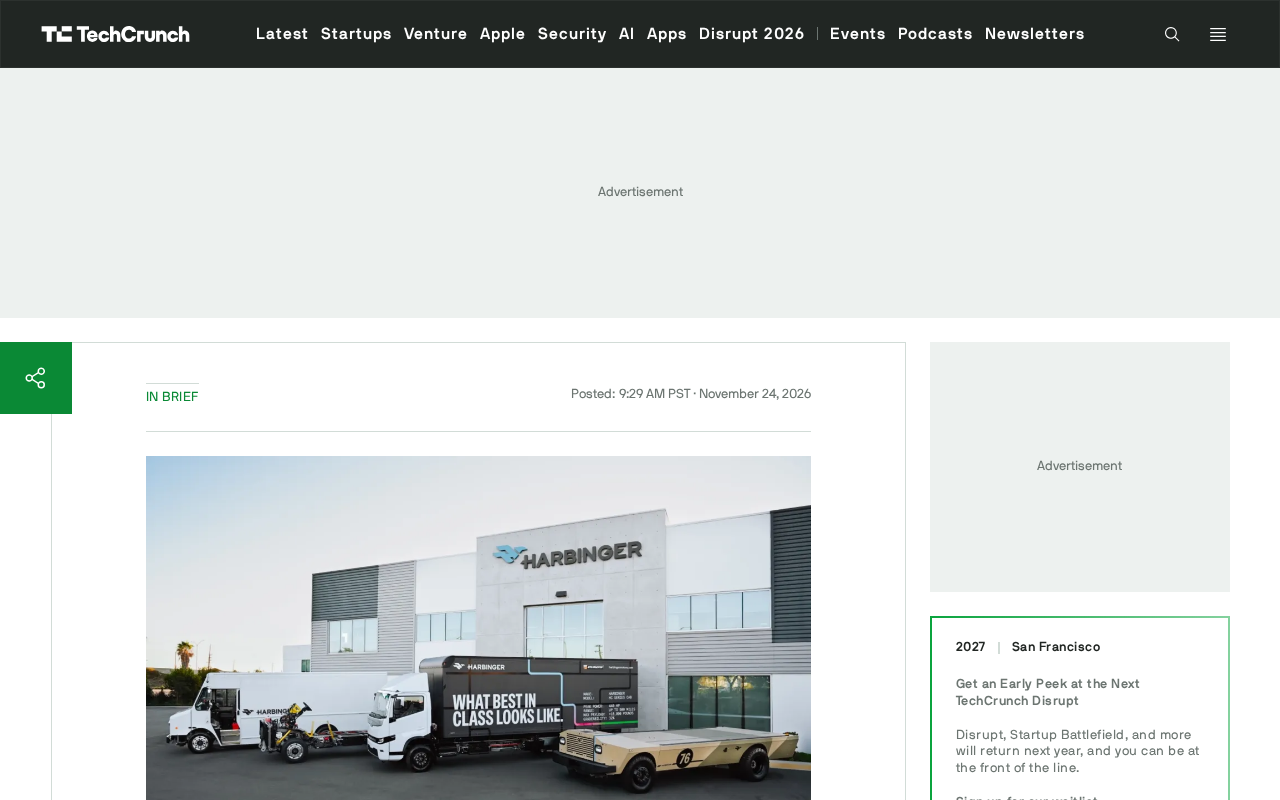
Harbinger brings in Palmer Luckey's Erebor Bank to diversify financing channels for the electric truck startup.
Electric truck startup Harbinger has introduced Palmer Luckey's Erebor Bank as a new capital source to diversify financing and support growth. The article notes that electric trucks face higher range, payload, and charging requirements, leading to slower commercialization and heavier capital consumption, so startups depend heavily on financing cadence. Bank capital entry signals a shift from single equity to diversified tools such as debt, consistent with moving from concept validation to scaled operations, and reflects banks' more positive view of the business model. Yet a single event does not mean the industry has emerged from funding difficulties; converting capital into capacity and orders is the key test.
Electric truck startup Harbinger is seeking more diversified funding channels for its growth, with its latest move being the introduction of Palmer Luckey's Erebor Bank as a new source of capital.
The Financing Move: From a Single Channel to Diversification
The core motivation behind Harbinger bringing Erebor Bank into its capital sources is to diversify its financing methods and support the company's growth. For an electric truck startup still in its expansion phase, relying on a single financing channel means higher risk to its capital chain. Introducing a bank-type capital provider typically signals that the financing structure is extending from equity toward debt or hybrid instruments.
Interestingly, Erebor Bank's connection to Palmer Luckey adds extra attention to this financing. Luckey himself is a well-known figure in the tech world, and this capital link—extended from the banking institution he helped establish into the electric truck sector—is itself a signal worth watching: tech-background capital is penetrating the relatively "hardcore" commercial vehicle electrification track.
Equity financing and debt financing are the two main funding paths for startups. Equity financing (such as venture capital and angel investment) exchanges company shares for capital; investors bear higher risk and share in future appreciation, but founder control is diluted. Debt financing (such as bank loans and credit lines) requires scheduled repayment of principal and interest and does not dilute equity, but it places higher demands on a company's cash flow stability and asset collateral capacity. Harbinger's introduction of a bank-type capital provider typically means its financing structure is extending from pure equity toward debt or hybrid instruments. This reflects that the company's assets have some collateralizability, and it also marks a transition from the "burn-cash validation" stage to the "scaled operations" stage, imposing higher requirements on capital efficiency and repayment capacity.
Why Electric Trucks?
Electric trucks have long been regarded as a more difficult piece of the electrification puzzle—compared with passenger cars, they impose stricter requirements on range, payload, and charging infrastructure, and the pace of commercialization is slower. Precisely because of this, startups in this field often need to continuously invest large amounts of capital between R&D and mass production, creating a high dependence on financing cadence.
Harbinger's choice to broaden its funding sources at this stage indicates that its growth plans have advanced to a point where a more stable capital structure is needed. The entry of bank capital also typically means that the funder has some confidence in the company's asset condition and cash flow expectations.
The core bottlenecks in electric truck commercialization are concentrated in three areas. First, the trade-off between battery energy density and payload: heavy-duty long-haul transport has far higher range requirements than passenger cars, while adding batteries eats into cargo space and drives up vehicle cost. Second, charging infrastructure: commercial fleets need dedicated high-power, high-utilization charging networks, which existing public chargers struggle to provide. Third, the total cost of ownership (TCO) validation cycle is long: fleet operators need to see that electric trucks are economical compared with diesel vehicles over the full lifecycle before they will purchase at scale. These factors make the cycle from R&D to mass production longer and capital consumption greater for electric truck startups, and their dependence on financing cadence and capital structure stability is significantly higher than that of startups in the passenger car space.
What Bank Capital Entry Means
From an industry perspective, the participation of bank-type institutions in financing electric commercial vehicle startups sends signals on two levels.
First, financing tools are becoming richer. Startups no longer rely solely on venture capital for funding; tools such as debt financing and credit lines are entering the toolbox, consistent with the stage characteristics of companies transitioning from "concept validation" to "scaled operations."
Second, capital providers are reassessing track risk. Banks naturally have lower risk tolerance than venture capitalists. Their willingness to participate indicates a more positive judgment about the medium- and long-term viability of the electric truck business model—at least for Harbinger as a company.
Of course, a single financing event is not enough to show that the entire electric truck industry has emerged from its funding difficulties. Whether startups can convert capital into production capacity and orders remains the more critical test.
The difference in risk appetite between banks and venture capital is key to understanding this financing move. Venture capital firms typically accept high failure rates in exchange for outsized returns from a few projects and have high tolerance for early-stage losses. Banks, constrained by capital adequacy and credit regulation, focus more on borrower asset quality, cash flow coverage, and collateral value. Therefore, when a bank is willing to provide funding to an electric truck startup, it often means the company already has an assessable asset base (such as production line equipment or order contracts) or relatively clear revenue expectations, rather than relying solely on concepts and team background. This signal has reference value for the judgments of other institutional investors going forward, but it does not mean the industry's overall financing environment has fully improved.
Observations and Judgment
Harbinger's move to bring in Erebor Bank can be seen as a microcosm of electric truck startups maturing in their capital strategies: shifting from chasing a single star investor to building a diversified funding structure that includes banks.
For those watching commercial vehicle electrification, what is worth noting next is the specific use of this funding—whether it goes into production lines, R&D, or channel expansion—and whether Harbinger can deliver quantifiable progress after the capital is in place. Financing is only the starting point; building the trucks and delivering them to customers is the real watershed.
One-line Summary
Harbinger brings in Palmer Luckey's Erebor Bank, advancing financing channel diversification for the electric truck startup.
Paragraph Summary
Electric truck startup Harbinger has introduced Palmer Luckey's Erebor Bank as a new source of capital, with the core aim of diversifying financing channels and supporting company growth. The article argues that electric trucks, due to higher requirements for range, payload, and charging facilities, have slower commercialization and greater capital consumption, making startups highly dependent on financing cadence. Bank capital entry sends two signals: first, financing tools are expanding from single equity to diversified instruments such as debt, consistent with the transition from concept validation to scaled operations; second, banks have lower risk tolerance than venture capital, and their involvement reflects increasingly positive judgment about the medium- and long-term viability of the electric truck business model. However, a single financing event is not enough to show the industry has emerged from funding difficulties; whether capital can be converted into production capacity and orders is the more critical test.
Related articles

Pure-Code Video Generation Tested: Which AI Model Actually Follows Instructions?
A Bilibili creator tested three AI models' pure-code video generation with unified prompts and three revisions each: Xiaonaomao has a high ceiling but lacks stability, GPT 6.2 Extra models well but only follows half the instructions, and OPAS 5.5 remains the benchmark.

GPT-6 Six-Tier Hands-On Test: Astra Ultra Dominates but Bills Double
GPT-6 six-tier test: Astra Ultra sweeps 3:0 in 3D tasks thanks to sub-agents and runs 14% faster, but hidden backend bills make its real cost 2.6x single-threaded.

GPT-6.2 Astra vs Fable 5.2: Huge Cost-Efficiency Gap Across 12 Real-World Tests
Bilibili creator tests GPT-6.2 Astra vs Fable 5.2 across 12 real tasks: Fable wins 7-5 but costs 7.2x more and takes nearly 5x longer. Token efficiency emerges as the key selection metric.