Harbor: The Evernote Alternative That Puts Its Pricing in Writing

Harbor bets on a 3-year price lock and full data portability to win over disillusioned Evernote users.
Harbor is a note-taking app that makes pricing transparency its core differentiator, promising a three-year price lock and annual increases capped at 10% — a direct response to frustration with Evernote's frequent price hikes. It supports OCR search across handwritten notes, scans, PDFs, and recordings, with full platform coverage including a CLI tool and one-step Evernote import. Notably, it offers complete data export on all plans, deliberately avoiding vendor lock-in. The product has earned 102 upvotes on Product Hunt but remains in early stages, and whether its pricing promises will hold long-term is yet to be proven.
A Note-Taking App That Makes Price Transparency Its Selling Point
The note-taking software market has never lacked competition, but Harbor took an angle few others have directly addressed — pricing commitments. This product, which earned 102 upvotes on Product Hunt and ranked 4th for the day, leads with the tagline "puts its price in writing." It promises a three-year price lock, with annual increases capped at 10% thereafter.
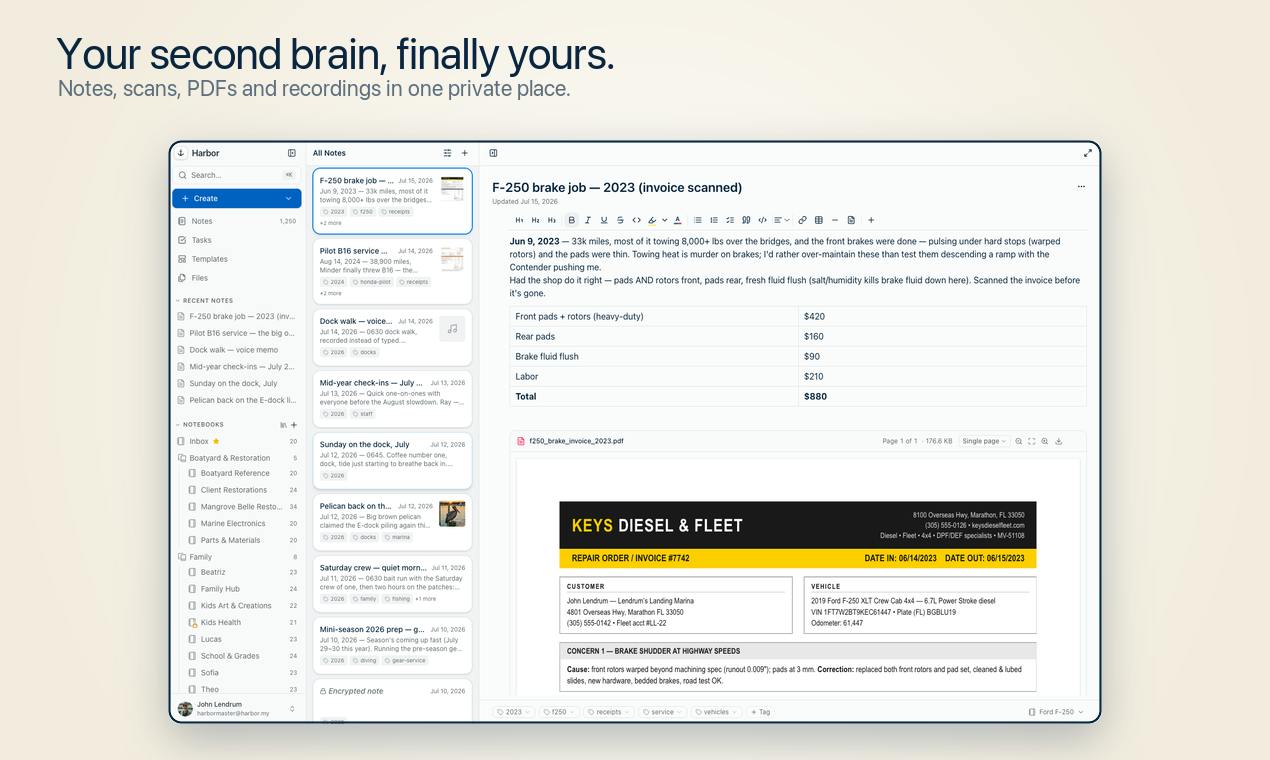
For longtime users who've weathered Evernote's repeated price hikes and feature restrictions, that promise carries real weight. Built by Spicer Matthews, Harbor positions itself as a "personal second brain" supporting notes, scans, PDFs, and recordings, with privacy and data portability placed front and center in its product narrative.
Features: OCR, Handwriting Recognition, and Full Platform Coverage
Harbor's feature set targets the complete knowledge management workflow. It supports search across notes, scans, PDFs, and even recordings. Its OCR (Optical Character Recognition) capability extends to handwritten content — meaning handwritten notes are fully searchable, something many competing tools still fall short on.
Platform coverage is impressively comprehensive: Mac, Windows, iPhone, iPad, Android, Web, and even a CLI (command-line tool). The command-line support is telling — it signals that developers and technically-minded users are part of the target audience, people who want their note-taking tools to integrate into automated workflows.
For users looking to migrate from Evernote, Harbor offers a one-step Evernote import. Data migration friction has long been one of the main reasons note-taking users resist switching tools, so streamlining the import process is a crucial move to capture users already invested in another platform.
OCR (Optical Character Recognition) is the technology that converts text in images into searchable, editable content. Early OCR was primarily designed for printed characters and achieved high accuracy. Handwriting Recognition is significantly harder, since handwriting styles vary widely from person to person, with stroke connections that differ substantially from printed text. Modern handwriting OCR typically relies on deep learning models — such as convolutional neural networks combined with recurrent neural networks — to recognize handwriting patterns. Mainstream products like Google Lens and Apple's Live Text have already brought this capability to consumer apps. In note-taking software, the core value of handwriting OCR lies in bridging analog input and digital search: content handwritten in a physical notebook or on a tablet becomes as searchable as typed text, dramatically reducing the "sunk cost" of analog information.
Privacy and Data Portability: Keeping Users Through Experience, Not Lock-In
Harbor is listed under the Productivity, Notes, and Privacy categories, and privacy is an explicit focus. The product describes itself as a "private second brain," making data confidentiality a key differentiator.
Even more noteworthy is its decision to offer full data export on every plan. This stands in contrast to many SaaS tools that treat data export as a premium-tier privilege. Allowing users to take their data with them at any time means Harbor is deliberately giving up "data lock-in" — a common retention tactic — and betting on product experience alone to keep users engaged. In a note-taking market where trust is scarce, this approach could become an unexpected competitive advantage.
Data Portability refers to a user's ability to export all of their accumulated data from a platform in a standardized, reusable format and migrate it to another service. The concept was given legal standing in Article 20 of the EU's General Data Protection Regulation (GDPR), which requires companies to provide machine-readable data exports where technically feasible. In practice, however, many SaaS services restrict full export functionality to higher-tier plans or store data in proprietary formats — such as closed database structures or encrypted formats — making it difficult to reuse exported data in other tools. This design pattern is known as Vendor Lock-in, and it's a subtle mechanism subscription software uses to maintain renewal rates. Harbor's decision to offer complete export on all plans means proactively abandoning this competitive moat.
Why the Pricing Commitment Is the Biggest Story
Harbor's true differentiation isn't in its features — it's in the transparency of its business model. The promise of a three-year price lock, followed by annual increases capped at 10%, directly addresses users' widespread anxiety about subscription software's boiling-frog pricing tactics.
Evernote's recent price adjustments and tightening of free-tier limits left many users feeling trapped. By committing pricing rules in writing, Harbor is essentially trading certainty for trust. For a tool where users invest years building a personal knowledge base, the biggest fear is being forced to accept unreasonable prices or migration costs down the road.
That said, it's worth keeping perspective: promises like this made on Product Hunt currently exist largely at the level of marketing language, and long-term follow-through remains to be seen. The product's community feedback is still limited (just 1 comment at the time of writing), indicating it's in an early stage where real-world user reputation and product stability still need more validation.
Takeaway
Harbor represents a new direction in the note-taking tool competition: as features become increasingly commoditized, "trust factors" like transparent pricing, data portability, and privacy are emerging as the new battleground for differentiation. Its OCR handwriting recognition, full platform plus CLI coverage, and one-step Evernote import provide a solid functional foundation, while the pricing commitment serves as the lever to pry away dissatisfied Evernote users. Whether Harbor can deliver on its promises and build a lasting reputation is well worth watching.
Related articles

Free Unlimited Claude Code Solution: Agnes AI + CC Switch Setup Guide
No paid subscription needed — pair the free AI platform Agnes AI with the open-source tool CC Switch to provide a backend for Claude Code, enabling unlimited free calls to text, image, and video models. This guide covers the full setup, test results, and usage boundaries.

A Complete Zero-Cost Guide to Getting Started with Claude Code for Beginners in China
A beginner's guide to Claude Code for users in China: two installation methods (command line and IDE plugin), full configuration steps for replacing the official API with the free domestic LongCat model, and a hands-on demo of building a small tool with natural language, plus tips.

When the NSA Gets Involved: The AI Supply Chain Crisis Behind Open-Source CVEs and API Key Hijacking
Multiple open-source projects disclosed severe CVEs in one day, PHP flaws alarmed the FBI, and Railway and OpenCode were breached with API keys stolen. This article breaks down the vulnerability window, AI-accelerated exploitation, and the AI supply chain crisis behind the API key black market, with a developer defense checklist.