HarborRL Update: Elastic Scaling and SSH-Free Cluster Deployment
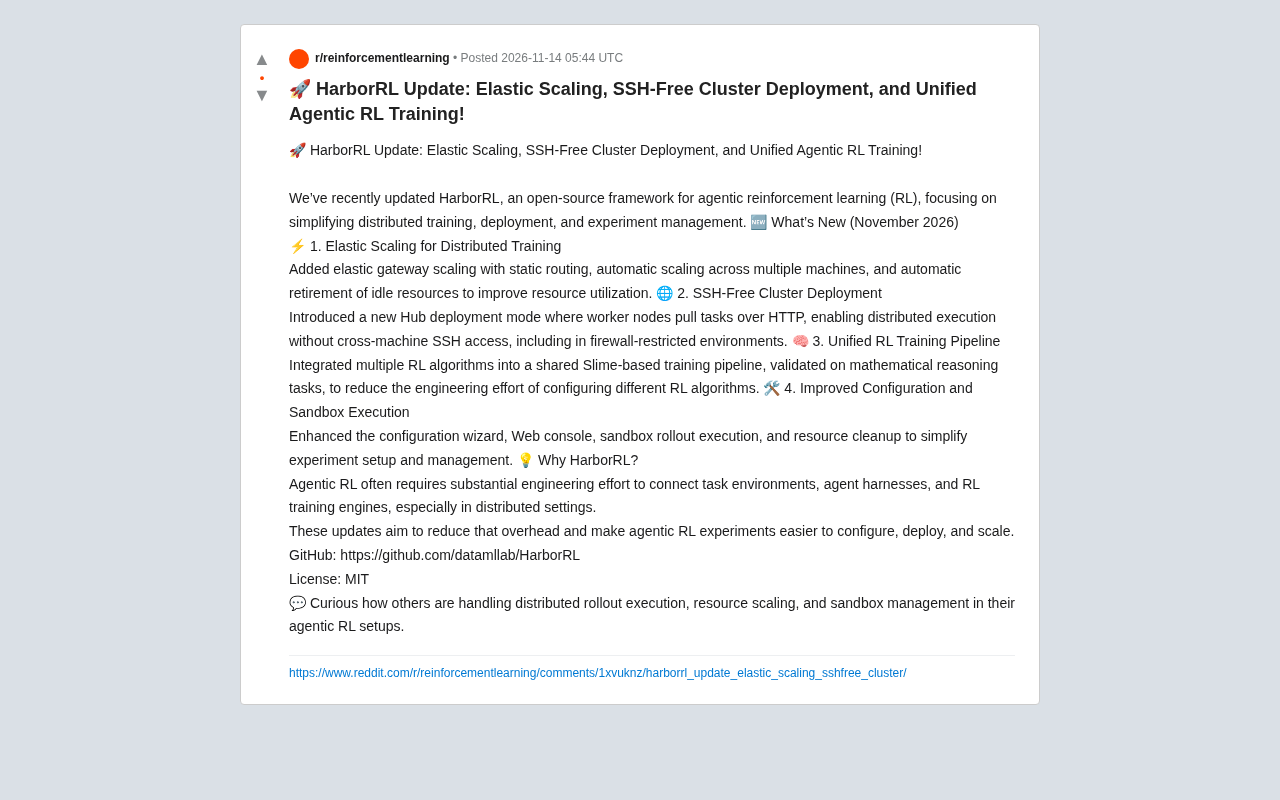
HarborRL update tackles distributed Agentic RL engineering bottlenecks and lowers the experiment barrier.
HarborRL's latest update addresses the engineering pain points of distributed Agentic RL by dismantling bottlenecks in four areas: adding elastic gateway scaling with static routing, supporting automatic cross-machine scaling and automatic reclamation of idle resources; introducing Hub deployment mode where workers pull tasks via HTTP without cross-machine SSH, enabling distributed execution in firewall-restricted environments; integrating multiple RL algorithms into a shared training pipeline based on Slime, validated on mathematical reasoning tasks; and improving the configuration wizard, web console, sandbox rollout execution, and resource cleanup to reduce experiment setup costs. The project uses the MIT license, and the community still lacks consensus on general solutions for distributed rollout and sandbox management.
The engineering bottlenecks of distributed Agentic RL are being dismantled
The barrier to entry for Agentic RL (agent reinforcement learning) experiments has long been not the algorithms themselves, but the engineering side: task environments, agent execution frameworks, and training engines need to be manually wired together, and distributed scenarios also require handling cross-machine scheduling, resource reclamation, and network access restrictions. The latest round of updates to the open-source framework HarborRL is aimed squarely at this "dirty work."
According to information released by the project in the community, this update focuses on four areas: elastic scaling, SSH-free cluster deployment, a unified RL training pipeline, and improvements to configuration and sandbox execution. The project uses the MIT license, and the code is hosted under the datamllab organization on GitHub.
Agentic RL (agent reinforcement learning) is a subfield of reinforcement learning in which the training target is not a single-step decision policy, but an agent capable of calling tools, executing multi-step actions, and continuously interacting with the environment. Compared with classic RL, its rollout process is longer, environment states are more complex, and it usually requires external tools or sandboxes to participate, so the demands on engineering infrastructure are significantly higher. Typical applications include mathematical reasoning, code generation, web navigation, and tool calling.
Rollout refers to the process in which an agent actually executes a series of actions in the environment and collects trajectories; it is the data generation stage of RL training. In distributed Agentic RL, rollouts are often executed in parallel by multiple workers, and the task volume fluctuates greatly, which is why elastic scaling and sandbox management become key engineering problems.
Elastic scaling: letting idle resources retire automatically
The most easily overlooked cost in distributed training is machines that are "occupied but not working." HarborRL has added elastic gateway scaling with static routing, supporting automatic scaling across multiple machines and automatically reclaiming idle resources.
The significance of this for experimental teams lies in improved resource utilization: when the rollout task volume fluctuates, the cluster does not need to maintain a fixed number of always-on nodes, and idle compute is actively released. Compared with static clusters that require manual intervention, this design is closer to the actual experimental rhythm of "a burst of tasks, followed by long periods of idling."
SSH-free cluster deployment: distributed execution that bypasses firewalls
Traditional multi-machine training often relies on cross-machine SSH to connect nodes, which is frequently an obstacle in enterprise intranets and firewall-restricted environments. HarborRL introduces a new Hub deployment mode: worker nodes pull tasks via HTTP, thereby completing distributed execution without cross-machine SSH permissions.
This change may seem like only a change in transport method, but what it actually affects is deployment feasibility—many teams do not lack compute; rather, network policies do not allow nodes to interconnect freely. By consolidating the scheduling channel into HTTP, the deployment prerequisite is lowered from "operations granting permissions" to "nodes being able to access the Hub service."
SSH (Secure Shell) is a common protocol for cross-machine remote login and command execution, and traditional distributed training frameworks often rely on it to distribute tasks and synchronize state. However, in enterprise intranets, cloud security groups, or firewall policies, SSH ports between nodes are usually restricted, which blocks multi-machine deployment. HarborRL's Hub mode changes the task distribution channel to HTTP: workers actively pull tasks from the Hub rather than having the control side push them via SSH. This "pull-based" architecture only requires workers to be able to access the Hub service, imposes fewer requirements on network policies, and is easier to pass through firewalls.
Unified training pipeline: no need to rewrite engineering when switching algorithms
HarborRL integrates multiple RL algorithms into a shared training pipeline based on Slime, and has completed validation on mathematical reasoning tasks. The goal emphasized in the original text is to reduce the repeated investment of "configuring engineering separately for different RL algorithms."
A real pain point of Agentic RL is that algorithms iterate quickly, but each algorithm switch requires re-adapting the training chain. A unified pipeline converges algorithm differences into the configuration layer, allowing engineering code to be reused. It should be noted that the original text only mentions validation on mathematical reasoning tasks; the generalization effect on other task types has not yet been provided in this update.
Slime is the shared training pipeline foundation mentioned in this update. In RL training, although different algorithms (such as PPO, GRPO, etc.) differ in loss functions and advantage estimation, the stages of data sampling, forward inference, and gradient updating are highly similar. Converging algorithm differences into the configuration layer and reusing underlying engineering code is the mainstream approach to reducing algorithm iteration costs. The original text only states that the pipeline has completed validation on mathematical reasoning tasks, so its ability to migrate to more complex Agentic tasks such as code generation and tool calling still needs to be tested in subsequent practice.
Configuration and sandbox: turning experiment management into a product experience
This update also strengthens the configuration wizard, web console, sandbox rollout execution, and resource cleanup. These changes do not involve algorithmic capabilities, but they directly determine the time cost of setting up experiments.
Sandbox rollout is the part of Agentic RL most prone to problems—environment isolation, execution timeouts, and resource residue all slow down iteration. The improved resource cleanup mechanism, combined with visual management through the web console, turns "running an experiment" from writing scripts into clicking through configuration. For teams that need to frequently compare different environment settings, the improvement in this experience is often more direct than gains at the algorithm level.
The community is still asking: the general solution for distributed rollout remains undecided
When releasing the update, the project team raised an open question: how are distributed rollout execution, resource scaling, and sandbox management done in other people's agentic RL environments? This suggests that current practice has not yet formed a consensus solution.
From the content of the update, HarborRL offers a path of "reducing engineering coupling": using a unified pipeline to converge algorithm differences, using HTTP pull to replace SSH connectivity, and using elastic scaling to replace static resource pools. Whether this combination is suitable for larger-scale or more complex task environments still needs validation through practical feedback from more users. For teams currently building Agentic RL infrastructure, this MIT-licensed project is worth adding to the evaluation list.
Related articles

Tutu Livestream Transcript: A Real Snapshot of the Streamer-Fan Ecosystem
From Bilibili streamer Tutu's livestream transcript, observe a solo streamer's real survival state amid technical glitches, badge payment systems, and PK traffic competition, and analyze long-tail streamers' professional cognition and emotional labor.

Bilibili Live Streaming Ecosystem: Interaction, Tipping, and the Traffic Game in a Co-Streaming Session
From a Bilibili co-streaming session, we observe streamer interactions, the tipping economy, and PK gameplay, analyzing the complex relationship between authenticity and performance, traffic and emotion in the livestream ecosystem.

Bill Gates' Old Interview Resurfaces: Why Is Public Scrutiny Fixed on Jensen Huang?
A resurfaced Bill Gates interview on Bilibili fuels comparisons with claims Jensen Huang was forced to resign. The article examines Gates' remarks on marriage and Epstein, analyzes short-video comparison tactics, and notes the Huang claims lack reliable sources.