Harness Architecture Explained: Context Engineering, Task Orchestration, and the Skills Lifecycle
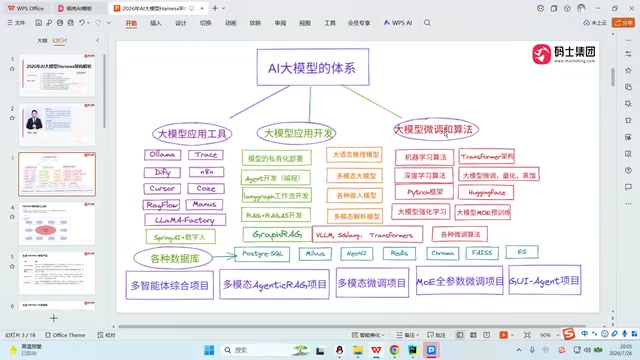
Context engineering, task orchestration, and the Skills lifecycle in the Harness architecture are becoming frequent interview topics for AI large model positions.
Drawing on a frontline instructor's open class, the article notes that interviewers for AI large model positions increasingly dig into complex resume projects, and whether one can clearly explain the Harness architecture has become a dividing line between "having called an API" and "having done engineering implementation." The article breaks the Harness architecture into three layers: context engineering decides what the model sees, task orchestration decides how the system moves, and the Skills lifecycle decides how capabilities are managed, and it offers transition-path advice.
In interviews for AI large model positions, interviewers increasingly tend to probe into the architectural details of complex projects. Several recent technical talks and practitioner feedback all point to the same signal: whether you can clearly explain the Harness architecture is becoming a dividing line between those who have "called an API" and those who have "done engineering implementation." Drawing on the open class content of a frontline instructor, this article systematically breaks down the three core modules of the Harness architecture: context engineering, task orchestration, and the Skills lifecycle.
Why the Harness Architecture Has Become a Frequent Interview Question
According to observations by Li Jing (an instructor at Mashi Education), a Bilibili creator, in an open class, interviewers are extremely interested in complex large model projects on resumes. As long as a resume lists one or two sufficiently complex projects, interviewers tend to focus on those and probe deeply, while asking less about the rest. There is a practical reason behind this questioning preference: the barrier to simply calling a model API and building a basic agent is already very low, so it cannot demonstrate a candidate's engineering ability.
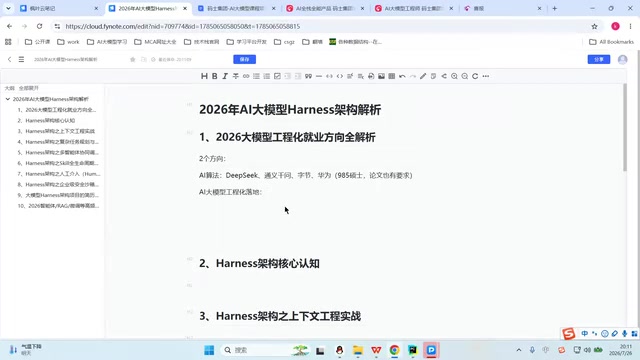
Li Jing notes that job descriptions for AI large model positions on the market appear somewhat scattered, but in summary there are actually only two directions: AI algorithms and large model engineering implementation. The algorithm direction handles model pretraining and version R&D, with high requirements for academic credentials and papers, basically aimed at 985 master's degree holders with top-conference paper backgrounds; for practitioners with an ordinary bachelor's background, the more reliable path is engineering implementation—taking mature models and applying them to enterprise business scenarios, for example deploying a model privately for medical diagnosis, or building an agent within a huge procurement platform to complete procurement analysis and generate purchase orders.
Engineering implementation requires a coding foundation, and there is no shortcut here. It covers agent development, RAG, large model inference and deployment, and a basic understanding of fine-tuning algorithms. At the foundational level, it requires understanding the overall flow of the Transformer architecture (without needing to go deep into mathematical derivations), familiarity with lightweight fine-tuning approaches such as LoRA and P-Tuning, mastery of deployment-related tools such as FastAPI, proxies, and cluster scheduling, as well as full-stack RAG capabilities including vector retrieval, knowledge graphs, semantic understanding, and hybrid retrieval. The agent development part corresponds to Multi-Agent collaboration, task planning and execution, and tool calling.
The term "Harness" originally referred in software engineering to a test harness, that is, the outer framework that wraps the code under test and provides the runtime environment and input/output. In the AI large model context, Harness is borrowed to mean the engineering shell that wraps the model and handles context injection, tool scheduling, and process control. Understanding the origin of this name helps grasp its essence: the model itself is a black box that only accepts input and produces output, while the Harness is all the engineering code outside the black box that makes it "usable, controllable, and reproducible." When interviewers ask about Harness, they are essentially testing whether the candidate realizes that the capability ceiling of a large model application depends not only on model parameters but also on the design quality of this shell.
Three Capability Levels You Must Master
It should be emphasized that these capabilities are not required to reach expert level in every item, but you must "know them and be able to use them." Li Jing clearly distinguishes between "being able to use" and "mastering"—all of these points may be asked about in interviews, but the depth required differs. For developers hoping to enter this track in 2026, staying at the level of "using tools to build a simple agent" is no longer enough; they need to go deeper into engineering architecture.
Breaking Down the Harness Architecture: Context Engineering
The reason the Harness architecture is valued by interviewers is that it elevates large model applications from "single calls" to "orchestratable, governable systems." Context engineering is the first layer: the quality of model output depends to a large extent on the quality of the context fed into the window, and the problem context engineering must solve is—within a limited context budget, how to organize system prompts, historical dialogue, retrieval results, and tool returns so that the model obtains appropriate decision-making grounds.
From the perspective of engineering implementation, context engineering is tightly coupled with full-stack RAG capabilities. Vector retrieval, knowledge graphs, semantic understanding, and hybrid retrieval together determine "what content can be recalled," while context engineering determines "which content should enter the window, in what order, and at what granularity." If the two are poorly coordinated, even the strongest model will produce results that deviate from business expectations. This is also why interviewers ask about RAG details together with architecture design.
The context window refers to the upper limit of the total number of tokens a model can receive in a single inference; anything beyond that is truncated or throws an error. The core constraint of context engineering is precisely this hard budget: system prompts, historical dialogue, retrieval snippets, and tool returns all compete for the same window. How to allocate tokens, how to summarize and compress long documents, and how to arrange information order to exploit the model's greater sensitivity to the beginning and end positions are all issues that need to be explicitly designed in engineering. Common approaches include using a sliding window to retain recent dialogue, reranking retrieval results before truncating them, and splitting long contexts into multiple rounds of subtasks handled separately.
Breaking Down the Harness Architecture: Task Orchestration
Task orchestration corresponds to the capabilities of task planning and execution and tool calling in agent development. A complex business scenario often requires multiple steps, multiple tools, and even multiple agents working together; the task orchestration layer is responsible for decomposing goals, allocating subtasks, scheduling tools, and handling failures and retries.
In his course system, Li Jing lists Multi-Agent collaboration as one of the core contents of agent development. In actual implementation, the difficulty of task orchestration is not getting a single agent to run successfully once, but keeping the entire process stable under real business load—this is precisely the key point by which interviewers judge whether a candidate has done "complex projects."
Multi-Agent collaboration usually refers to multiple agents with independent role settings collaborating through message passing or shared state to accomplish complex goals. Common topologies include supervisor-worker, pipeline, and debate structures. Related concepts also include ReAct (a prompting paradigm that alternates reasoning and action) and function calling; the former determines how a single agent plans its next step, while the latter determines how an agent converts natural language intent into structured tool parameters. What the task orchestration layer must solve is global scheduling on top of these mechanisms, including managing subtask dependencies, timeout and retry strategies, and fallback paths upon failure—these are exactly where the gap lies between "running successfully once" and "running stably."
Breaking Down the Harness Architecture: The Skills Lifecycle
The Skills lifecycle focuses on the entire process of a capability unit from definition, registration, and invocation to iteration and retirement. Treating tools and skills as assets with a lifecycle rather than as functions hardcoded once is an important feature that distinguishes the Harness architecture from earlier ways of building agents.
This layer and deployment-side capabilities support each other: inference and deployment involve FastAPI, proxies, and cluster scheduling, and the loading, version switching, and canary rollout of skills at runtime all require coordination with the deployment system. For readers leaning toward technical management positions, Li Jing also mentions that how to design secure sandboxes and how to plan Multi-Agent collaboration in enterprises are common implementation topics—a secure sandbox is essentially the intersection of the Skills lifecycle and permission governance.
The Path from "Having Built an Agent" to "Understanding Architecture"
Taken together, the value of the Harness architecture lies in linking context engineering, task orchestration, and the Skills lifecycle into a reusable engineering chain. For developers in transition, mastery of this chain is directly reflected in their resumes and interview performance. Li Jing's advice is quite direct: traditional developers with a programming foundation (Java, frontend, Python, Go) can all transition smoothly into the large model engineering direction, but project experience must demonstrate architectural depth rather than staying at the level of basic calls.
For students still in school, planning ahead in this direction, together with resume and mock interview coaching, can build a differentiated advantage when job hunting after graduation; for practitioners already in AI positions but who feel their work is too shallow, filling in the engineering capabilities related to the Harness architecture is a realistic choice for going deeper. As for candidates with stronger academic backgrounds and accumulated papers, the algorithm direction remains open, but for most people, engineering implementation is the more controllable track.
When interviewers ask about the Harness architecture, what they are really asking is whether the candidate understands how a complex AI system is organized. Context engineering answers "what the model sees," task orchestration answers "how the system moves," and the Skills lifecycle answers "how capabilities are managed." Explaining these three things clearly is more persuasive than listing ten APIs you have called.
One-line Summary
The context engineering, task orchestration, and Skills lifecycle of the Harness architecture are becoming frequent interview topics for AI large model positions.
Paragraph Summary
Drawing on the open class content of a frontline instructor, the article points out that interviewers for AI large model positions increasingly tend to dig into complex projects on resumes, and whether one can clearly explain the Harness architecture has become a dividing line between "having called an API" and "having done engineering implementation." Market positions can be grouped into two categories: algorithm R&D and engineering implementation, with practitioners of ordinary backgrounds better suited to the latter, requiring agent development, RAG, inference deployment, and fine-tuning fundamentals, with a requirement to "know rather than master." The article breaks the Harness architecture into three layers: context engineering determines what the model sees, task orchestration determines how the system moves, and the Skills lifecycle determines how capabilities are managed, and it offers advice on the transition path from "having built an agent" to "understanding architecture."
Related articles

9 AI Subscription Plans Compared: The Real Cost Per 100M Tokens Revealed
Bilibili creator tests 9 AI subscription plans from Volcano, Alibaba, Tencent, Baidu, Zhipu, Xiaomi, MiniMax and more, converting them all to real cost per 100M tokens, breaking down fixed-quota vs. three-tier coefficient billing and how caching, time-of-day discounts, and window limits affect actual quota.

Vibe Coding for Beginners: Expressing Intent Instead of Handwriting Code
What is Vibe Coding? A 137-episode Bilibili course defines it: the core is expressing intent, not writing code. This article analyzes Vibe Coding's productivity logic, target audience, and entry expectations to help beginners decide if it's worth learning.

LangChain Beginner's Guide: An Agent Development Roadmap from LangGraph to Deep Agents
Clarify the encapsulation relationship among LangChain, LangGraph, and Deep Agents, and master the learning path and selection logic for agent development frameworks—suitable for beginners in large model development.