Harness Engineering: A Complete Guide to Enterprise-Level AI Development with Claude Code

Harness Engineering uses Skill-driven rules and feedback loops to turn LLMs into controllable enterprise development agents.
Harness Engineering represents the third evolutionary stage of AI programming—beyond Prompt Engineering and Context Engineering. By combining predefined rules, reusable Skills, and continuous feedback mechanisms with LLMs like Claude Code, developers can achieve full-process automated development covering requirements analysis, coding, testing, and deployment at enterprise scale.
In an era where AI programming tools are everywhere, most developers still use AI at a basic level—asking questions and getting answers, or feeding context. The approach that truly enables full-process automated development in enterprise projects is a new paradigm called "Harness Engineering." This article systematically covers the core philosophy and practical implementation of this methodology, based on a tech blogger's hands-on experience with Claude Code for enterprise development.
What Exactly Is Harness Engineering?
The English word "Harness" literally refers to horse tack—the reins and equipment used to control a horse. Translated into engineering terms, it means "engineering for control and guidance."
The metaphor is quite apt: if you think of a large language model (LLM) as a powerful stallion, its capabilities are immense, but to truly "ride it well," you need a set of tools for precise command—making it turn left, turn right, accelerate, and perform complex maneuvers. That set of tools is the Harness.
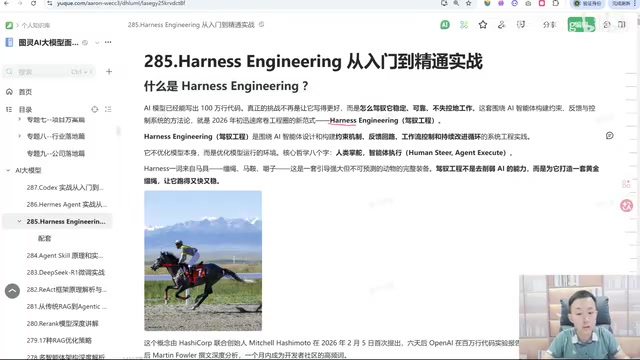
The concept of Harness Engineering is rooted in the software engineering community's ongoing exploration of AI Agent controllability. In traditional software development, we use design patterns, architectural constraints, and CI/CD pipelines to ensure engineering quality. In AI-driven development paradigms, similar constraint mechanisms are equally indispensable. While large language models possess powerful code generation capabilities, their outputs are probabilistic and uncertain—asking the same question twice may yield different answers, and models tend to "hallucinate" non-existent APIs or libraries. Harness Engineering essentially applies the determinism principles of software engineering to AI Agent behavior control, transforming uncertainty into controllable engineering output through predefined rules, processes, and feedback loops.
Here's a concise formula to summarize it:
Harness + LLM = Agent
In other words, the prompts, rule constraints, and interactive feedback mechanisms provided by the Harness, combined with the underlying model's capabilities and precise human direction, form an intelligent agent capable of completing complex tasks.
In the AI field, an Agent is a system with autonomous planning, tool invocation, and environment interaction capabilities—distinct from simple Q&A chatbots. A complete Agent typically has four core capabilities: perception (understanding inputs and environment state), planning (decomposing complex tasks into sub-steps), action (calling tools to execute specific operations), and reflection (evaluating execution results and adjusting strategies). In AI programming scenarios, an Agent can not only generate code but also read file systems, run tests, analyze error logs, and autonomously fix problems. This represents the critical step the industry is taking from "simple conversations" to "complex task automation."
Three Evolutionary Stages of AI Programming Paradigms
To understand the value of Harness Engineering, we first need to see the three stages of AI engineering evolution clearly.
Stage 1: Prompt Engineering
When ChatGPT first launched, the hottest term was "prompt engineering." The core idea was how to clearly express your question to the model in a Q&A format. This is the most basic form of AI interaction.
Stage 2: Context Engineering
As task complexity increased, a single sentence could no longer produce satisfactory results. Here's a vivid example: if you directly ask AI to "write a technical article mimicking a certain teacher's style," the result will likely be unsatisfactory—because the model has no idea what that teacher's writing style looks like.
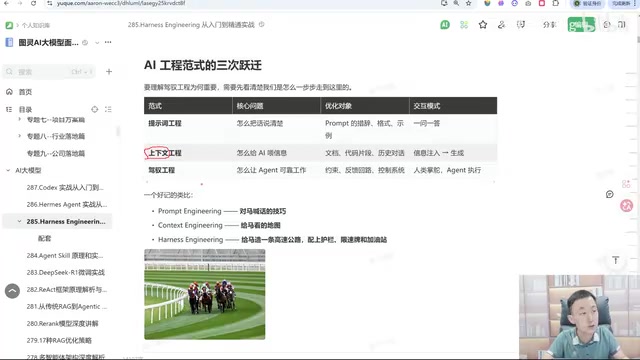
The solution is to provide "context": first feed the model hundreds of that teacher's past articles for learning, then give instructions, and output quality improves dramatically. Similarly, in AI programming, if you simply say "help me develop a shopping cart CRUD feature," the code often won't meet requirements. But if you first provide coding standards and reference snippets, the output will align with expectations.
The core technical challenge of context engineering is the LLM's context window limitation. Even though Claude 3.5 supports 200K tokens and GPT-4 Turbo supports 128K tokens of extended context, enterprise project codebases often far exceed these limits. A mid-sized project might have hundreds of thousands of lines of code—directly inputting everything into the model is impractical. Therefore, context engineering must solve the "information retrieval" problem—how to precisely extract the most relevant snippets from massive codebases for the current task. Common techniques include RAG (Retrieval-Augmented Generation, which first retrieves relevant documents from a knowledge base, then inputs them as context to the model), code indexing, AST (Abstract Syntax Tree) analysis, and more. But even with retrieval solved, single-session context feeding still lacks process standardization and reusability—precisely the pain point Harness Engineering addresses.
It's estimated that over 95% of developers—even those using advanced tools like Claude Code, Codex, or Cursor—still remain at this stage.
Stage 3: Harness Engineering
This is the latest and will be the mainstream direction for the next two to three years. It targets Agent-level complex work: it's no longer sufficient to just pass some context. Instead, it requires extensive rule constraints, continuous interaction during execution, feedback, correction, and more granular control over AI to accomplish extremely complex tasks well.
Practical Setup: Claude Code with Chinese LLMs
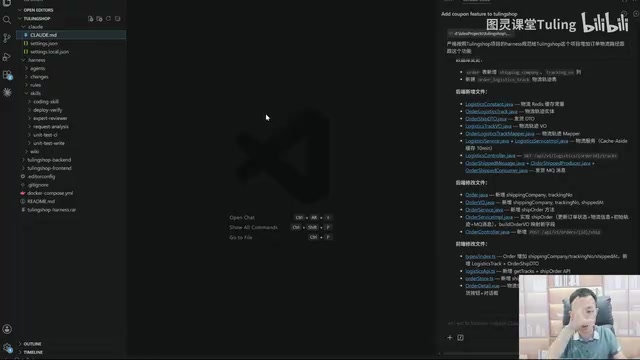
The presenter's tech stack is both representative and pragmatic:
- IDE: VS Code (Microsoft's open-source mainstream editor)
- AI Programming Tool: Claude Code (integrated via VS Code plugin)
- Underlying LLM: Zhipu's GLM series (via Coding Plan, approximately 200 RMB/month)
Regarding tool selection, here are some reference points worth noting:
Why recommend Claude Code? Claude Code is Anthropic's command-line AI programming tool, with core advantages in deep file system integration and multi-step task execution capabilities. Unlike traditional AI code completion tools, Claude Code runs directly in the terminal with system-level permissions to read/write files, execute shell commands, and run test suites. It supports defining project-level rules and constraints through CLAUDE.md files (similar to how .eslintrc defines code standards), which provides a natural rule injection entry point for Harness Engineering. Additionally, Claude Code's "extended thinking" mode allows the model to perform deep reasoning and planning before executing complex tasks, which is crucial for multi-step engineering tasks. Of course, if you prefer Cursor or other tools, that works too—what matters is the methodology, not the tool itself.
Regarding LLM selection, the progress of Chinese LLMs in code generation is remarkable. Zhipu's GLM-4 series has reached international first-tier levels on code benchmarks like HumanEval and MBPP, with particular localization advantages in Chinese technical documentation understanding and domestic tech stack code generation (such as Spring Boot, Vue, etc.). Alibaba's Qwen2.5-Coder performs exceptionally among open-source code models, while Xiaomi's MiMo excels in reasoning capabilities.

Volcano Engine's Coding Plan is ByteDance's AI programming service, using a subscription model that supports flexible switching between multiple LLMs, reducing migration costs and vendor lock-in risks for enterprise users. This "model-agnostic" approach aligns perfectly with Harness Engineering's philosophy of "prioritizing methodology over tools."
An important point: If even a mid-tier Chinese model (like GLM) combined with Harness Engineering can deliver enterprise-level projects, then switching to more capable models like Claude or the latest GPT versions will only yield better results. The value of methodology lies precisely in its ability to amplify the capabilities of any underlying model.
Core Mechanism of Harness: Skill-Driven Full-Process Automated Development
This section contains the highest value of the entire practice. Consider a seemingly simple instruction:
"Strictly following the Turing Shop project's Harness Engineering specifications, add an order logistics tracking feature to this project."
While you could write this instruction too, its execution flow is worlds apart from what an average developer casually types. The reason is that this instruction strictly depends on a complete Harness Engineering specification system and custom-built enterprise-level full-process development Skills.
This system contains approximately six to seven core Skills spanning the entire development lifecycle:
- Coding Skill (coding standards)
- Requirements Analysis Skill
- Unit Testing Skill
- Continuous Integration Skill
- Deployment Skill
The Skill system in Harness Engineering essentially abstracts each stage of a traditional DevOps pipeline into standardized modules executable by AI. In traditional CI/CD, tools like Jenkins, GitLab CI, and GitHub Actions define automated build, test, and deployment processes through YAML configuration files. The Skill system goes further—it defines not only "what to do" but also "how to do it" and "to what standard" through natural language rules. For example, a Coding Skill doesn't just specify code style; it may also include constraints on error handling patterns, logging standards, secure coding practices, and other dimensions. This ensures that AI-generated code isn't just "code that runs" but "code that meets enterprise engineering standards."
These Skills automatically complete the full pipeline from requirements analysis, system architecture, and coding through testing, integration, and deployment, following the project's Harness specification system. In other words, a single natural language instruction triggers an engineered, reusable, constrained automated development workflow.
This is the fundamental difference between Harness Engineering and Context Engineering: the former is a reusable engineering system; the latter is a one-time context feed.
Practical Takeaways for Developers
From this practice, we can extract several insights valuable to enterprise developers:
First, prioritize methodology over tools. Whether it's Claude Code or Cursor, whether the underlying model is GLM or Claude, what truly determines the ceiling of AI programming is whether you've established a system of rule constraints and Skills.
Second, upgrade from Context Engineering to Harness Engineering. If you're still at the stage of "feeding code standards and asking AI to follow them," the next step should be thinking about how to crystallize requirements analysis, testing, deployment, and other stages into reusable Skills for full-process automation.
Third, practice takes priority over concepts. A vast number of online videos focus on conceptual explanations—you finish watching, remember a few buzzwords, but have no idea how to apply them. The truly valuable learning path is: get hands-on first, understand how things work at the code level, then revisit the concepts to truly internalize them.
A note of caution: the content of this article comes from a single practitioner's experience, and the details of the "custom Skill system" and specific implementation results mentioned should be referenced judiciously in conjunction with your own practice. However, Harness Engineering as a direction in AI programming evolution is worth every technical professional's attention and exploration.
Key Takeaways
Related articles

Amphibious Transforming Drone: Beyond 100x Power Savings, What Are the Real Needs?
Is the amphibious transforming drone just a gimmick? Starting from the 100x power difference of the M4 Morphobot, explore real application scenarios and thesis topic ideas, analyzing boundary conditions where pure drones and pure ground robots both fail.

Warhound Raises $200 Million: Genetically Engineered "War Dogs" Paired with Anduril Gear
Warhound raises $200M, backed by Ben Lamm and Palmer Luckey, to genetically engineer dogs for military and law enforcement use and equip them with Anduril gear. This article analyzes its technology direction, funding logic, and ethical controversy.

Claude API Comes to Google Cloud: IAM Integration and SDK Access Guide
Anthropic hosts the full Claude API on Google Cloud with IAM-controlled permissions and unified billing. This guide covers the Vertex AI and Anthropic-hosted entry points, IAM role configuration, and SDK access.