Harness Engineering: A New Paradigm for Agent Development

Harness Engineering is everything outside the model and is becoming the new paradigm for agent development.
The article traces agent development from prompt engineering to context engineering to Harness Engineering, noting that the three are in a containment relationship rather than a replacement relationship. Harness Engineering is defined as "everything other than the model itself," with the formula agent equals model plus Harness; its value lies in turning uncertain model intelligence into a reliable engine for long-horizon complex tasks. Using examples such as financial account analysis, it explains that older approaches face context explosion, state loss, chaotic tool invocation, and lack of planning, while Harness Engineering unifies planning, memory, and tool orchestration. Prompts are not gone but dynamically injected at runtime through mechanisms such as Memory. The author advises developers to shift focus from prompt tricks to system architecture design.
Agent development is undergoing a paradigm shift. Over the past two years, prompt engineering and context engineering have successively become the focus of developers, but neither alone can solve the deployment challenges of long-horizon complex tasks. In a recent tutorial, Teacher Xiao from the Bilibili channel Ma Shi Education systematically breaks down the architectural logic of Harness Engineering and maps its relationship with prompt engineering and context engineering into a clear evolutionary trajectory. Drawing on that tutorial, this article analyzes why Harness Engineering has become the critical infrastructure for current agent development.
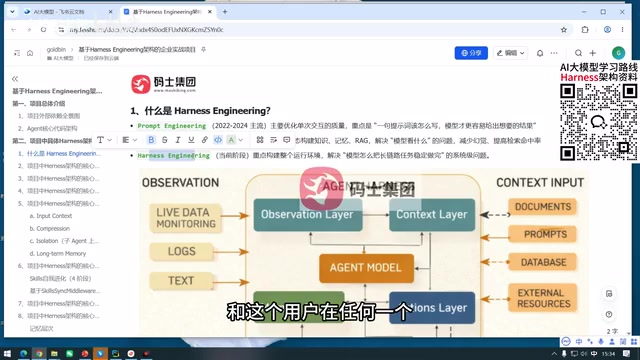
The Containment Relationship Among Three Generations of Engineering Approaches
In the tutorial, Teacher Xiao lays out a clear timeline: prompt engineering emerged around 2024, context engineering began gaining attention after February 2025, and Harness Engineering only gradually took shape after February 2026. The three are not replacements but a containment relationship—Harness Engineering contains context engineering, and context engineering contains prompt engineering.
This judgment has direct implications for interviews and project defenses. Teacher Xiao states plainly that at this stage, discussing prompt engineering alone on a resume or in an interview is no longer very valuable, because the prompts of new agents are inherently not fixed. Each user has different preferences and a different execution context, so prompts must be adjusted dynamically. Explaining today's agents using the 2024 mindset of "hard-coded prompts" is simply the wrong direction.
So how do you write dynamic prompts? The answer is through an injection mechanism. The Harness Engineering architecture includes a dedicated Memory directory for recording user preferences and likes. For example, if a user prefers to display content with radar charts, that preference is passed to the model through prompt injection every time the large model generates a decision or an image. Without injection, the model has no way of knowing the user wants a radar chart. This is exactly how Harness Engineering internalizes prompt engineering—prompts still exist, but their form has shifted from static authoring to runtime dynamic injection.
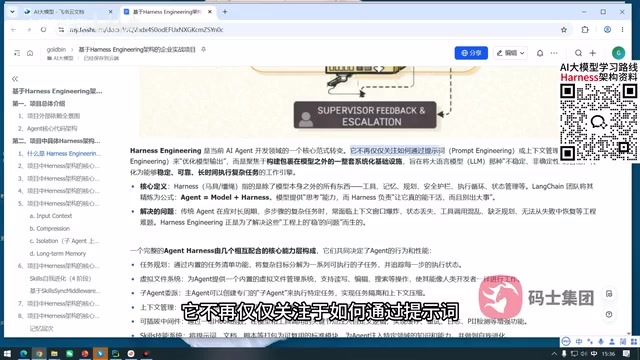
Prompt Engineering refers to the technical practice of designing and optimizing the text instructions fed to a large model so that its output better matches expectations. Typical techniques include role setting, few-shot examples, Chain-of-Thought guidance, and output format constraints. In 2023–2024 it was the primary means of tuning agents, but it presupposed relatively static prompts written offline by developers.
Context Engineering expands the focus from "what instructions to write" to "what information to place in the limited context window." It involves retrieval-augmented generation (RAG), compression of conversation history, trimming and ranking of tool-returned results, and layered organization of system prompts and user input. Compared with prompt engineering, it places greater emphasis on dynamically assembling context at runtime, and is a necessary evolution for handling long conversations and multi-tool scenarios.
The Core Definition of Harness Engineering: Everything Outside the Model
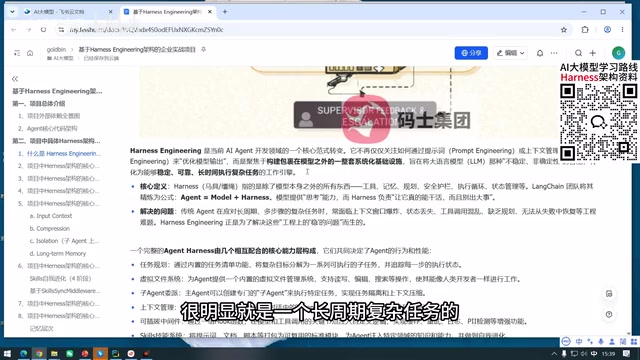
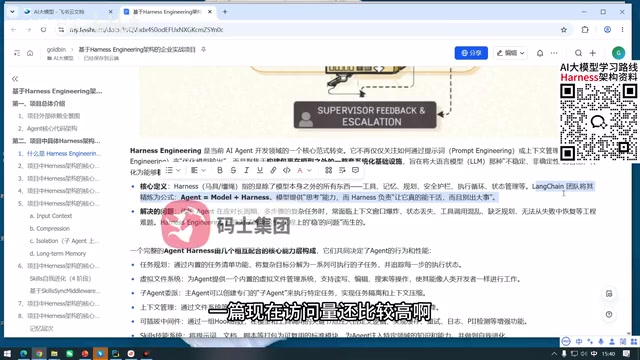
According to a paper by the LangChain team with roughly 126K views, Harness is defined as "everything other than the model itself." The formula the team gives is: agent equals model plus Harness. The model provides thinking capability, while the Harness is responsible for enabling the agent to actually do work, do it well, and avoid major failures.
Teacher Xiao translates Harness as "harness" or "reins," and the metaphor is apt—the model is the horse, providing the power, and the Harness is the reins and tack, transforming uncertain, unstable intelligence into a work engine that is reliable and can execute complex tasks stably over long periods.
The value of this definition lies in drawing a clear boundary. In traditional agent development, developers often spend a great deal of effort tuning model output, whereas Harness Engineering directs attention to an entire set of systematic technical infrastructure outside the model. Model intelligence is uncertain, but the surrounding system can be certain and engineerable.
Context window explosion is a typical failure mode in long-horizon tasks. A large model's context window has a hard upper limit, and every time an agent calls a tool or performs a step of reasoning, it appends content to the conversation history. As task steps multiply, the history accumulates rapidly, ultimately either exceeding the window and being truncated, or pushing key information to the margins so that the model "forgets" early goals—manifesting as repeated work, deviation from the task, or giving up midway. Engineering countermeasures include history summarization, external storage of key state, and on-demand retrieval and re-injection—all of which are system-level designs outside the model.
Long-Horizon Complex Tasks: The Real Problem Harness Engineering Solves
The tutorial uses a comparison to illustrate the problem domain. A simple task such as "What's the weather in Shanghai tomorrow?" can be answered with a single tool call. But in real scenarios, user needs are often long-horizon complex tasks—for example, in a financial context, "summarize the number of all accounts involving court proceedings in Q1 2016, analyze the characteristics of these accounts involved in cases, and determine whether the fraud category accounts for a higher proportion."
Such tasks have two characteristics: first, they are complex, requiring the agent to determine the dimensions of analysis on its own; second, execution takes a long time, possibly requiring seven or eight tool calls plus three to five skills to reach a final conclusion. Agents before 2026 generally encountered engineering challenges with such tasks, including context window explosion, state loss, chaotic tool invocation, lack of planning, and inability to recover from failures and exceptions.
Teacher Xiao particularly emphasizes the planning step. Facing a complex task, the agent must first decompose it into a task list, clarifying what to do in step one, step two, and step three, and only deliver results after all steps are complete. Under older approaches, developers needed to build a separate planning agent to achieve this capability, whereas Harness Engineering incorporates planning, memory, tool orchestration, and other capabilities into a unified architecture—which is precisely its core value.
Skill in the agent context usually refers to a capability unit encapsulated as a reusable module—for example, a packaged code function, a dedicated sub-flow, or a set of operating specifications for a specific domain. Unlike general tool invocation, a skill often carries domain knowledge and fixed execution logic; the agent simply calls it by name when needed, without reasoning through the steps from scratch each time. Breaking complex capabilities into skills reduces the burden of a single reasoning pass and facilitates testing and reuse, making it an important means of organizing long tasks in Harness Engineering.
Practical Implications for Developers
Judging from the architectural details revealed in the tutorial, the Memory directory is just one component of the Harness Engineering system. The new understanding developers need to establish is this: the capability ceiling of an agent is no longer determined solely by the model; the completeness of the surrounding infrastructure is equally critical. How tool calls are orchestrated, how state is persisted, how to recover after failure, how user preferences are injected—the solutions to these engineering problems together constitute the practice of Harness Engineering.
For developers currently working on agent projects, Teacher Xiao's advice is direct: shift your learning focus from prompt tricks to system architecture design. Prompt engineering has not disappeared; it has been absorbed into Harness Engineering and become one link in runtime injection. Understanding this is the only way to find the right direction in the next stage of agent development.
One-line Summary
Harness Engineering is everything outside the model, and it is becoming the new paradigm for agent development.
Paragraph Summary
The article traces the evolution of agent development from prompt engineering to context engineering to Harness Engineering, pointing out that the three are in a containment relationship rather than a replacement relationship. Harness Engineering is defined as "everything other than the model itself," with the formula agent equals model plus Harness; its value lies in transforming uncertain model intelligence into a work engine that is reliable and can execute complex tasks over long periods. Using long-horizon complex tasks such as financial account analysis as examples, the article explains that older approaches face challenges including context explosion, state loss, chaotic tool invocation, and lack of planning, whereas Harness Engineering incorporates planning, memory, and tool orchestration into a unified architecture. Prompts have not disappeared; they are dynamically injected at runtime through mechanisms such as Memory. The author advises developers to shift their learning focus from prompt tricks to system architecture design.
Related articles

A 19-Year-Old's Rental Horror Story: Ceiling Collapse, Bug Infestation, and the Lessons It Taught Me
At 19, my first off-campus rental brought bug infestations, no heat, a collapsed ceiling, and a ruined laptop with no renter's insurance. Here are the hard-won lessons for first-time student renters.

Veda Nurse's Cranial Nerve Exam: Why ASMR Role-Play Is Going Viral
Bilibili creator Veda's cranial nerve exam ASMR video goes viral, blending humor and sensory triggers through nurse role-play. This article analyzes its unique appeal and the audience psychology behind ASMR role-play.

LG Cinebeam AI Review: 120-Inch Giant Screen + 3000 Lumens, a New Choice for the Living Room Theater
LG Cinebeam AI projector review: 3000 ANSI lumens, 4K, 100 inches from about 8 cm and 120 inches from about 18 cm. Built-in webOS, AI Concierge voice recommendations, AI Sound Pro 11.1.2 virtual surround, and Game Optimizer—positioned for fixed living room installation, complementing the portable Cinebeam S.