Harness Engineering: A New Paradigm for Multi-Agent Architecture Explained

Harness Engineering is the new paradigm for building complete infrastructure systems around AI agents.
Harness Engineering represents the latest evolution in AI agent development, moving beyond Prompt and Context Engineering to encompass the entire infrastructure wrapped around large models. It integrates seven core capabilities — tool calling, memory, planning, execution loops, state management, security controls, and sandboxes — into a unified architecture that solves enterprise-level challenges like context explosion, state loss, and security vulnerabilities.
From Prompts to Harness: The Evolution of Agent Engineering
In the field of AI agent development, the pace of engineering paradigm iteration is astonishing. Looking back at the trajectory of the past few years, we can clearly see an evolution from localized optimization to systematic architecture.
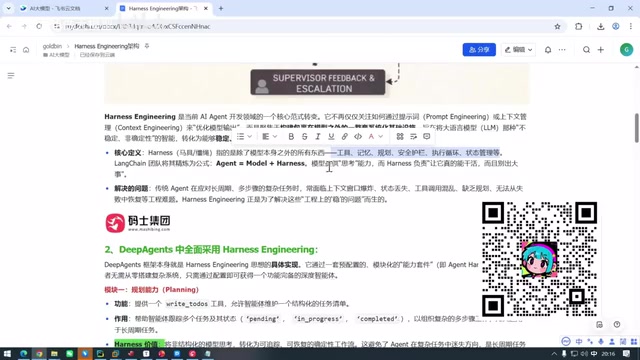
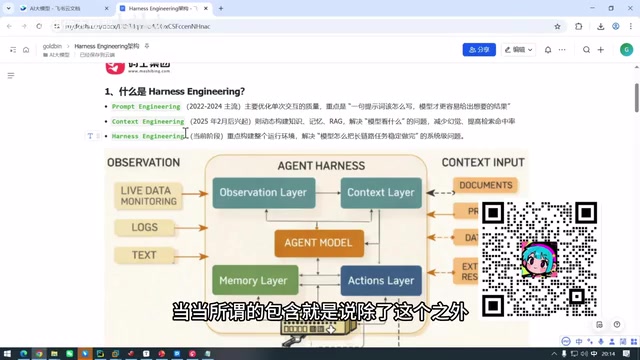
The earliest industry buzz was around Prompt Engineering — developers racking their brains to tweak wording, structure, and examples, trying to squeeze better outputs from models. Prompt Engineering emerged during 2022-2023, becoming a hot skill alongside the explosive adoption of large language models like ChatGPT. Its core techniques include Few-shot Learning (embedding examples in prompts to guide model output), Chain-of-Thought (improving reasoning by asking models to "think step by step"), and Role Prompting strategies. However, Prompt Engineering's limitation is that it essentially works only on the model's input side, offering limited control over model behavior — when task complexity exceeds what a single prompt can carry, mere wording adjustments fall short.
Next, the focus shifted to Context Engineering, which addresses how to organize, retrieve, and manage richer contextual information for models. The core idea of Context Engineering is that output quality depends not just on the prompt itself, but on the overall quality of context fed to the model. This paradigm's rise is closely tied to the maturation of RAG (Retrieval-Augmented Generation) technology. RAG uses vector databases (such as Pinecone, Weaviate, Chroma, etc.) to retrieve external knowledge and inject it into the context window, vastly expanding the model's knowledge boundaries. Additionally, Context Engineering involves context window management, information compression and summarization, dynamic context assembly, and more. As models like Gemini and Claude have expanded context windows to the million-token level, efficiently organizing and utilizing this context space has become a core challenge in engineering practice. In many technical job interviews, "Context Engineering" has already become a high-frequency topic that interviewers are sure to ask about.
Now, an even grander concept is emerging — Harness Engineering. This term was originally proposed by Anthropic and refers to the complete infrastructure system built around large models. Anthropic was co-founded in 2021 by former OpenAI research VP Dario Amodei and Daniela Amodei, with AI safety research as its core mission. Its flagship Claude series models are known for the Constitutional AI methodology, which constrains model behavior through a built-in set of principles, creating differentiated advantages in safety and controllability. It is precisely this deep pursuit of "controllability" that gave birth to the concept of Harness Engineering.
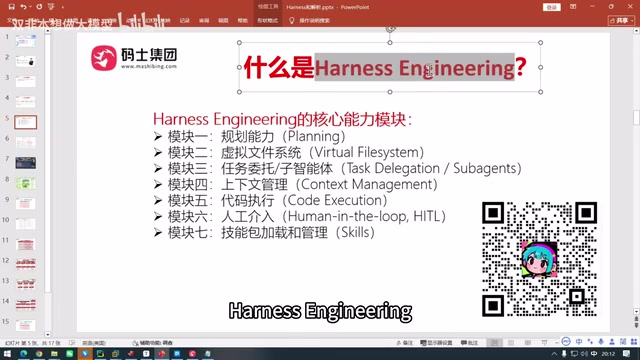
What is Harness Engineering
In English, "Harness" originally means the equipment placed on a horse to guide and constrain its behavior. This metaphor is perfectly apt: a large model is like a powerful but difficult-to-control horse, and the Harness is the complete set of equipment that makes it controllable, usable, and capable of sustained work.
Core Definition
If we were to define Harness Engineering, it can be understood as:
Harness Engineering is the core development paradigm and software architecture paradigm in current agent development. It no longer focuses programmers solely on prompts or context, but rather on building a complete set of systematic infrastructure wrapped around the model.
In other words, everything needed in agent development besides the large model itself can be collectively referred to as the Harness. This is a broad understanding — many online definitions describe Harness too narrowly, when in reality its boundaries are far wider than they appear on the surface.
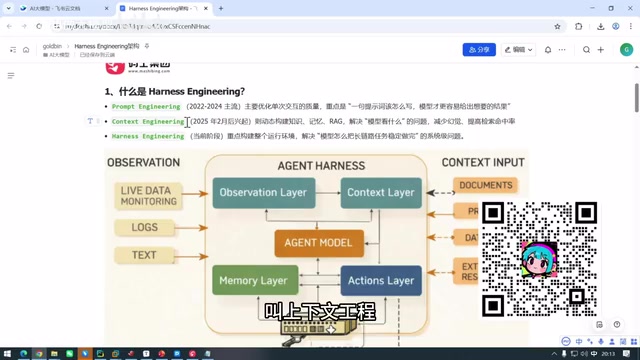
The Containment Relationship of Three Engineering Paradigms
From an evolutionary perspective, we can summarize the relationship between these three paradigms as a set of containment relationships:
- Harness Engineering ⊃ Context Engineering ⊃ Prompt Engineering
That is, Harness Engineering encompasses Context Engineering, which in turn encompasses Prompt Engineering. Of course, this "containment" means that Harness covers far more capability modules beyond the first two. This layered progression also reflects the deepening of industry understanding: from focusing on "how to talk to the model," to "what to show the model," to "how to build a complete runtime environment for the model."
The Seven Core Capabilities of Harness
A complete Harness architecture consists of seven core modules. Its power lies precisely in integrating these previously scattered capabilities into a unified architecture.
1. Tools (Tool Calling)
The agent's ability to invoke external tools serves as the bridge between agents and the real world. Whether it's API calls, database queries, or code execution, the tool system is the foundation for agents to deliver practical value. The technical foundation of tool-calling capability is the Function Calling protocol, first officially introduced by OpenAI into the GPT API in June 2023. It works as follows: instead of directly outputting a natural language answer, the model outputs a structured function call request (containing the function name and parameters), which is then executed by an external system that returns results to the model. This mechanism was further standardized by MCP (Model Context Protocol) — proposed by Anthropic in late 2024, the MCP protocol aims to establish a unified communication standard between AI models and external tools/data sources, similar to how USB standardized hardware interfaces. Currently, mainstream agent frameworks such as LangChain, CrewAI, and AutoGen have deeply integrated tool-calling capabilities.
2. Memory and Storage
This includes short-term and long-term memory storage mechanisms, solving the "state loss" problem agents face in long-cycle tasks. Effective memory management allows agents to maintain consistency across sessions and tasks. Agent memory systems are typically divided into three levels: Working Memory, Short-term Memory, and Long-term Memory. Working memory corresponds to the current conversation's context window, constrained by token limits; short-term memory is usually implemented through session-level caching, covering intermediate states within a single task; long-term memory relies on vector databases or knowledge graphs for persistent storage, enabling agents to retain user preferences, historical decisions, and learned experiences across sessions. MemGPT (now renamed Letta) is a representative project in this area, simulating an operating system's virtual memory mechanism to let agents manage information far exceeding window capacity within a limited context window.
3. Planning
Multi-cognitive task planning capability enables agents to decompose complex goals and formulate execution steps. This is the key leap that takes agents from "single-response" to "continuously completing complex tasks." Planning capabilities are typically implemented using algorithmic approaches like Tree Search and Task Decomposition. For example, the Tree-of-Thought method lets models explore multiple reasoning paths and select the optimal one for execution, while frameworks like HuggingGPT demonstrate how a manager model can decompose complex tasks into subtasks and dispatch multiple specialized models to collaborate on completion. The maturity of planning capabilities directly determines whether an agent can handle enterprise-level complex workflows.
4. Execution Loop
The behavior-and-observation loop — the closed loop where agents execute actions, observe results, and make decisions. This Act-Observe-Decide cycle is the core engine of autonomous agent operation. Its theoretical foundation comes from the ReAct (Reasoning + Acting) paradigm, proposed by Shunyu Yao et al. at Princeton University in 2022. The ReAct framework has models alternate between reasoning (Thought) and action (Action): the model first thinks about what to do, then executes an action (such as calling a tool), observes the result (Observation), and then reasons again based on the observation. This loop shares similarities with the Event Loop in traditional software engineering, but adds dimensions of reasoning and adaptive decision-making. More advanced execution loops also incorporate Reflection mechanisms, allowing agents to evaluate the quality of their own behavior and self-correct.
5. State Management
State management covers context but goes beyond it, including tracking the state of the entire task process. It ensures that agents always "know where they are" during multi-step execution. In traditional software engineering, state management has mature patterns — such as Finite State Machines (FSM) and Statecharts — and these concepts have been introduced into agent architecture as well. LangGraph is a typical example, using directed graph structures to manage agent state transitions, where each node represents a processing step and edges represent state transition conditions. Good state management also needs to support state persistence, state rollback, and checkpoint recovery, enabling agents to resume execution from the point of interruption rather than starting over after unexpected failures.
6. Security and Access Control
This is an easily overlooked yet critically important component. Imagine a script containing malicious code — should an agent execute it unconditionally? Obviously not. Therefore, access control, file operation management, and security protection are all incorporated into the Harness system. In enterprise scenarios, security control needs to cover multiple layers: input-layer Prompt Injection protection — preventing users from inducing the model to perform malicious operations through carefully crafted inputs; execution-layer principle of least privilege — agents can only access resources necessary to complete the current task; and output-layer content moderation and sensitive information filtering. OWASP (Open Web Application Security Project) has published a security risk checklist specifically for LLM applications (OWASP Top 10 for LLM Applications), providing a systematic guidance framework for enterprise-level agent security.
7. Sandbox and File System
Sandboxes provide isolated execution environments that, combined with file systems and self-evolving Skill mechanisms, allow agents to safely experiment while continuously accumulating capabilities. Sandbox technology originates from the operating system security domain, with the core idea of running untrusted code in isolated environments to prevent damage to the host system. In agent scenarios, commonly used sandbox technologies include Docker container isolation, WebAssembly (WASM) runtimes, and lightweight virtualization solutions like gVisor. E2B (Environment to Build) is a cloud sandbox platform specifically designed for AI agents, offering isolated execution environments with millisecond-level startup. The importance of sandbox mechanisms for agents lies in this: when agents need to execute generated code (extremely common in coding assistant scenarios), sandboxes effectively prevent security risks like malicious code execution, resource abuse, and data leakage, while allowing agents to safely experiment and iterate. The Skill mechanism (skill accumulation) allows agents to save successful operational patterns as reusable skill modules, achieving progressive capability growth.
Why Claude Code Works So Well
The reason Anthropic's Claude Code performs so well in practice is that it uses TypeScript to build a completely new agent architecture — and this architecture is essentially one of the best implementations of Harness Engineering. The choice of TypeScript is no accident: its strong type system catches type errors at compile time, providing higher engineering reliability for building complex agent infrastructure; meanwhile, the Node.js ecosystem's asynchronous programming capabilities are naturally suited for handling the large volume of concurrent I/O operations in agents (such as simultaneously calling multiple APIs, reading/writing files, etc.).
It organically integrates tool calling, memory, planning, sandbox, and access management capabilities, making the agent stable and reliable when handling long-cycle, multi-step complex programming tasks. Notably, Claude Code also deeply integrates Anthropic's proprietary MCP protocol, enabling it to connect to various external data sources and tool services through standardized interfaces, further expanding its capability boundaries. This is precisely the systemic advantage brought by Harness architecture — not a single-point breakthrough, but synergistic enhancement across the entire chain.
What Pain Points Does Harness Engineering Solve
Traditional agents often expose a series of fatal problems when facing long-cycle, multi-step complex tasks:
- Context explosion: As tasks progress, context continuously expands until it exceeds the model window. Even though current models support 128K or even million-token-level context windows, in actual long-cycle tasks, the rate of context expansion is still alarming — the input/output of every tool call and the intermediate products of every reasoning round accumulate and occupy window space, causing early important information to be truncated or diluted.
- State loss: Critical information gets lost midway during multi-step execution. This problem is compounded by the model "hallucination" phenomenon — models not only forget previous states but may also "fabricate" non-existent state information, causing subsequent execution paths to completely deviate.
- Chaotic tool calling: Lack of unified scheduling mechanisms leads to disorderly tool invocations
- Lack of planning capability: Inability to effectively decompose and organize complex objectives
- Security vulnerabilities: Malicious code and unauthorized operations lack protection
Harness Engineering systematically solves these problems by unifying them within a single architecture. It's no longer about patching issues piecemeal, but providing a complete infrastructure solution oriented toward enterprise-level scenarios. From a software engineering perspective, the emergence of Harness Engineering marks agent development's transition from the "craft workshop" era to the "industrialization" era — just as web development evolved from hand-writing HTML to using React/Vue frameworks, agent development is also undergoing a qualitative shift from loose scripts to standardized architecture.
Enterprise Implementation: Multi-Agent Collaborative Architecture
For enterprises, the value of Harness architecture lies in its natural fit for complex multi-Agent collaboration scenarios. Multi-Agent collaborative architecture is a system design pattern that distributes complex tasks to multiple specialized agents for cooperative completion. Current mainstream collaboration models include: Hierarchical (a manager Agent assigns tasks to multiple executor Agents); Peer-to-Peer (multiple Agents negotiate as equals to make joint decisions); and Pipeline (Agents process different stages of a task sequentially). Representative frameworks include Microsoft's AutoGen (supporting multi-Agent conversational collaboration), CrewAI (role-and-task-based Agent team collaboration), and LangGraph (graph-structure-based multi-Agent workflow orchestration).
Combining Sandbox isolated execution, self-evolving Skill mechanisms, and Human-in-the-loop intervention when necessary, enterprises can build agent systems that are both efficient and controllable. The Human-in-the-loop mechanism is particularly critical in enterprise scenarios — it introduces human approval at key decision points, balancing agent autonomy with business risk control needs. For example, when an agent is about to execute a large financial transaction or modify production environment configurations, the system can pause execution and wait for human confirmation before continuing.
The mainstream direction for enterprise-level agent development will likely be a comprehensive architecture with Harness Engineering as the backbone, combined with multi-Agent collaboration, sandbox security, skill evolution, and human oversight. For developers and teams looking to go deep in the AI application space, understanding and mastering this paradigm will be the critical foundation for building next-generation agent applications.
Conclusion
From Prompt to Context, and now to Harness, each leap in agent engineering represents a deeper understanding of "how to harness large models." If large models are the engine, then the Harness is the complete drivetrain that makes this engine truly power business operations. Whoever masters this architectural paradigm first will gain the competitive edge in enterprise-level AI applications.
Related articles

Altman Declares: The Cybersecurity Crisis Is Unsolvable and There Are Too Many Vulnerabilities to Patch
OpenAI CEO Sam Altman publicly admits he can't fix all security vulnerabilities and that the cybersecurity crisis will keep worsening. This article analyzes the industry reality behind this statement: exploding software complexity, the double-edged sword of AI, and the need to shift security paradigms from "zero vulnerabilities" to resilient defense.

Product Hunt Launches Visual Launch Editor, Saying Goodbye to Tedious Form Filling
Product Hunt launches a Visual Launch Editor with in-place editing for name, tagline, gallery, and maker info, auto-saved drafts, and a checklist to guide creators.

Zelensky Speaks: How We Held Kyiv Against 200,000 Russian Troops
Zelensky recalls the early Russia-Ukraine war: 200,000 Russian troops drove on Kyiv while Ukraine's main forces were in the east. He explains how mobilization grew the army from 200,000 to 800,000 and how Kyiv and Chernihiv oblasts were recaptured.