He Built a Real-Time Conversational AI Companion for Skyrim

A developer built a real-time conversational AI companion for Skyrim using STT, LLM, and TTS pipelines.
A developer created a low-latency AI game companion for Skyrim that enables real-time voice conversations. The project chains together speech recognition, LLM inference, and text-to-speech synthesis, with pipeline parallelism to keep response times under perceptual thresholds. While still experimental, it demonstrates the feasibility of embodied AI agents in games and points toward a future where NPCs evolve from scripted puppets into adaptive, context-aware companions.
When AI Companions Truly Enter the Game World
In The Elder Scrolls V: Skyrim, players have long grown accustomed to being bombarded by NPCs repeating that mechanical line: "I used to be an adventurer like you." While these companions can fight and carry items, they're essentially script-driven puppets that can't truly understand what the player is doing, let alone provide a sense of genuine companionship.
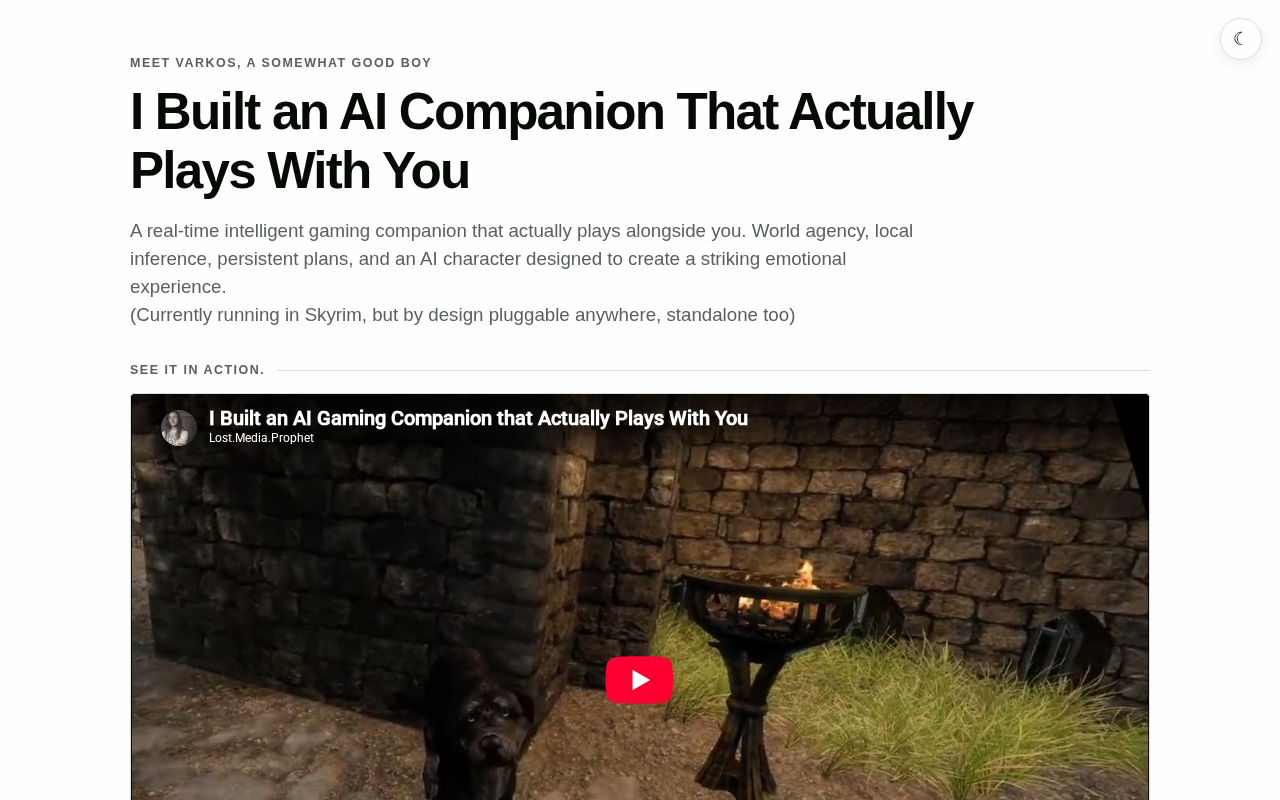
Recently, a developer shared his project on Hacker News: a low-latency AI game companion that can play Skyrim alongside him in real time. Although the post didn't generate much discussion (16 points, 1 comment), it touches on a rapidly heating direction—embedding large language models (LLMs) and real-time voice technology into gaming experiences, evolving virtual characters from "scripts" into "companions that can understand what you're saying."
The Core Challenge: Why "Low-Latency" Is the Key Term
The most noteworthy technical aspect of this project is hidden in two words from the title: low-latency.
Conversation Must Keep Pace with Gameplay
In an action RPG, player actions are continuous and fast-paced. If you shout "block that troll for me" during combat and the AI companion takes three to five seconds to respond, the "companionship" experience instantly collapses. The natural rhythm of human conversation operates at the scale of hundreds of milliseconds—linguistic research shows that the average turn-taking gap in normal conversation is approximately 200 milliseconds. Once response latency exceeds 1-2 seconds, the brain clearly perceives "the other party is processing" rather than "naturally responding after listening," and immersion is completely shattered.
The Complete Real-Time Voice Interaction Pipeline
To achieve this experience, an entire real-time processing pipeline must be connected end-to-end:
-
Speech-to-Text (STT): Converting the player's speech into text in real time. Modern speech recognition has evolved from traditional Hidden Markov Models (HMM) to end-to-end deep learning architectures—for example, OpenAI's Whisper model supports multilingual high-accuracy recognition. However, in gaming scenarios, STT faces additional challenges—players often speak against noisy game audio backgrounds, and their utterances tend to be fragmented commands rather than complete sentences. Streaming ASR technology allows the system to begin processing audio frames while the user is still speaking, rather than waiting for the entire sentence to finish, which is critical for compressing end-to-end latency;
-
Context Understanding: Constructing prompts by combining the current game state (location, quests, combat situations);
-
LLM Inference: Generating responses that match the character's persona. Inference latency is often the biggest bottleneck in the entire pipeline. Current mainstream optimization strategies include: using fine-tuned small-to-medium models (such as Mistral 7B, Llama 3 8B) instead of ultra-large models for faster inference; employing quantization techniques (GPTQ, AWQ, GGUF, etc.) to compress models from FP16 to INT4 precision; leveraging Speculative Decoding where a small model predicts large model outputs for parallel acceleration; and using high-performance inference engines like vLLM and TensorRT-LLM for KV-Cache optimization. In real-time companionship scenarios, Time to First Token needs to be kept within 200-500ms to ensure a smooth experience;
-
Text-to-Speech (TTS): Converting text into natural voice output. Next-generation TTS systems (such as ElevenLabs, XTTS, Bark) are based on deep generative models capable of producing highly natural speech with emotional variation. For game AI companions, TTS must not only be fast but also support voice customization—different vocal qualities, tones, and accents directly impact immersion. Streaming TTS allows the system to begin converting completed portions into speech while the LLM is still generating subsequent text, and this pipeline parallelism significantly compresses the wait time perceived by users.
Latency in any of these four stages accumulates into the final conversation response time. Therefore, "low-latency" isn't a single-point optimization but requires end-to-end engineering refinement across the entire pipeline—such as adopting streaming STT and TTS, choosing models with fast inference speeds, and minimizing network round trips. Ideally, the entire pipeline needs to operate like an assembly line: while speech recognition is still processing the last few syllables, the LLM has already begun generating responses based on earlier text, and TTS starts synthesizing as soon as it receives the first text segment—all stages flowing in parallel rather than waiting sequentially.
From Game Mod to AI Interaction Testbed
Why Skyrim Became the Go-To Testing Ground for AI NPCs
It's worth noting that Skyrim's frequent role as a vehicle for AI experiments is no coincidence. As an open-world game with over a decade of history and an extremely mature modding ecosystem, it offers rich interfaces and community tools that allow developers to relatively easily read in-game state and inject custom character behaviors.
The power of Skyrim's modding ecosystem is largely attributable to SKSE (Skyrim Script Extender), a community-developed script extension framework. SKSE injects into the game process, exposing a large number of internal functions and data structures not made available by the original game, enabling developers to read character attributes, modify AI behavior packages, and listen for various game events. Combined with Bethesda's official Papyrus scripting language and Creation Kit editor, developers can build highly complex custom behavior systems. This technical openness makes Skyrim an ideal sandbox for AI researchers—external AI systems can establish bidirectional data channels with the game's internal state, enabling truly environment-aware AI characters.
In fact, as early as 2023, developers had already created well-known mods that let ChatGPT drive Skyrim NPCs (such as the widely followed Mantella project), allowing villagers and merchants to "speak freely." This latest project goes further—instead of having NPCs passively answer questions, it creates an actively engaging companion character capable of real-time interaction.
The Technical Essence of Companionship: From Chatbot to Embodied Agent
What these projects truly aim to solve is a deeper proposition: how to give AI characters a sense of "presence." This requires not only conversational ability but also environmental awareness, understanding of player intent, and timely reactions. This has already crossed from traditional "chatbots" to the embryonic form of embodied agents—AI is no longer a text box on screen but an entity living within the game world, fighting alongside you.
Embodied agents represent one of the core research directions in artificial intelligence, with theoretical foundations rooted in Embodied Cognition—a school of cognitive science that holds that intelligence cannot exist independently of body and environment, and that the feedback loop between perception and action forms the basis of cognition. In gaming scenarios, a qualified embodied agent needs multimodal perception capabilities (understanding spatial information in game visuals, receiving player voice commands), spatial reasoning ability (assessing terrain advantages and enemy positions), action planning ability (formulating movement paths and combat strategies), and social interaction ability (sensing the player's emotional state and implicit intent). Meta's CICERO project and Google DeepMind's SIMA agent trained in Minecraft are frontier explorations in this direction. Game AI companion projects are essentially the practice of bringing academia's embodied agent research to the consumer experience level.
What This Direction Means for the Gaming Industry
The Future Form of Game NPCs
While this is just an individual developer's experimental project, it reflects a clear trend in the gaming industry. Traditional NPCs rely on pre-written dialogue trees, where designers must manually arrange every branch and trigger condition—content is limited and repetitive, with a main quest NPC typically having only dozens to hundreds of pre-recorded lines. LLM-based dynamic NPCs can theoretically achieve never-repeating, adaptive responses, and even remember your previous actions to deliver personalized reactions.
Major game companies are already exploring this domain—from NVIDIA's ACE (Avatar Cloud Engine) digital human technology to multiple studios experimenting with AI-driven NPCs, the direction is highly consistent. NVIDIA ACE is a complete technology stack for game AI characters, integrating multiple components including Audio2Face (automatically generating facial animations from speech), NeMo (large language model dialogue engine), and Riva (speech recognition and synthesis). At CES 2024, NVIDIA partnered with companies like Convai to showcase live demonstrations of ACE-driven NPCs—characters could not only respond dynamically to players' natural language, but their facial expressions and body language also synchronized with speech in real time, demonstrating expressiveness far beyond traditional NPCs. This represents the industry's systematic investment in AI NPCs, going beyond text-based dialogue to pursue comprehensive upgrades in visuals, voice, and behavior.
The value of projects like this lies in validating the experiential feasibility of "real-time AI companionship" at minimal cost, providing proof of concept for larger-scale industrial applications.
Unresolved Practical Issues
Of course, gaps remain between the ideal and reality. These systems currently face several common challenges:
-
Cost: Continuously calling large models and voice services means non-trivial API expenses for extended play sessions. Taking a GPT-4-level model as an example, a single conversation round-trip (including a prompt with game context) might consume thousands of tokens. At current pricing, an hour of intensive conversation could generate several dollars in API fees. For RPGs that easily span tens to hundreds of hours, this represents considerable ongoing expenditure;
-
Consistency: AI sometimes "breaks character," saying things inconsistent with the game's worldbuilding or character settings. This is known in the LLM field as the "character consistency" problem—models may gradually drift from their established personality during long conversations, or inadvertently reference real-world knowledge that breaks the fourth wall. Current mitigation approaches include carefully designed system prompts, few-shot example constraints, and rule-based output filtering;
-
Local Deployment: Relying on cloud services creates both latency and privacy concerns (uploading voice data to the cloud each time adds network round-trip time and may raise player privacy concerns), while local deployment demands significant hardware. Running a quantized 7B-parameter model typically requires a GPU with at least 8GB of VRAM, and the game itself is already heavily utilizing GPU resources—how both can coexist on the same graphics card with reasonable compute allocation is a practical engineering challenge.
Conclusion
This "AI companion that plays Skyrim with me" project may still be rough around the edges technically, but it represents an exciting possibility: when low-latency voice interaction meets large language models, characters in virtual worlds are finally beginning to feel "alive."
For developers, it's an excellent full-stack exercise—involving real-time audio processing, model inference optimization, and game engine interaction. For players, it heralds an open world that's no longer lonely. Perhaps in the near future, we won't be discussing "how smart the AI in games is," but rather "which AI companion do you prefer adventuring with."
Related articles

Bilibili's Hit Dify Tutorial: A Practical Guide to Building 20+ AI Apps from Scratch
A distilled guide to Bilibili's top-rated Dify tutorial: Windows + Docker deployment, MySQL connection, five app types, model integration strategy, and publishing.

Agent Skills Beginner's Guide: From Concepts to Multi-Agent Collaboration in Practice
A comprehensive guide to Agent Skills: core concepts, components, the importance of Description, standardization, beginner learning paths, and multi-agent collaboration.

One Neuron Detects Both Cats and Cars? We Reproduced It and Found a New Explanation
The cat-car neuron reinterpreted: researcher Cammarata argues it distinguishes pointy from round, not cats from cars. We reproduced the experiment and found the new explanation holds on most inputs—but cars are the exception. The interpretability debate continues on language models.