Headroom: Slimming Down LLM Inputs with Up to 95% Fewer JSON Tokens

Headroom compresses tokens before data enters the LLM, cutting coding agent tokens by 20% and JSON by 60-95% while preserving answer quality.
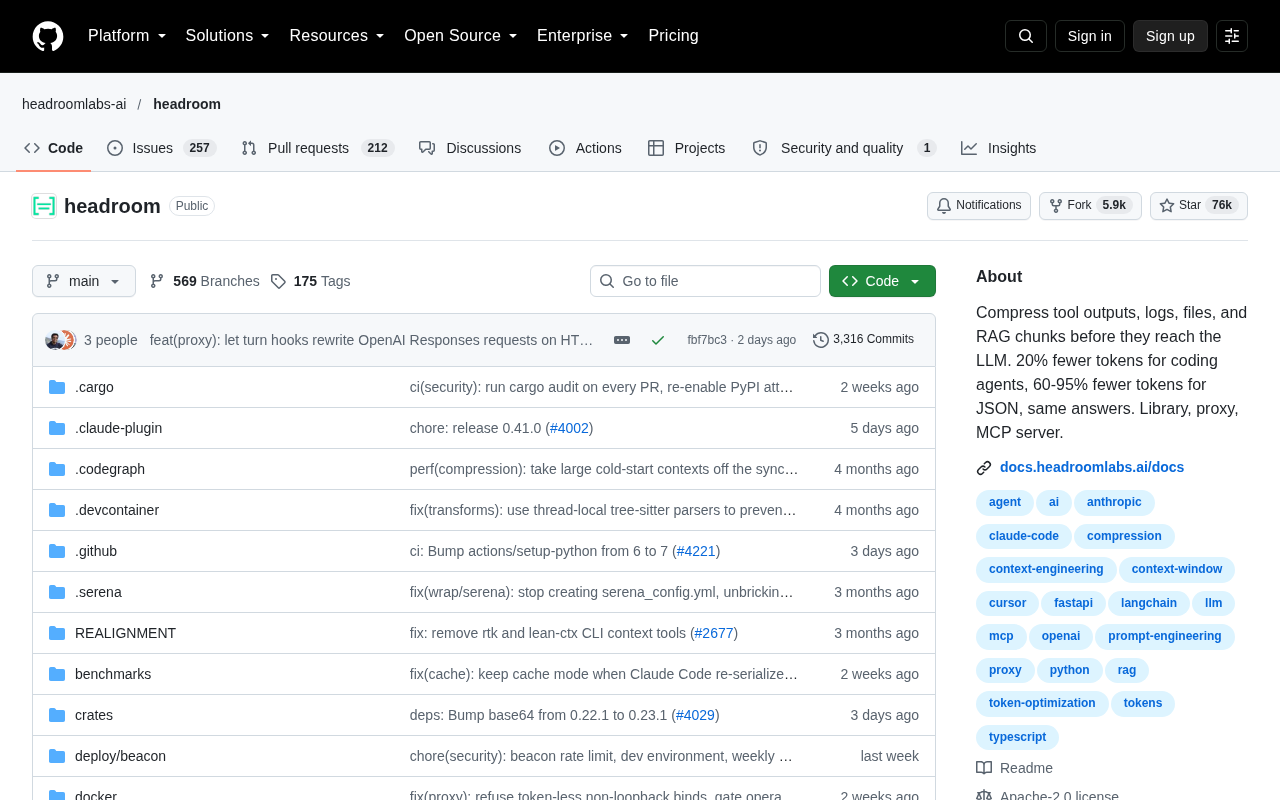
The open-source GitHub project Headroom proposes "pre-compression": semantics-aware compression of tool outputs, logs, files, and RAG chunks before they enter the LLM, drastically reducing token consumption. According to the project description, token counts drop by 20% in coding agent scenarios and JSON data compression reaches 60-95%, all while keeping answer quality unchanged. Implemented in Python, the project offers three integration methods—library, proxy, and MCP server—adapting to different architectures. Headroom has already garnered over 75,000 stars, with 317 new stars today, indicating high popularity. Its core value lies in addressing the urgent need for LLM cost optimization, but detailed benchmarks are lacking, so developers must validate actual results against their own scenarios.
In AI application development, context window consumption often becomes a bottleneck for both cost and performance. An open-source project on GitHub called Headroom offers a new approach: compressing tool outputs, logs, files, and RAG chunks before they enter the LLM, thereby drastically reducing token counts. According to the project description, token counts can be reduced by 20% for coding agents and by as much as 60-95% for JSON data, all while keeping answer quality unchanged. Implemented in Python, the project has already garnered over 75,000 stars, with 317 new stars today—a clear sign of its popularity.
Compression Strategy: Reducing Token Consumption at the Source
The core of Headroom is "pre-compression." The traditional approach feeds raw data directly to the LLM, causing large amounts of irrelevant information to occupy the context. Headroom instead streamlines the input through intelligent algorithms—for example, removing redundant whitespace in JSON, merging duplicate key-value pairs, and compressing repetitive patterns in logs. This compression is not simple truncation; it reduces tokens while preserving semantic integrity. The project offers three usage modes: integrating as a library into your code, acting as a proxy to intercept requests, or running as an MCP server—flexibly adapting to different architectures.
According to the project documentation, the compressed data still produces "the same answers," meaning the information loss is within an acceptable range. For RAG applications that need to process large amounts of structured data, the 60-95% token savings are particularly significant, directly lowering API call costs and improving response speed.
Tokens and Context Windows
A token is the basic unit of text processed by an LLM; typically an English word is split into 1-2 tokens, and a Chinese character takes about 1-2 tokens. The context window is the maximum number of tokens a model can receive in a single call—for example, 128K for GPT-4 and 200K for Claude. The window size directly determines the total amount of tool outputs, logs, and RAG chunks that can be included. When the input approaches the limit, you must either truncate and lose information or split into multiple calls—both of which increase costs or reduce answer quality. Therefore, compressing token counts before data enters the LLM is equivalent to increasing effective capacity without expanding the window. This is the core value of "pre-compression" solutions like Headroom.
Significant Gains in Coding Agent and JSON Scenarios
Coding agents typically need to read tool outputs, file contents, and logs, and this data often contains a large amount of boilerplate text. Headroom is optimized for such scenarios, achieving a 20% token reduction. Although the percentage may seem modest, the cumulative effect is significant in high-frequency calls. JSON, a common format for API interactions, is even more redundant, and Headroom's compression reaches 60-95%, almost overturning traditional data-passing methods.
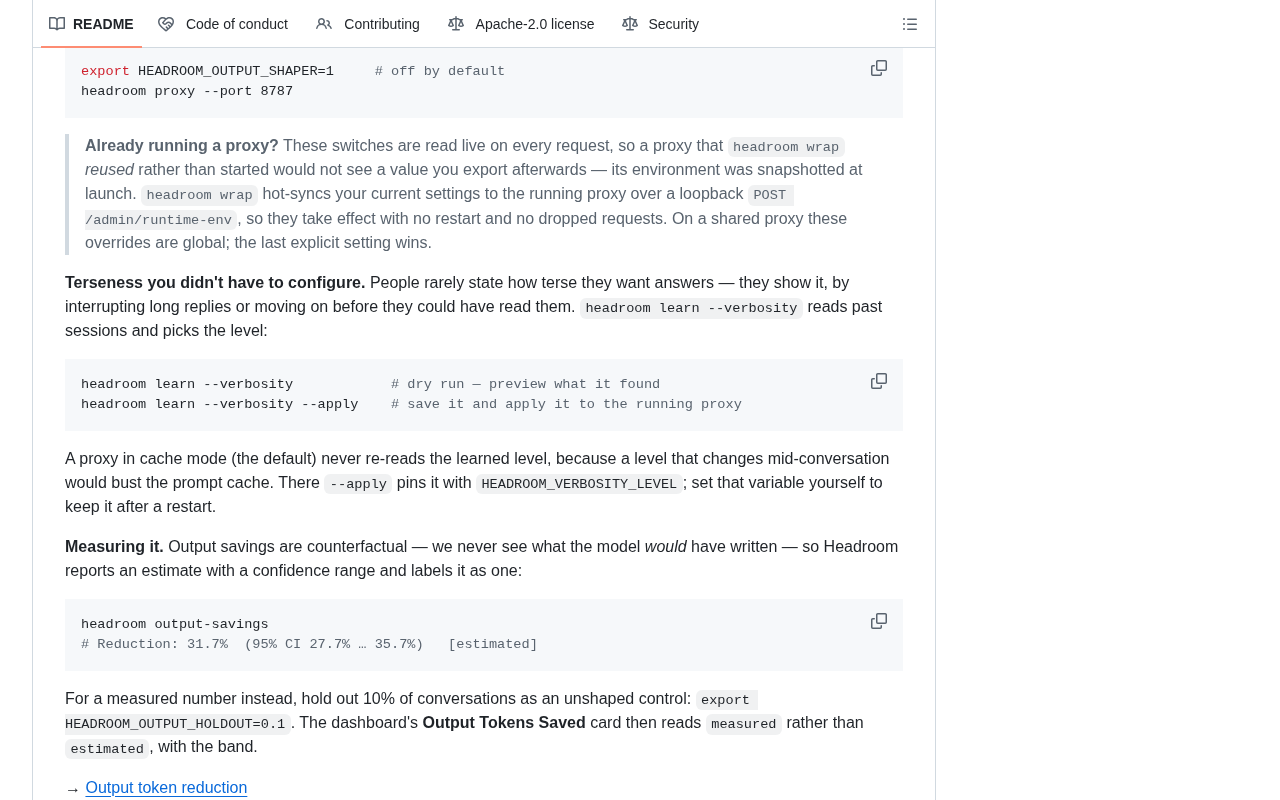
The project author emphasizes that the compression process does not change the correctness of answers. This is thanks to an understanding of data structures rather than brute-force deletion. For example, for JSON, unnecessary whitespace and duplicate metadata can be removed; for logs, similar lines can be aggregated. This "semantics-aware" compression is what sets Headroom apart from general-purpose text compression tools.
Semantics-Aware Compression and the Lossless/Lossy Boundary
General-purpose text compression (such as gzip) works at the byte level and must fully restore the original content upon decompression; LLM input compression only needs to retain the semantic information that affects the generated answer—it is "lossy but task-lossless." Headroom removes whitespace and merges duplicate key-value pairs in JSON, and aggregates similar lines in logs, all by exploiting the predictability of data structures to eliminate redundancy rather than deleting at random. The risk is that certain metadata (such as timestamp order or nesting levels) may be useful for specific reasoning tasks, and although the compressed answers are "the same," this may not cover all scenarios. Therefore, developers should perform A/B validation on their own data to confirm answer consistency before and after compression, and then decide on compression strength.
Three Integration Methods: Library, Proxy, and MCP Server
Headroom offers three flexible integration paths. As a Python library, developers can call compression functions in code to directly process the data to be sent. As a proxy, it can be deployed in front of the LLM API to automatically compress all requests passing through, without modifying application code. As an MCP (Model Context Protocol) server, it can seamlessly connect with AI toolchains that support MCP, for example in environments such as Claude Desktop. This multi-modal integration design lowers the barrier to adoption and suits scenarios ranging from prototyping to production.
The project is written in Python, making it easy for AI developers to get started. With 75,970 stars and 5,911 forks, it shows high community activity, and today's 317 new stars also indicate that the project is on the rise. However, the project has not yet provided detailed performance benchmark data, so actual compression results may vary depending on data characteristics; developers need to validate against their own scenarios.
MCP (Model Context Protocol)
MCP is an open protocol proposed by Anthropic to standardize the way AI applications connect with external tools and data sources. It defines the communication format between clients (such as Claude Desktop) and servers, enabling models to call resources such as file systems, databases, and APIs through a unified interface. When Headroom runs as an MCP server, it can automatically perform compression before tool results are returned to the model, completely transparent to the upper-layer application. This means any AI toolchain that supports MCP can integrate Headroom with zero code, without worrying about the implementation details of the compression logic. The MCP ecosystem is still expanding, and using it as a compression entry point helps Headroom quickly cover diverse agent frameworks and IDE plugins.
Positioning and Outlook in the Open-Source Ecosystem
At a time when LLM application costs are high, Headroom hits the essential need of "token optimization." Unlike mere prompt compression, it focuses on tool outputs and structured data, filling a gap in a niche market. Its open-source nature makes it likely to become part of AI agent infrastructure. In the future, if the project can supplement more real-world benchmark tests and case studies, its credibility will be further enhanced. For AI teams pursuing cost reduction and efficiency gains, Headroom is worth following and trying.
Related articles

Frontend to AI Agent Development: A Frontline Architect Explains Career Paths and Opportunities
A frontline AI architect explains the industry changes and practical paths for frontend developers transitioning to AI Agent development: why pure frontend jobs are disappearing, why Agent + full-stack has become mainstream in hiring, and three transformation routes—Agent development engineer, FDE, and remote contracting—along with corresponding learning strategies.

How to Choose an AI Agent Development Course: Five Pitfall-Avoidance Guidelines
A mechanical-engineering career changer's two-year pitfall-tested checklist for screening AI Agent development courses: complete delivery pipeline, resume-worthy projects, real development perspective, update frequency, and coaching feedback—with concrete judgment methods and pitfall-avoidance tips.

Coze AI Agent Building for Beginners: A Zero-Code AI Agent Development Guide
Coze, ByteDance's one-stop AI application development platform, supports zero-code drag-and-drop AI agent building. This article outlines Coze's core concepts, three advantages, differences between the domestic and international versions, and the distinction between agents and apps, helping beginners quickly get started with AI Agent development.