Hermai Brand API: One Endpoint to Automatically Match Customer Branding for B2B SaaS

Hermai Brand API enables B2B SaaS to auto-match customer branding from just an email or domain.
Hermai Brand API solves the B2B SaaS white-label challenge by automatically returning company logos, brand colors, and ready-to-apply themes from a work email or domain. With 1,000 free brand lookups per month and no credit card required, it lets developers deliver personalized branded experiences from a customer's first login without manual configuration.
The Old White-Label Problem, Solved with One API
In the B2B SaaS world, there's a long-standing pain point: how do you make every enterprise customer see their own brand identity when using your product?
The term "White Label" originated in the music industry—early promotional records without a label would be sent out with plain white stickers. In software, white labeling refers to one company's product being repackaged and used by another company under their own brand. Typical scenarios include: payment gateways letting e-commerce platforms display checkout pages under their own brand; project management tools letting consulting firms deliver Kanban boards to clients with their own logo. The core value of white labeling is making end users perceive brand continuity rather than realizing a third-party vendor is behind the scenes. Implementing white labeling typically involves customization across three dimensions: the UI layer (logo, colors, fonts), the communication layer (email sender, SMS signatures), and the domain layer (custom subdomains).
Traditional white-label solutions often require customers to manually upload logos, set theme colors, and fill in company information—a tedious process that creates a fragmented experience.
Hermai Brand API, which recently launched on Product Hunt, offers a more elegant answer. Its core approach is straightforward—when a customer signs up with their work email or company domain, the API automatically returns that company's logo, brand colors, company description, and a ready-to-apply theme configuration. From the customer's very first login, the SaaS interface already reflects their own brand.
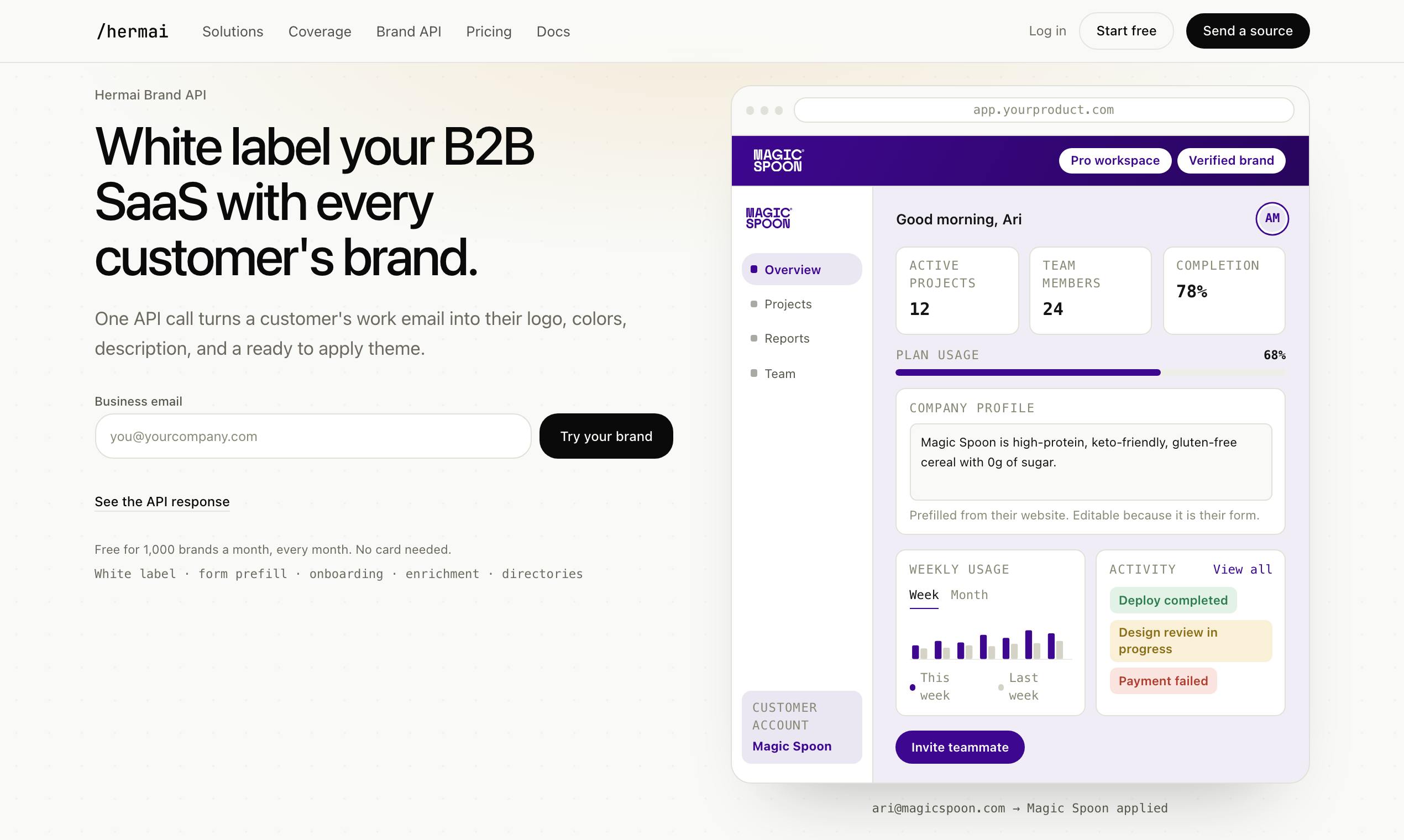
The product received 74 upvotes on Product Hunt, ranking 18th on its launch day, categorized under Design Tools, SaaS, and Developer Tools.
How Hermai Brand API Works
Hermai Brand API's workflow can be summarized as a simple data request and response:
Input: Email or Domain
Developers simply pass the work email (e.g., jane@acme.com) or company domain (acme.com) provided during customer registration to the API. This is the most natural trigger point in B2B scenarios—enterprise customers almost always sign up with their company email.
Output: A Complete Brand Asset Package
The API returns a full set of brand data:
- Logo: The customer company's logo image
- Brand colors: Primary color, secondary colors, etc.
- Company description: A brief company bio
- Ready-to-apply theme: A theme configuration that can be directly applied to the interface
For developers, this eliminates the significant effort of scraping, parsing, and maintaining brand data themselves. Automatically fetching enterprise brand data is no simple technical task—common implementation paths include: parsing the target domain's favicon and Open Graph metadata, scraping company homepages to extract dominant colors, calling social platform APIs for company avatars, and verifying corporate identity through DNS records and WHOIS information. Each method has limitations: favicons are typically too low-resolution for display, dominant color algorithms are easily thrown off by background colors, and many companies use different logo versions across platforms. Maintaining an accurate, real-time global corporate brand database requires continuous investment in crawling infrastructure and manual review mechanisms. Hermai encapsulates all this complexity behind a single API call—in theory, one request is all it takes to personalize a new customer's account interface with white-label branding.
Free Tier: 1,000 Brands Per Month
A notable detail about Hermai's pricing strategy—1,000 free brand lookups per month, with no credit card required.
This quota is quite generous for early-stage startups and small-to-medium SaaS products. 1,000 brands means you can process a substantial number of new enterprise customers each month, more than enough for most B2B products in their early growth phase. The "no credit card" policy dramatically lowers the barrier to try, aligning with the mainstream developer tools trend of "use it first, pay later."
Why This Direction Deserves Attention
White Labeling Is a Must-Have for B2B SaaS
In the enterprise software market, brand consistency is critical to customer experience. When a company purchases SaaS tools for its employees, they often want those tools to look like "their own system" rather than a third-party product. This isn't just about visual aesthetics—it also affects employee trust and usage habits.
Modern B2B SaaS overwhelmingly adopts multi-tenant architecture—multiple customers share the same application instance and infrastructure while keeping data isolated from each other. Implementing white-label customization in this architecture requires introducing a tenant-level configuration layer within the shared codebase: each tenant has its own theme, logo, and brand assets, with the system dynamically loading the corresponding configuration based on the currently logged-in tenant at render time. The challenge lies in supporting high personalization without increasing code complexity. Traditionally, implementing this customization requires significant engineering investment—including building configuration management interfaces, storing and CDN-distributing brand assets, and implementing theme-switching logic. Hermai abstracts the brand configuration retrieval step into a single external API call, turning it into a plug-and-play capability.
The Value of Automated Brand Data Retrieval
Hermai's true core value lies in automated brand data retrieval. Previously, developers either had customers configure things manually or maintained their own brand database while handling various scraping and cleaning logic. Hermai abstracts this into a standardized API, essentially offering "Brand Data as a Service."
This follows the same line of thinking as companies like Clearbit and People Data Labs doing enterprise data enrichment. Data enrichment refers to automatically supplementing and enriching existing customer records through third-party data sources. Representative companies in this space include Clearbit (now acquired by HubSpot), ZoomInfo, People Data Labs, and Apollo.io. A typical use case: when a user signs up with a work email, the CRM automatically populates that user's job title, company size, industry, and funding stage. Clearbit was valued at over $2 billion at its peak, thoroughly validating the market value of such data services. Hermai's unique positioning is its focus on the "visual brand" vertical—starting from an email/domain, it returns not company size or revenue data, but logos, color palettes, and visual themes, serving the product experience layer rather than the sales intelligence layer.
Enhancing the First Login Experience
The product copy specifically emphasizes "from the first login." In SaaS user activation funnels, the first login experience directly impacts retention rates.
User activation refers to the moment when a newly registered user first experiences the product's core value, typically occurring within the first few minutes to first few days after signup. Industry data shows that most SaaS products lose 40%-60% of new users within 24 hours of registration. Key factors affecting activation rate include: onboarding smoothness, speed of first value delivery (Time to Value), and user trust in the product. In B2B scenarios, seeing your own company brand appear in the product interface creates a powerful psychological suggestion of "this was customized for me"—this relates to the behavioral psychology concept of the "endowment effect," where users invest more willingness to use something that already appears to belong to them. If customers see familiar brand imagery the moment they log in, this sense of ownership can significantly boost perceived product professionalism and conversion rates.
Potential Considerations and Challenges
Despite the excellent concept, brand recognition services like Hermai face some real-world issues that developers should evaluate before integration:
Data accuracy: Automatically identified logos and colors may not always be correct, especially for companies with non-standard brand assets or lesser-known enterprises. An incorrect logo can actually harm customer experience. Brand data sources typically rely on web crawlers and public APIs, but many companies have varied website structures, and logo placement, format (SVG, PNG, inline Base64), and naming conventions lack unified standards—making 100% reliable automatic extraction difficult to guarantee.
Data sourcing and compliance: Where does the brand data come from? How is timeliness ensured? Are there copyright or privacy concerns? These are questions to confirm before adoption. Company logos are typically protected by trademark law, and whether obtaining and caching these assets at the technical level requires authorization may be interpreted differently across jurisdictions.
Coverage limitations: Results may be excellent for well-known large enterprises, but whether the API can return valid data for long-tail SMBs and startups remains uncertain. This is a common challenge for all data enrichment services—data for top companies is abundant, while long-tail coverage determines the product's actual usability in real-world scenarios.
Conclusion
Hermai Brand API addresses the real pain point of white-label customization in B2B SaaS, standardizing the complex brand data retrieval process with a clean API. Its generous free tier and zero credit card barrier make it a tool worth trying for developers.
For teams building multi-tenant SaaS products who want to enhance customer brand experience, this kind of "Brand Data as a Service" solution could save considerable in-house development costs. However, before deep integration, it's advisable to test recognition accuracy with real customer data before deciding whether to embed it into your product workflow.
Related articles

Bilibili's Hit Dify Tutorial: A Practical Guide to Building 20+ AI Apps from Scratch
A distilled guide to Bilibili's top-rated Dify tutorial: Windows + Docker deployment, MySQL connection, five app types, model integration strategy, and publishing.

Agent Skills Beginner's Guide: From Concepts to Multi-Agent Collaboration in Practice
A comprehensive guide to Agent Skills: core concepts, components, the importance of Description, standardization, beginner learning paths, and multi-agent collaboration.

One Neuron Detects Both Cats and Cars? We Reproduced It and Found a New Explanation
The cat-car neuron reinterpreted: researcher Cammarata argues it distinguishes pointy from round, not cats from cars. We reproduced the experiment and found the new explanation holds on most inputs—but cars are the exception. The interpretability debate continues on language models.