Hermes Agent Hands-On: The Evolving AI Infrastructure That Leaves Single-Turn Chatbots Behind

Hermes Agent upgrades AI from single-turn chatbot to a continuously evolving Agent with persistent memory and multi-agent collaboration.
Hermes Agent is an open-source Agent framework with over 80,000 GitHub stars. Its core innovation is the EVIL MAP three-layer memory system (episodic, procedural, search) that replaces the "forget everything" model of traditional chatbots, using an infinite loop to accumulate skills and self-evolve. It supports deployment on Windows WSL, cloud servers, and even idle Android phones via Termux. Vector semantic search replaces keyword matching so the Agent remembers user preferences over time. With 79 built-in skills and 4,500+ community extensions, plus Profiles sandboxes for physically isolated multi-agent collaboration, it functions more like a sustainable AI productivity infrastructure — though free model stability and community skill quality warrant real-world testing.
Most people still interact with AI in a "send a message, get a reply, repeat" loop — essentially a conversation with severe amnesia. The moment a task ends, the AI forgets everything and walks away. According to a hands-on demo shared by a Bilibili tech creator, Hermes Agent (which has surpassed 80,000 stars on GitHub) offers a fundamentally different path: it upgrades AI from a disposable conversation tool into a continuously evolving "digital entity" capable of memory and collaboration.
This article distills that creator's walkthrough, covering Hermes Agent's core architecture, deployment options, and real-world capabilities — so you can decide whether it's worth migrating away from traditional chatbots.
From "Single-Use Tool" to "Infinite Loop": A Paradigm Shift
Traditional bots follow a simple pattern: you input, it outputs, conversation ends. Each session is isolated. Hermes Agent works differently — it runs an infinite loop. After completing a task, it automatically extracts the skills it used, writes them into its memory network, and continuously evolves from the experience.
Underpinning this loop is a three-layer memory system called the EVIL MAP, which includes episodic memory, procedural memory, and search memory, along with a built-in active learning mechanism. This foundational architecture is what's driving its popularity in the open-source community.
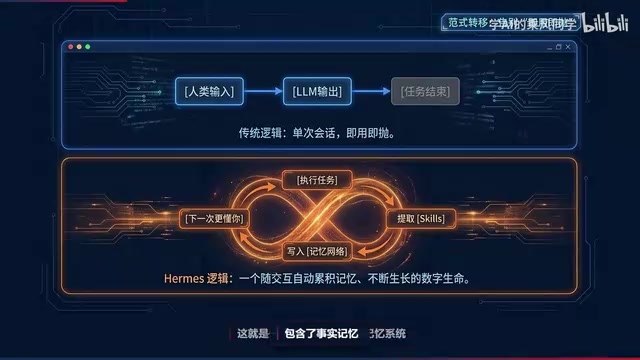
Architecturally, it breaks from the traditional conversational framework at the base layer, works upward through installation and communication ecosystems, covers full cross-platform support for cloud, PC, and mobile, and culminates in a memory flywheel and multi-agent evolution mechanism at the top. This is a relatively complete AI infrastructure system — not a single-feature module.
Cross-Platform Rapid Deployment: From PC to That Old Phone in Your Drawer
Hermes Agent emphasizes a cross-platform ecosystem, with multiple official deployment paths. Windows users can connect seamlessly via the built-in Linux subsystem (WSL) — no dual-boot headaches required. For cloud deployment, there's a Tencent Cloud LighthouseAd server template ready to apply directly.
The most interesting option is mobile deployment — you can turn that dusty old Android phone in your drawer into a portable "pocket server." No Root access required; just install the open-source terminal tool Termux and keep it running in the background, squeezing computing power out of idle hardware.
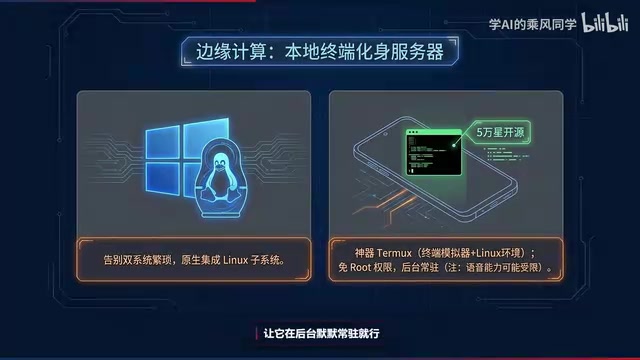
The installation process was described by the creator as a "geek shortcut" — essentially just two steps: paste the official installation command and hit Enter, and Python, Node.js, FFmpeg, and other environment dependencies are configured automatically; then run a source command to activate the global system. For anyone who has suffered through broken environment setups, this level of automation genuinely lowers the barrier to entry.
Termux is an open-source terminal emulator and Linux environment for Android that runs a full command-line toolchain — including Python, Node.js, Git, and other common development dependencies — without requiring Root access. It achieves this by simulating a Linux filesystem in user space, bypassing Android's restrictions on low-level permissions. Using Termux as a lightweight server has been popular in geek communities for years, with common use cases including self-hosted Git services, web scraping scripts, and lightweight web hosting. For Hermes Agent, using an old phone as a "pocket server" requires maintaining a stable background process and network connection. Android's background process management (which varies in aggressiveness across manufacturers) may cause service interruptions — pay close attention to battery optimization settings in practice.
Injecting an LLM Brain and Frontend Management
Once deployed, you'll need to choose a large model to serve as the Agent's "brain." The creator suggests two directions: users with an international credit card can test the Memo V2 model on Nous Portal; budget-conscious makers are recommended to configure NVIDIA's Nemotron series models via the OpenRouter gateway — free to use with decent out-of-the-box performance.
After connecting a model, you can authorize the Agent to integrate with Lark (Feishu) or WeCom, turning it into an always-on assistant. On the management side, the pure terminal interface is replaced by a modern Web UI visual console that lets you manage tasks and status through an intuitive dashboard.
One caveat: your model choice directly determines the Agent's actual capability ceiling. The stability of free models on complex tasks still needs real-world testing, and the creator's recommendations are more suited to the "getting started" stage.
Memory and Skill Library: The Real Moat
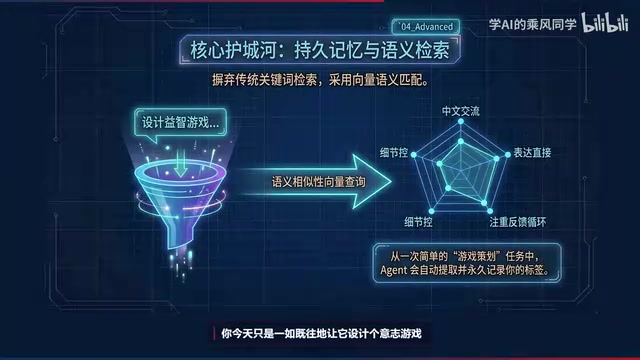
Traditional bots rely on rigid keyword matching for retrieval, while Hermes Agent uses vector search. The difference: when you ask it to design a game, it acts like an attentive collaborator — extracting your preferences and phrasing patterns from your instructions, tagging them with a personality profile, and storing them permanently. The next time you hand it a task, it directly targets your habits. This is what "the more you use it, the better it knows you" actually means.
On the skills front, the system ships with 79 native skills, and there are over 4,521 community skills available, covering scenarios like coding, OCR recognition, and audio processing. For example, if you drop an article link in WeChat, it can automatically scrape the content, summarize it, and generate a Markdown-formatted knowledge node graph in your local Obsidian vault — enabling automated knowledge base management.
These numbers (79, 4,521, 80k+ stars) all come from a single-source demonstration. Verify actual availability and quality against the official repository.
Vector Search is a semantic search technology that differs fundamentally from traditional keyword matching. It first converts text into high-dimensional numerical vectors using an embedding model, then calculates cosine similarity between vectors to determine semantic closeness. This means content with different wording but similar meaning can still be matched — for example, "help me code a snake game" and "make a classic arcade mini-game" have no overlap in keyword matching, but are close neighbors in vector space. Hermes Agent stores user preferences, style tags, and task history as vectors in its memory database, and retrieves not by exact string matching but by finding the "nearest semantic neighbors" — the technical foundation of its "gets smarter the more you use it" capability.
Multi-Agent Collaboration: Physically Isolated "Expert Teams"
Hermes Agent's advanced mode is multi-agent collaboration. The creator demonstrated a natural-language-driven video rendering workflow: you describe your requirements in plain language, and the AI pipeline automatically handles storyboard planning, formula code generation, visual rendering, asset assembly, and final review — no handwritten code required. The user's role is simply to give orders.
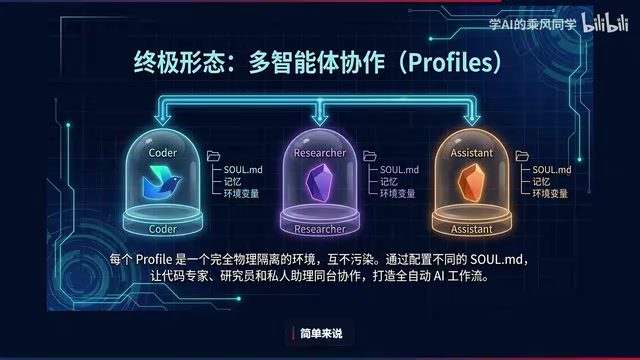
What prevents multiple Agents running simultaneously from interfering with each other? That's handled by Profiles collaboration sandboxes — physically isolated runtime environments that assign each Agent its own independent memory and environment variables via separate configuration files. A code expert, a researcher, and a personal assistant each operate in their own "clean room," with no memory cross-contamination. This isolation mechanism is a key design feature of the multi-agent architecture.
Migration and Exit: Zero-Cost Experimentation
For users worried about getting stuck, Hermes Agent offers a low-risk trial. Users migrating from an older framework can transfer their data with three commands; if you decide to quit, you can choose to keep your API keys while only removing the framework, or wipe everything with a single command — complete freedom to come and go.
This design lowers the psychological barrier to trying it out, and is a key part of how open-source tools attract users away from alternatives.
Final Thoughts
The creator's closing line is memorable: "Those who master single-turn Q&A are operators. Those who truly master Agent collaboration systems will become the full-stack architects of the digital world." Marketing rhetoric aside, Hermes Agent's value lies in integrating memory systems, cross-platform deployment, skill libraries, and multi-agent collaboration into a relatively complete Agent infrastructure.
For everyday users, it's considerably closer to a "sustainable productivity tool" than a traditional chatbot. But for its actual capabilities, testing it against your own use cases is still recommended — especially regarding free model performance and community skill reliability. This type of content largely comes from single-source demonstrations, and real-world results will vary.
Background: Key Concepts Explained
EVIL MAP is Hermes Agent's custom name for its three-layer memory system, with each layer corresponding to a different type of knowledge: Episodic Memory stores personalized information like user preferences and interaction history; Procedural Memory saves learned skill steps and execution logic; and Search Memory caches external retrieval results for reuse. This layered design draws from the classic cognitive science taxonomy of human memory — humans similarly distinguish between "knowing facts" (declarative memory) and "knowing how to do things" (procedural memory). By storing and retrieving these three memory types separately, the Agent can precisely access relevant context for different task scenarios rather than starting from scratch each time, gradually building a deeper understanding of the user over extended use.
Memory contamination in multi-agent systems (Multi-Agent Systems) is a common engineering challenge: if multiple Agents share the same memory space, incorrect information written by one Agent, or context specific to one task, can influence the judgment of other Agents — leading to behavioral drift or even cascading errors. Hermes Agent's Profiles sandbox addresses this by assigning each Agent its own independent environment variable file and memory storage directory — essentially filesystem isolation at the operating system level. This mirrors the design philosophy of containerization technologies like Docker: letting each process "see" only the filesystem view that belongs to it. For users who need to simultaneously run heterogeneous tasks like code generation, research, and schedule management, this isolation mechanism effectively prevents "memory crosstalk" between Agents with different roles.
Related articles

Free Unlimited Claude Code Solution: Agnes AI + CC Switch Setup Guide
No paid subscription needed — pair the free AI platform Agnes AI with the open-source tool CC Switch to provide a backend for Claude Code, enabling unlimited free calls to text, image, and video models. This guide covers the full setup, test results, and usage boundaries.

A Complete Zero-Cost Guide to Getting Started with Claude Code for Beginners in China
A beginner's guide to Claude Code for users in China: two installation methods (command line and IDE plugin), full configuration steps for replacing the official API with the free domestic LongCat model, and a hands-on demo of building a small tool with natural language, plus tips.

When the NSA Gets Involved: The AI Supply Chain Crisis Behind Open-Source CVEs and API Key Hijacking
Multiple open-source projects disclosed severe CVEs in one day, PHP flaws alarmed the FBI, and Railway and OpenCode were breached with API keys stolen. This article breaks down the vulnerability window, AI-accelerated exploitation, and the AI supply chain crisis behind the API key black market, with a developer defense checklist.