Hermes Agent Practical Tutorial: An AI Framework That Saves More Tokens Than Open Cloud

Hermes Agent is an AI Agent framework with lower token consumption, compatibility with 200+ models, and automatic Skill encapsulation.
Hermes Agent is an AI Agent framework positioned similarly to Open Cloud, supporting conversational task execution, coding, browser operation, and local file management. Its five core advantages include significantly lower token consumption than Open Cloud thanks to more refined context management, support for over 200 model providers to avoid vendor lock-in, automatic encapsulation of repetitive processes into Skills for direct invocation, built-in Claude Code-like plugin capabilities for excellent coding experience, and integration with Telegram, Discord, WeChat, DingTalk, and Feishu for remote control. It supports both Windows local and Docker deployment, and is better suited for users who use an Agent daily and long-term rather than light occasional queries.
Hermes Agent Practical Tutorial: An AI Framework That Saves More Tokens Than Open Cloud
AI Agent frameworks keep emerging, but few manage to excel simultaneously in token consumption, model compatibility, and degree of automation. Hermes Agent is a framework that has been frequently discussed in tech communities recently. Bilibili creator Bao Ge broke it down in detail during a public class. This article, based on that course content and combined with the framework's own characteristics, helps you quickly understand what Hermes Agent can do and who it's suited for.
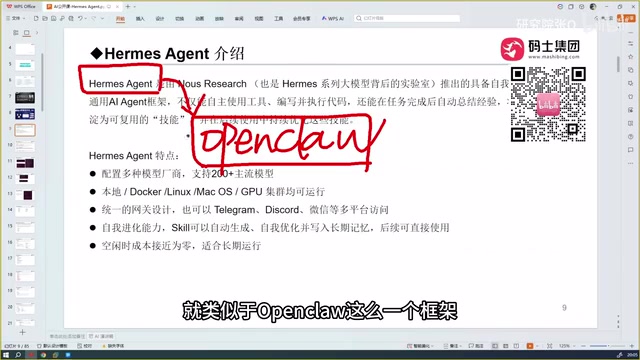
What Is Hermes Agent? How Does It Relate to Open Cloud?
Hermes Agent is essentially an AI Agent framework with a positioning similar to Open Cloud (also called "Xiao Long Xia" in the community). If you've used Open Cloud, you should be familiar with its core capabilities: conversation-driven AI that performs web searches, sends emails, summarizes materials, writes code, operates browsers, and manages the local file system. Hermes Agent has these same capabilities, and since it emerged after Open Cloud, it has absorbed quite a few lessons.
The operating logic of both is identical—you issue instructions through conversation, and the Agent calls the toolchain to execute tasks. But Hermes Agent has made differentiated improvements in several key dimensions. In the course, Bilibili creator Bao Ge mentioned that after personally comparing both with the same model, he felt Hermes Agent's answers were more precise while token consumption was noticeably lower.
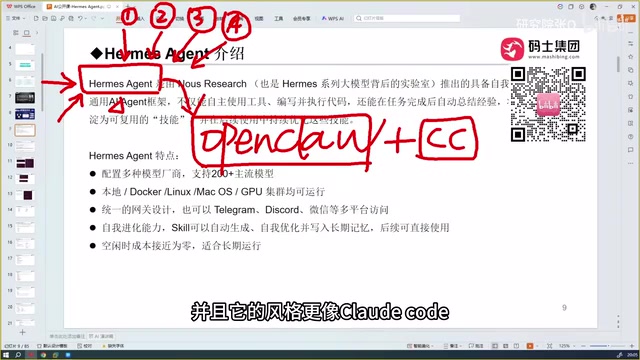
Five Core Advantages of Hermes Agent
Significantly Lower Token Consumption
According to the creator's actual testing, Hermes Agent's token consumption is significantly lower than Open Cloud, with a quite noticeable gap. This is thanks to its more refined management and loading mechanism for context (conversation history)—it doesn't repeatedly stuff large amounts of redundant information into every request. For scenarios requiring long-running Agents, token cost is an unavoidable hard metric.
What is a Token? A token is the smallest unit of text processed by an AI model. Roughly, one Chinese character equals about 1-2 tokens, and one English word equals about 1-3 tokens. Each round an Agent executes a task, it needs to send the system prompt, conversation history, and tool return results together to the model, which then generates the next action; this total input and output directly determines API costs. Context management refers to how the framework selectively brings historical information into each request: early Agent frameworks often concatenated all conversations losslessly, and as rounds piled up, input tokens would grow quadratically. Hermes Agent uses strategies like summary compression and on-demand retrieval to retain only fragments relevant to the current task, so single-round costs tend to stabilize during long-term operation—this is the technical root cause of its significantly lower token consumption compared to Open Cloud.
Broader Model Compatibility
Hermes Agent supports integration with over 200 model providers. This means whether you're using mainstream commercial APIs or locally deployed open-source models, you can most likely connect directly without being locked into a single vendor.
Automatic Skill Encapsulation, Reducing Repetitive Descriptions
This is a very practical feature of Hermes Agent: during conversation, it automatically encapsulates something you repeatedly do into a Skill, which can then be directly invoked in subsequent conversations. In contrast, Open Cloud requires you to re-describe the same process every time. For users with fixed daily workflows, this mechanism can save substantial communication costs.
Skill in the Agent context refers to a structured, reusable capability unit, typically containing a fixed instruction template, the required tool call sequence, and necessary parameter slots. Unlike ordinary conversation history, once a Skill is generated, it effectively solidifies the process of "telling the Agent how to do it" into a module that can be repeatedly invoked. In subsequent conversations, the Agent only needs to recognize the trigger intent and fill in parameters to execute it. Hermes Agent's automatic encapsulation mechanism essentially precipitates stable workflows exposed during multi-turn conversations, reducing both the input tokens from re-describing each time and the probability of execution failures caused by model comprehension deviations. This is also the most important difference from most frameworks that rely on manually written prompt templates.
Both Conversational and Coding Capabilities
Hermes Agent has built-in plugin capabilities similar to Claude Code, so it can not only perform conversational task execution like Open Cloud, but also offers an excellent coding experience. The creator described it as a combination of "Open Cloud plus Claude Code"—however, Hermes Agent itself has no graphical interface and mainly interacts through command line or client, but it still runs smoothly and also supports configuring external UIs.
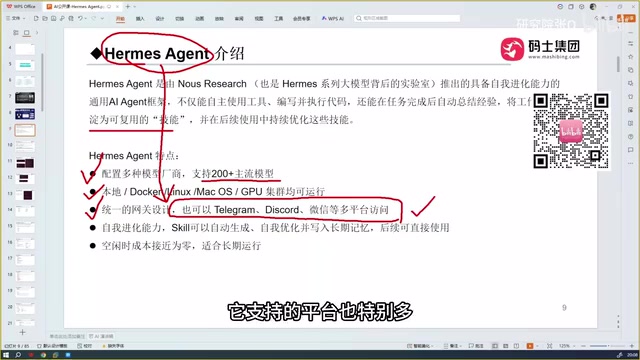
Multi-Platform Message Gateway Integration
Hermes Agent can connect to various messaging platforms, enabling "remote control of the local Agent from within a chat app." Supported platforms cover mainstream domestic and international options: internationally, Telegram, Discord, and Slack; domestically, WeChat, WeCom, DingTalk, Feishu, and more. The configuration process is simpler than Open Cloud's, reducing cumbersome steps.
A message gateway is a forwarding layer between external chat platforms and the local Agent: messages from each platform are pushed to the gateway via Webhook or long connection, the gateway uniformly converts them into an input format the Agent can understand, and then returns execution results along the original path. It solves the problem of "different platform protocols"—Telegram uses the Bot API, while the WeChat ecosystem involves different access methods such as WeCom apps, official accounts, and personal accounts. If you had to rewrite the Agent logic for every platform you connect to, maintenance costs would be extremely high. Hermes Agent consolidates the adaptation layer within the gateway, so users only need to configure platform credentials to enable it. This is also why the article says its "configuration process is simpler than Open Cloud's." Note that connecting to domestic platforms usually requires a publicly accessible callback address, and purely local deployment may require tunneling tools.
Deployment and Usage Threshold
Hermes Agent's deployment flexibility is another plus. It supports running locally on Windows and can also be deployed via Docker to Linux or other server environments. For users who want to get started quickly, local Windows deployment is the lowest-threshold path; users with server resources can use Docker for long-term operation.
It's worth noting that the creator emphasized in the course that Hermes Agent is better suited for a "long-term operation" usage pattern. If your need is only occasional one-off conversational queries, its advantages like automatic Skill encapsulation may not manifest; but if you're a user who needs to use the Agent to handle fixed tasks every day, these features will gradually generate obvious returns.
Docker is a containerization technology that packages an application and its dependencies into an independent image, which can run the same way on any system supporting Docker, thereby avoiding "it works on my machine" environment issues. For Agent frameworks, the greatest value of Docker deployment lies in the stability of long-term operation: it can work with restart policies to automatically bring the service back up after crashes, conveniently mount configuration volumes to persist Skills and conversation data, and facilitate migration to cloud servers. The Windows local installation path wins in being more intuitive for changing configs and viewing logs, suitable for getting it running first before considering long-term use; while for users preparing to have it on standby 24/7, ready to respond to WeChat or Telegram commands at any time, Docker plus a low-spec cloud host is a more worry-free combination.
Who Is It For
Combining the course content and the framework's characteristics, Hermes Agent's core audience roughly falls into three categories:
- AI application developers: Those who need to integrate Agent capabilities into their own products without wanting to be locked into a single model vendor.
- Heavy users of productivity tools: Those who daily remote-control their computers via chat platforms to complete tasks and are sensitive to token costs.
- Teams with fixed workflows: Those with many repetitive tasks, where automatic Skill encapsulation can genuinely reduce communication and description costs.
If you're already using Open Cloud, Hermes Agent is worth testing as an alternative, especially for comparison in the two dimensions of token consumption and model selection flexibility. The creator also mentioned that tool-type frameworks are "essentially quite similar," and the key is which one better fits your actual usage scenario.
Frequently Asked Questions
Does Hermes Agent require payment? The framework itself, as a tool, mainly incurs costs from the model APIs you call. Lower token consumption means spending less money for the same tasks.
Can I use it without programming basics? Yes. Conversational interaction is the primary usage method, but deployment may require some command-line basics, or you can follow community tutorials.
Which is better compared to Open Cloud? There's no absolute answer. Hermes Agent has advantages in token efficiency, model compatibility, and Skill automation; Open Cloud has a graphical interface and may be more intuitive to get started with. It's recommended to test based on your own needs.
Related articles

Uber Deploys ChatGPT Work Company-Wide: AI in the Workplace Enters the Scaled Implementation Phase
Uber deploys ChatGPT Work to 30,000+ employees, extending it from engineering to all roles. We analyze its expert-engineer pairing, end-to-end automation, and questions of AI control and power concentration—insights for scaling AI in the workplace.

Shift at Midnight Hands-On: When "ID Verification" Becomes Alien Hunting
Shift at Midnight blends ID verification with horror survival in a four-player co-op game. We break down its inspection mechanics and chaotic humor.

Zelensky Recounts the Outbreak of War: I Need Ammunition, Not a Ride
Zelensky recalls the first day of war in a YouTube interview: farewell to family, rejecting Biden's evacuation offer with "I need ammunition, not a ride," and how Bucha shaped his stance on compromise and peace talks.