Hierarchy-GBP: Accelerating Factor Graph Inference with Hierarchical Abstraction

H-GBP uses hierarchical coarse-graph abstraction to break GBP's global error propagation bottleneck, with proven convergence.
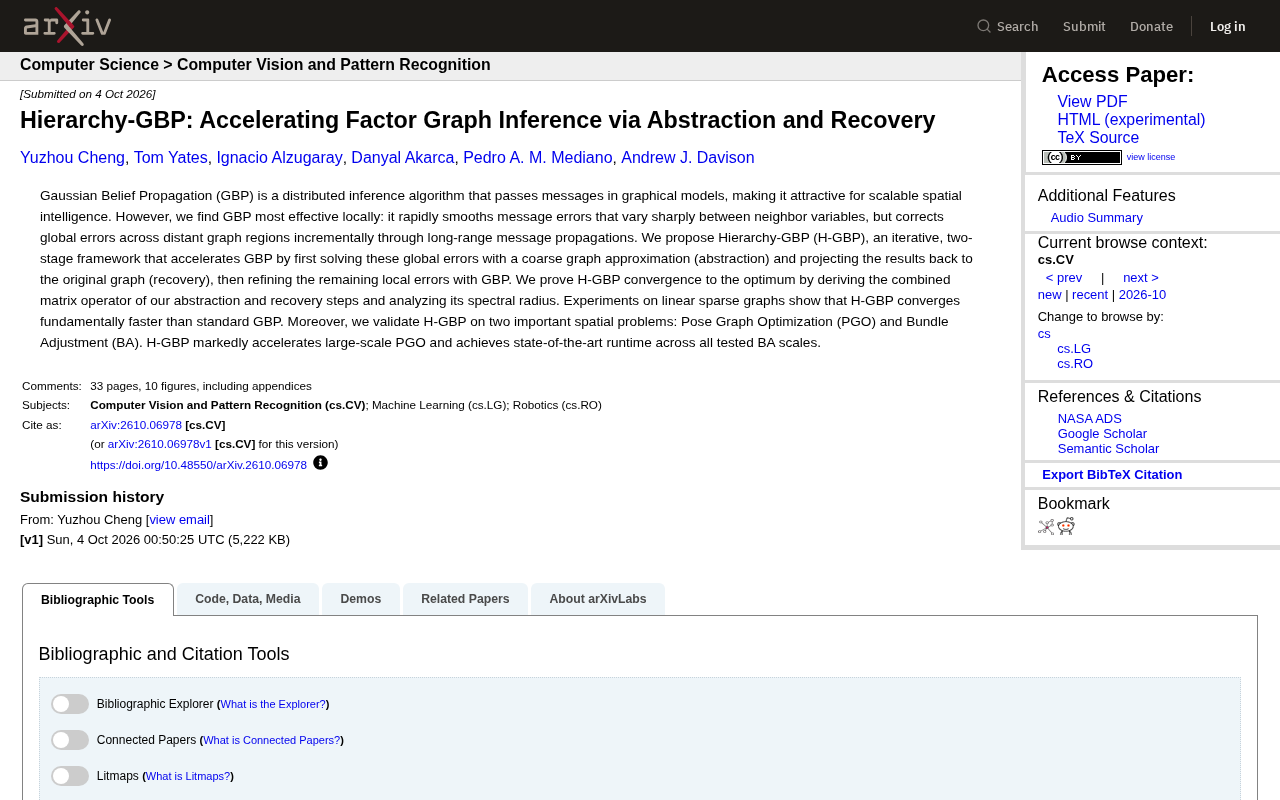
Gaussian Belief Propagation (GBP) holds promise for large-scale spatial inference due to its distributed parallelism, but suffers from a fundamental flaw: it quickly eliminates local errors yet corrects global errors only through slow, node-by-node long-range propagation. The proposed Hierarchy-GBP (H-GBP) addresses this with a two-phase abstraction-and-recovery framework — first efficiently resolving global errors on a compressed coarse graph, then projecting back to the original graph for GBP-based local refinement. The authors rigorously prove convergence by analyzing the spectral radius of the combined operator. Experiments on sparse graphs, Pose Graph Optimization, and Bundle Adjustment confirm its effectiveness, with BA achieving state-of-the-art runtime at all tested scales.
The Local Strengths and Global Bottleneck of Gaussian Belief Propagation
Gaussian Belief Propagation (GBP) is a distributed inference algorithm that passes messages through graphical models. Its naturally distributed architecture makes GBP an attractive choice for scalable spatial intelligence — it propagates information in parallel across graph nodes, making it well-suited for large-scale parallel hardware acceleration.
However, a new arXiv paper identifies a critical performance characteristic of GBP: it performs best locally. Specifically, GBP can rapidly smooth out large message errors between neighboring variables, but global errors spanning distant regions of the graph can only be corrected incrementally through long-range message propagation. As graph scale grows and errors must traverse many nodes, GBP's convergence speed slows considerably.
This observation points to a fundamental issue: a single-scale message-passing mechanism struggles to efficiently handle both local high-frequency errors and global low-frequency errors simultaneously. This is precisely the motivation behind the authors' hierarchical approach.
The mathematical foundation of GBP is the message-passing mechanism on factor graphs. In a factor graph, variable nodes and factor nodes alternate, with messages passing back and forth between them — each node only needs to communicate with its neighbors to perform inference. When all variables follow Gaussian distributions, messages are themselves Gaussian and can be compactly represented by means and covariances (or information matrices), keeping computational overhead manageable. GBP's theoretical roots trace back to Pearl's belief propagation algorithm, and its behavior in sparse linear systems is equivalent to Gauss-Seidel iteration or conjugate gradient methods — which is the theoretical basis for analyzing convergence via spectral radius. In robotics and vision, factor graph variables are typically spatial quantities like poses and map points, while factors encode sensor observation constraints. The graph's sparse structure naturally reflects the local sensing range of sensors, which is why GBP is favored for these problems.
The Two-Phase Framework of Hierarchy-GBP
The paper proposes Hierarchy-GBP (H-GBP), an iterative two-phase framework built around the core idea of abstraction and recovery.
Abstraction: Resolve Global Errors on a Coarse Graph First
In the first phase, rather than tackling global errors head-on in the original graph, H-GBP constructs a coarse-grained graph approximation. On this compressed graph, errors that would normally require propagation across many nodes become short-range problems that can be resolved quickly — sidestepping the inefficiency of standard GBP for long-range propagation.
Recovery: Project the Solution Back to the Original Graph
Once the global solution is obtained on the coarse graph, the second phase projects the result back onto the original fine-grained graph. This step transfers information from the abstract layer back to the original layer. The system then applies standard GBP to refine the remaining local errors — which is precisely where GBP excels at rapid correction.
This division of labor — coarse graph for global errors, GBP for local errors — lets each mechanism do what it does best, dramatically improving overall convergence efficiency.
Theoretical Convergence Guarantees
Unlike many acceleration techniques that rely solely on empirical validation, H-GBP provides rigorous convergence proofs. The authors derive the combined matrix operator for the abstraction and recovery steps and analyze its spectral radius to prove that H-GBP converges to the optimal solution.
Spectral radius is the classical tool for determining whether an iterative algorithm converges — when the combined operator's spectral radius is less than 1, the iterative process stably converges to a fixed point. This theoretical analysis not only guarantees algorithmic correctness but also provides a mathematical explanation for why H-GBP achieves faster convergence. For an inference framework targeting real-world engineering applications, such a theoretical foundation is especially valuable.
The spectral radius ρ(A) of a matrix is the maximum absolute value among all its eigenvalues. For linear iterations of the form x_{k+1} = A x_k + b, convergence to a unique fixed point occurs if and only if ρ(A) < 1. In standard GBP, the iterative operator's spectral radius is closely tied to the graph's connectivity and the problem's condition number: larger graph diameter and higher condition number push the spectral radius closer to 1, slowing convergence. H-GBP combines abstraction and recovery into a single equivalent operator, reshaping its eigenvalue distribution — the coarse-graph solve eliminates components in the low-frequency modes (directions of large eigenvalues), significantly reducing the combined operator's spectral radius compared to the original GBP operator, and thus theoretically guaranteeing faster convergence. This analytical framework closely parallels the smoothing analysis used in multigrid methods.
Experimental Validation: From Sparse Graphs to Large-Scale Spatial Problems
The paper validates H-GBP's effectiveness at multiple levels.
In fundamental experiments on linear sparse graphs, H-GBP converges substantially faster than standard GBP, confirming the hierarchical design's advantage in handling global errors.
More compelling are the results on two important spatial problems:
- Pose Graph Optimization (PGO): A core problem in SLAM and robot localization. H-GBP significantly accelerates large-scale PGO solving.
- Bundle Adjustment (BA): A key component in 3D reconstruction and visual geometry. H-GBP achieves state-of-the-art runtime across all tested scales.
Both applications are typical large-scale factor graph inference scenarios. The larger the graph, the more pronounced the global error propagation bottleneck — and the greater H-GBP's speedup advantage.
Pose Graph Optimization (PGO) and Bundle Adjustment (BA) are the most representative large-scale nonlinear least-squares problems in robotics and computer vision. PGO variables are six-degree-of-freedom robot poses at different timestamps, with constraints from odometry or loop closures; the graph typically approximates a chain structure with sparse loop-closing edges, resulting in long global error propagation paths. BA jointly optimizes 3D map points and camera poses at larger variable scales, but the bipartite factor graph structure gives the information matrix a special arrow-head sparsity pattern amenable to efficient factorization. Traditional approaches rely on sparse Cholesky decomposition and the Schur complement trick to accelerate each respectively. The advantage of GBP-based methods lies in their natural distributed parallelism — no centralized matrix decomposition required — making them better suited for future large-scale parallel hardware or decentralized robotic systems.
Significance and Outlook
The value of H-GBP lies in bringing multigrid-style hierarchical thinking into the belief propagation framework while preserving GBP's distributed, parallelizable nature. For fields like robotics, SLAM, and 3D vision that require real-time inference over large-scale graphs, this translates to substantial speed gains without sacrificing accuracy.
From a methodological standpoint, this work also suggests a more general principle: when single-scale iterative algorithms hit bottlenecks in global information propagation, introducing hierarchical abstraction with provable convergence is often a promising direction worth exploring. As spatial intelligence's demand for large-scale real-time inference continues to grow, methods that combine theoretical guarantees with engineering performance will become increasingly important.
Related articles

Qwen 4 First Test Leaks: Performance Rivals Opus 5.5, DeepSeek V4 Series Surfaces
Early Qwen 4 test outputs leak, with front-end generation said to rival Opus 5.5; DeepSeek V4 Mini, Flash, and Pro names appear in a code repo; Ant Group's Ling-3.1-flash surfaces too. Here's the latest on model tiering and on-device lightweight models.

OpenCode Makes DeepSeek V4.1 Flash Free, AI Daily Roundup
AI daily roundup: OpenCode makes DeepSeek V4.1 Flash free, StepFun Step5 Preview and Ling 3.1 Flash open-sourced, Grok Voice 3.0 tops speech leaderboard, Matrix Game 4.0 open-sourced, and the EU opens its first AI Act enforcement probe into OpenAI and Anthropic.

DeepSeek V4.1 Flash 1017 Released: Reasoning and Coding Upgrades, Search and Fetch API Now Available
DeepSeek releases V4.1 Flash 1017 with major gains in reasoning, coding, and agentic tasks, plus web search and fetch APIs at 5 yuan per 1,000 requests. Tencent Hunyuan open-sources High Memory 2.0, Perplexity open-sources multimodal decision models, and MOFCOM seeks comments on AI export catalog.