High-Performance Retrieval Models Built for Private Deployment: Nils Reimers' Team Releases SOTA Results

Nils Reimers' team announces SOTA retrieval models with private deployment support, but details remain unverified.
Renowned AI researcher Nils Reimers and his team have released a new set of semantic retrieval models, highlighting three key strengths: extreme scalability, SOTA accuracy, and fully private deployment via the Model Vault platform. The private deployment capability is particularly notable for regulated industries like finance, healthcare, and law, enabling enterprises to run the entire inference pipeline within their own infrastructure. However, the announcement is based solely on a brief social media post, with no benchmark data, model specs, or third-party verification yet available. Decision-makers are advised to wait for official documentation and community testing before adoption.
A New Generation of Retrieval Models Arrives
A brief post on social media caught the attention of professionals in the AI retrieval space. It announced that a new set of models from Nils Reimers and his team delivers a compelling combination of capabilities: extreme scalability, state-of-the-art (SOTA) accuracy, and fully private deployment — accessible through the Model Vault platform.
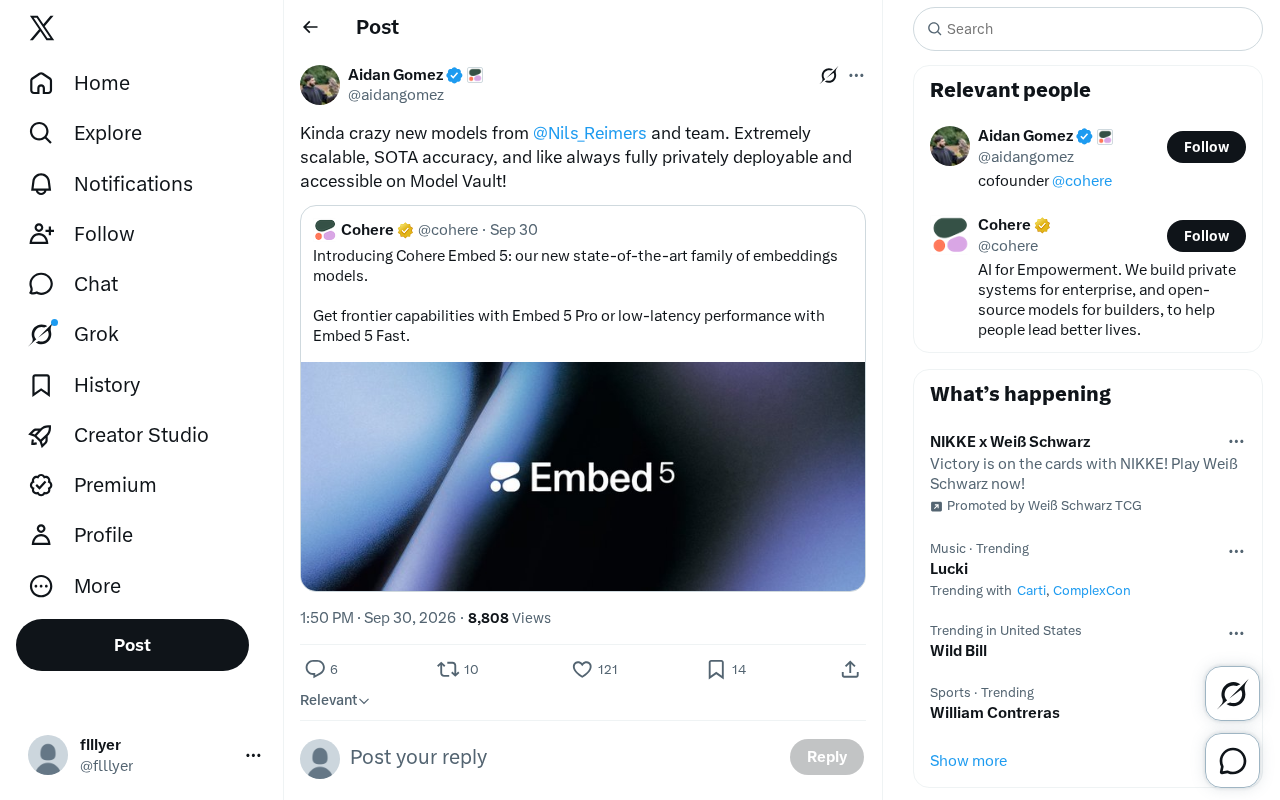
Nils Reimers is a well-known researcher in the fields of semantic search and sentence embeddings, whose open-source contributions have long shaped engineering practice in text retrieval and semantic similarity matching. Naturally, when his team releases new models, the community pays close attention.
Reiners is perhaps best known for the sentence-transformers library and the Sentence-BERT (SBERT) model family behind it. Introduced in 2019, SBERT fine-tunes BERT using a Siamese network architecture to produce sentence embeddings that can be directly compared via cosine similarity — speeding up semantic similarity computation by thousands of times. He subsequently continued advancing large-scale multilingual embedding models at companies including Cohere. This background gives his team's releases a high degree of credibility in the developer community, as their work consistently balances academic rigor with practical engineering applicability.
Breaking Down the Three Core Selling Points
Based on what the post reveals, the new models emphasize three dimensions of advantage — each corresponding to a pain point that enterprise retrieval systems commonly face in production.
Scalability
"Extremely scalable" implies the model can maintain stable performance at large data volumes and under high-concurrency conditions. For enterprise applications that need to process massive document collections and serve real-time retrieval requests, scalability is often the deciding factor in whether a system can actually make it to production. While the post doesn't provide specific throughput or latency figures, leading with scalability signals that the team prioritized engineering usability in the design process.
SOTA Accuracy
"SOTA accuracy" is a research team's core commitment to model quality. In retrieval and embedding tasks, accuracy is typically measured through metrics like recall and ranking quality on standard benchmarks. Claiming industry-leading performance suggests these models are genuinely competitive. That said, the original announcement includes no specific evaluation data or comparison baselines — real-world performance still awaits broader public testing.
Retrieval model accuracy is commonly evaluated on standard benchmarks such as BEIR (Benchmarking IR) and MTEB (Massive Text Embedding Benchmark). MTEB covers a wide range of tasks including retrieval, classification, clustering, and semantic similarity, and has become the dominant leaderboard standard for embedding models. The meaning of "SOTA" varies depending on the task type and language scope — a model that leads on English general-domain retrieval may not hold the same advantage in multilingual or domain-specific settings. When evaluating any "SOTA" claim, it's important to clarify which benchmark, which task subset, and which baseline models are being compared.
Fully Private Deployment
"Fully privately deployable" is arguably the most noteworthy claim in the announcement. As data compliance and privacy protection become increasingly critical, many enterprises cannot send sensitive data to external cloud APIs. A retrieval model that can be fully deployed on-premises means the entire inference pipeline runs within the company's own infrastructure — data never leaves the organization. This is especially important for heavily regulated industries such as finance, healthcare, and legal services.
On-premises (self-hosted) deployment and cloud API-based access are fundamentally different architecturally. In the cloud API model, text data must leave the enterprise network and travel to a third-party server for vectorization, introducing data leakage and compliance risks. Private deployment keeps model weights and the inference runtime entirely within the company's own infrastructure, with data never leaving its boundaries. Achieving this typically requires downloadable model weights, a locally runnable inference framework (such as ONNX Runtime, vLLM, or Triton Inference Server), and appropriate GPU/CPU hardware. For embedding models, the hardware requirements for private deployment are considerably lower than for large generative models, which is one reason they are easier to operationalize in enterprise environments.
The Role of Model Vault
The post mentions that these models are accessible via the Model Vault platform. As a vehicle for model distribution and deployment, such platforms lower the barrier to private deployment — allowing enterprises to obtain high-quality models while retaining full control over their data and runtime environment. The combination of scalability, high accuracy, and private deployment reflects a classic enterprise-market positioning: strong performance, data safety, and the ability to scale.
Limitations and a Measured Perspective
It must be noted that the source material for this article is a single, brief social media post — lacking critical details such as model parameters, evaluation data, supported languages, and task types. Phrases like "SOTA" and "extremely scalable" are promotional claims from the releasing party and have not yet been independently verified.
For developers and enterprise technology decision-makers following semantic retrieval, it is advisable to wait for official technical documentation, benchmark results, and real-world community feedback before adoption — and to assess these against your own data scale and compliance requirements. A truly excellent retrieval model ultimately needs to deliver verifiable results on your own business data.
Summary
This announcement reflects a broader trend: semantic retrieval models are steadily evolving toward "high performance + private deployment." For enterprises that prioritize data privacy, models that can run locally while delivering competitive accuracy meaningfully expand the available options. We look forward to more complete technical details being published, so the true capabilities of these new models can be thoroughly put to the test.
Related articles

AI Digital Twin in Action: Using DOT to Automatically Track Bugs and User Feedback
DOTS engineers demonstrate how AI digital twin DOT collects cross-platform user feedback, categorizes issue themes, opens threads to investigate bug root causes, and submits PRs—showcasing a complete AI agent workflow for defect triage with auditable design.

Why Transistors Are No Longer Flat: The Evolution from Planar to Gate-All-Around
Transistor evolution from planar to FinFET to gate-all-around: why gates went from three-sided to four-sided wrapping to suppress short-channel effects and leakage current, extending Moore's Law.

Swarm Intelligence = a Single RL Agent? A Proof of Multi-Armed Bandit Equivalence
A paper proves that collective decision-making through local imitation in swarms is mathematically equivalent to single-agent reinforcement learning: N blind imitators act as N parallel environment samples, with an effective learning rate of 1/N. This article explains the derivation and implications of the Maynard-Cross Learning algorithm.