HN Email Addresses Scraped for Scams: A Wake-Up Call for Community Data Security

HN users' public emails were bulk-collected by crawlers and used for scams, exposing data misuse risks in technical communities.
The Hacker News community has disclosed that user emails are being bulk-scraped by automated crawlers and used for scams. Because HN allows users to make emails public in their profiles, has a stable page structure, and imposes limited anti-scraping restrictions, scraping costs are extremely low. Collected emails may be used for phishing attacks, identity impersonation, or email list resale, and technical professionals' emails are often tied to critical accounts such as GitHub and cloud services, making leaks more impactful. Community discussion has not been intense, but commenters suggest the platform hide emails by default or strengthen rate limits. The article concludes with user self-protection tips, including removing public emails, using disposable emails, enabling email filtering, and separating identities, and notes that platforms need to balance openness and security.
Incident Overview: HN User Emails Maliciously Scraped
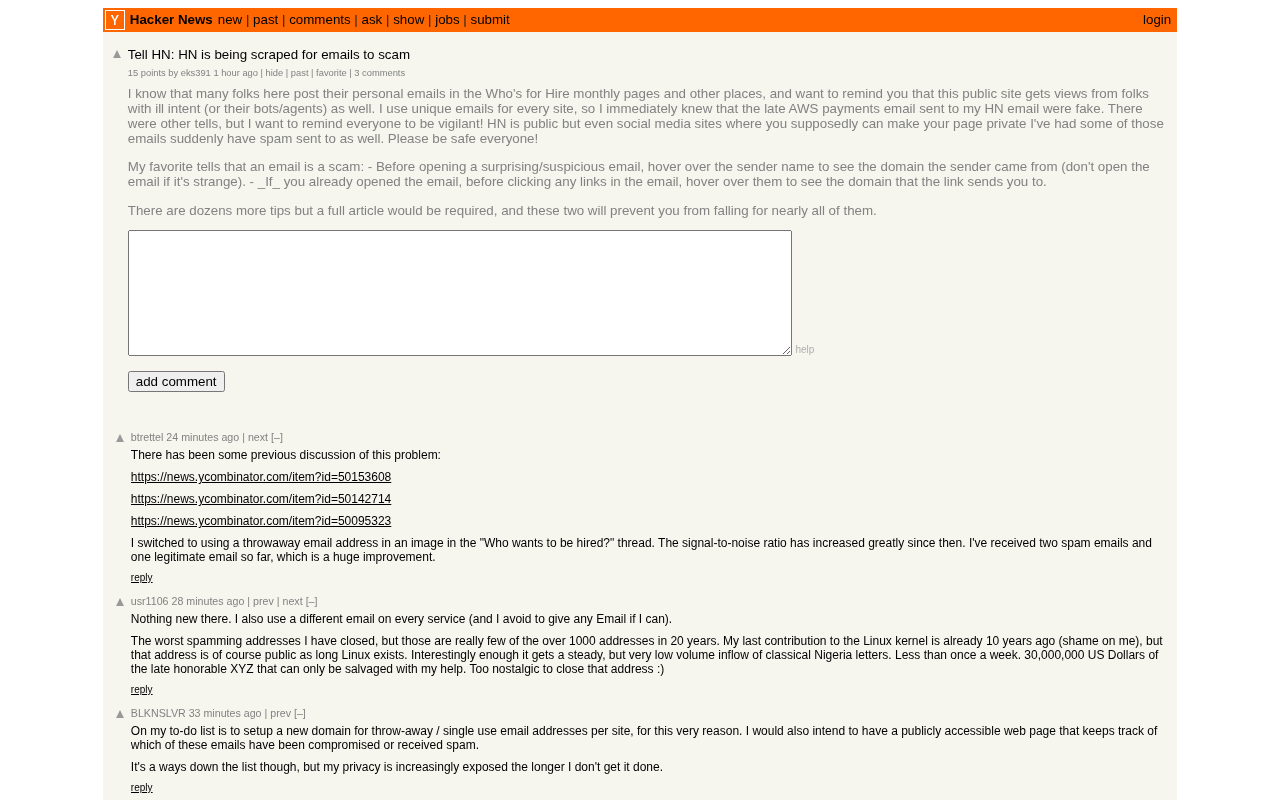
According to a "Tell HN" post in the Hacker News (HN) community, user email information on the platform is being maliciously scraped and used to carry out scams. The poster pointed out that attackers collect public or semi-public email addresses through automated means, then send phishing emails or engage in other fraudulent activities. The post received 12 points on HN; although discussion was not particularly heated, it touches on a data security issue that technical communities have long overlooked.
How Did the Scraping Succeed?
HN itself does not force users to make their emails public, but users can fill them in on their profile pages. Some users choose to display their emails publicly for easier contact or to show their identity. Crawler programs then scan these pages in bulk, associating email addresses with usernames to form a usable "target list."
This scraping behavior does not require advanced skills—a simple crawler script plus reasonable request intervals can collect a considerable amount of data over time. HN's page structure is relatively stable, and its restrictions on automated access are limited, making the cost of scraping extremely low.
Anti-scraping mechanisms and rate limiting are key to understanding the cost of scraping. Common anti-scraping measures include: IP-based request frequency limits (e.g., a maximum of N requests per minute), CAPTCHA challenges, User-Agent and behavioral feature detection, and dynamic page rendering to increase parsing difficulty. HN's pages are primarily static HTML with a long-stable structure, and it does not impose strict frequency limits or CAPTCHAs on unauthenticated access, so a crawler only needs to simulate ordinary browser requests and control concurrency and intervals to complete a full scan within a few days. By contrast, platforms with comprehensive anti-scraping systems combine WAF, behavioral analysis, and fingerprinting to significantly raise the cost of bulk collection.
Speculation on Scam Tactics
Although the original post does not elaborate on the specific forms of fraud, based on common patterns, scraped HN emails could be used for:
- Phishing attacks: Forging HN notifications or community invitations to trick users into clicking malicious links.
- Identity impersonation: Posing as "technical collaboration" or "recruitment" to gain trust and then carry out financial fraud.
- Email list resale: Packaging and selling technical professionals' emails to marketing or black-market teams.
Since HN users are mostly developers, entrepreneurs, and other technical people, their emails are often tied to critical accounts such as GitHub and cloud services. Once compromised, the impact could far exceed that of ordinary social platforms.
Phishing attacks typically forge the sender address or use lookalike domains to imitate notification emails from the target platform, tricking recipients into clicking links and entering credentials on counterfeit pages. Phishing emails aimed at technical people often disguise themselves as "repository collaboration invitations," "cloud service billing anomalies," or "job interview arrangements," exploiting professional contexts to lower vigilance. Once credentials are leaked, attackers may further access associated code hosting, CI/CD, or cloud consoles, creating supply chain risks. Email list resale refers to packaging collected emails by industry, job title, and other tags and selling them on gray markets to marketing teams or fraud gangs, forming a black industry chain of "data to monetization."
Community Reaction and Platform Responsibility
The post has only 3 comments, and the discussion is not intense, but this kind of "low heat, high risk" issue is precisely what deserves attention. Some commenters believe the platform should hide the email field by default, or at least impose stricter rate limits and verification mechanisms on crawler behavior.
From the platform's perspective, HN's minimalist design and respect for anonymity are a double-edged sword: they lower the barrier to participation, but also make abuse difficult to detect immediately. Scraping public information is not technically illegal, but using it for fraud clearly crosses the line. Whether the platform should proactively filter public emails and whether it should introduce stricter anti-scraping measures are practical questions for HN's operators.
How Users Can Protect Themselves
Before platform measures are in place, users can take the following steps to reduce risk:
- Check your profile: If an email is not necessary, consider removing it from your HN profile or using a dedicated disposable email.
- Enable email filtering: Stay alert to emails from unknown senders, especially "community notifications" containing links or attachments.
- Separate identities: Avoid using the same email for your HN account and critical services to reduce the cascading impact of a single point of leakage.
- Report suspicious behavior: When you receive suspected scam emails, report them to HN administrators to help the platform identify scraping patterns.
Disposable email refers to temporary email services that can be generated instantly, are valid for a short period, and require no real-name registration. They are suitable for low-trust scenarios such as forum registration and profile display, and can effectively isolate your primary email from public exposure. Email filtering and SPF/DKIM/DMARC are also worth understanding: SPF, DKIM, and DMARC are email authentication mechanisms. Although they are configured by the sending domain, the receiving end can use their verification results to identify forged emails. Users can set rules in their email clients to automatically flag emails that fail verification or come from unknown domains, reducing the probability of clicking phishing links by mistake.
Conclusion: A Big Problem Behind a Small Incident
This "Tell HN" post itself contains limited information, but it reveals a common dilemma: while pursuing openness and simplicity, technical communities often underestimate the risk of data misuse. Email scraping is not unique to HN; any platform that displays user contact information can become a target. For users, actively managing public information is the most direct line of defense; for platforms, finding a balance between openness and security is a long-term challenge.
(This article is based on the Hacker News post and public discussion; specific scam details are subject to the original post.)
Related articles

Zed Editor Releases v1.29.2: Observations on a Routine Version Iteration
Zed editor releases patch v1.29.2, version bump by @JosephTLyons, commit verified via GitHub signature. This article covers the release's basic info, what a patch version means, and practical upgrade advice for users.

Anthropic IPO Questioned: Hacker News Debates Timing of Going Public
A Hacker News post titled "Just say no to Anthropic's IPO" sparks debate on the timing of Anthropic's public listing and AI capitalization, touching on valuation bubbles and mission independence.

Hands-On with the Genie 4 World Model: Directing Worlds in Real Time Like a Puppeteer
Google DeepMind's Genie 4 world model in depth: Special Guest X's hands-on demo of real-time scene direction via prompts, custom interactive apps in Project Genie, and prompts-as-seeds reproducibility.