HN New Project: An Animated Tech Explainer Tool You Can Interrupt at Any Time

Show HN project generates interruptible animated explanations from technical questions, signaling AI Q&A's shift toward interactive processes.
This article covers a Hacker News Show HN project where users ask technical questions and receive animated explanations they can interrupt at any time to follow up. This interaction breaks the turn-based model of traditional AI Q&A and requires the system to maintain continuous explanation state and context. Animating technical explanations faces three challenges: content structuring, animation generation stability, and post-interruption context recovery. The tool suits learning concepts with state transitions like distributed systems and network protocols, but not scenarios needing precise derivations or original specs. With only 4 points and no comments on HN, it's extremely early-stage but points toward AI Q&A evolving from content generation to interactive explanation processes.
From Static Q&A to Interruptible Animated Explanations
In the Show HN section of Hacker News, a project called "Ask a technical question, get an animated explainer you can interrupt" has drawn some attention. Its core idea is straightforward: the user asks a technical question, and instead of returning a block of text or a few static images, the system generates an animated explanation that allows the user to interrupt at any time during playback to follow up or change direction.
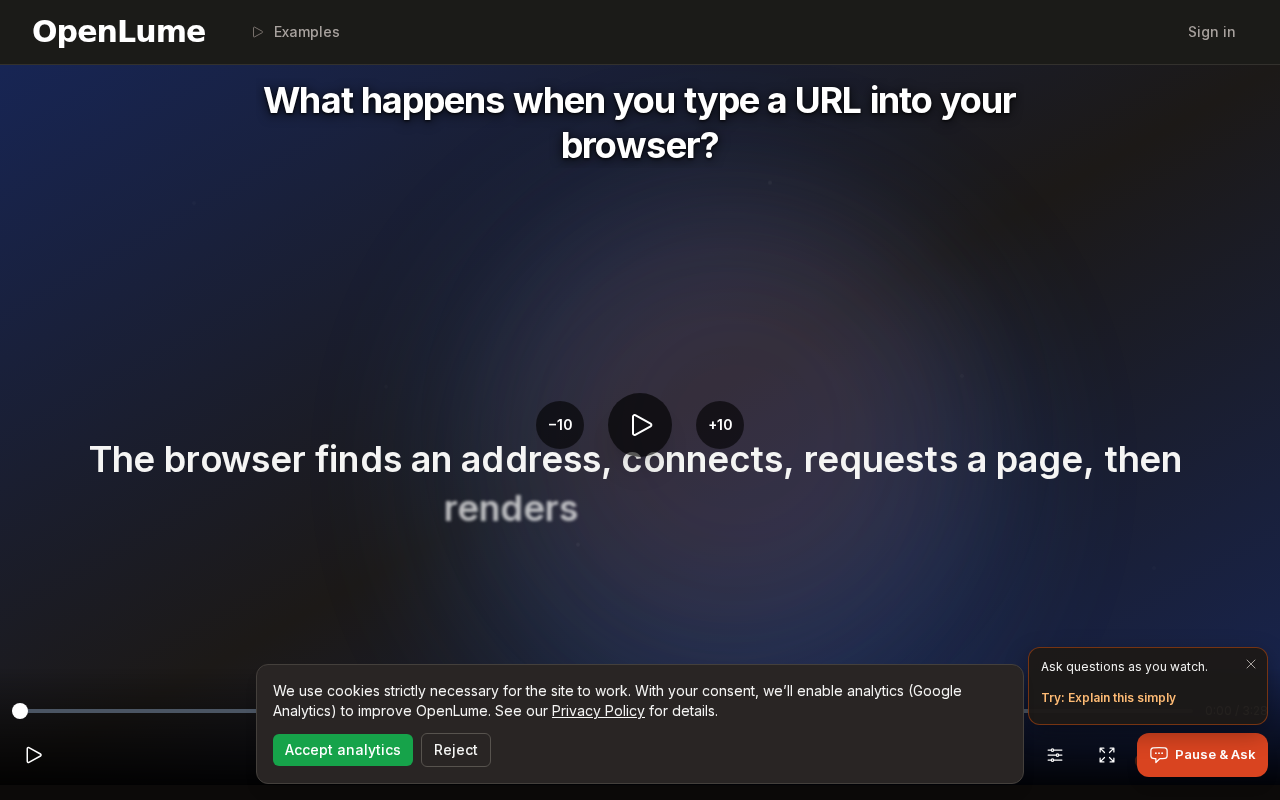
This interaction model hits on a pain point in current AI Q&A products — most tools are still stuck in a turn-based "you ask, I answer" mode, where after reading a long response, users often need to rephrase their question just to follow up. This project tries to turn "explanation" into a conversational process.
Why "Interruptibility" Deserves to Be Treated as a Feature in Its Own Right
Explanations of technical concepts are naturally layered. A question like "What is the Raft consensus algorithm?" may branch into leader election, log replication, network partitions, and other subtopics. With text responses from traditional chatbots, users can only scroll through and judge for themselves where they got lost. Animated explanations, at minimum, introduce a temporal dimension to the interaction — users can pause at a particular frame and ask, "What does that state transition mean?"
From a product design perspective, "interruptibility" means the system needs to maintain a continuous explanation state: it must know which segment the user is currently watching, what the context is, and where a follow-up question after an interruption should be anchored. This is harder than generating one-off content, and it gets closer to the experience of a student raising their hand to ask a question in a real classroom.
The Raft consensus algorithm is a distributed consensus algorithm for managing replicated logs, proposed by Diego Ongaro and John Ousterhout in 2014, designed to be easier to understand and implement than Paxos. It coordinates all client requests by electing a leader, who receives log entries and replicates them to other nodes (followers), committing them once a majority of nodes acknowledge. Raft decomposes the consensus problem into three relatively independent subproblems: leader election, log replication, and safety. When the leader fails, the cluster triggers a new election via a timeout mechanism. Network partitions can split the cluster; in that case, only the partition containing a majority of nodes can elect a leader and continue working, while the minority partition stops accepting writes to preserve consistency. Raft's state transitions and temporal ordering make it especially well-suited to animated explanation.
What Makes Animating Technical Explanations So Hard
Turning technical questions into animations is challenging not just because you need to make things move on screen.
The first layer is content structuring. An explanation of the "TCP three-way handshake" needs to be broken down into orchestratable steps, states, and roles before it can drive an animation. This means the model isn't just generating text — it's also generating an explanation script with ordering and dependencies.
The second layer is the stability of animation generation. LLM outputs are stochastic, but animations have strict requirements for timing and spatial layout. Ensuring that the model's explanation logic maps reliably to visual presentation is a key engineering problem in this direction.
The third layer is context recovery after interruption. When a user interrupts at step 3 of the animation, the system needs to determine: Is the follow-up about content already covered, or is it asking ahead about later content? After responding, should it return to the original progress point, or reorganize the explanation path? These decisions directly affect whether the experience feels smooth.
The TCP three-way handshake is the standard process by which the Transmission Control Protocol (TCP) establishes a connection, ensuring that both communicating parties are ready to transmit data and synchronizing initial sequence numbers. First handshake: the client sends a SYN (synchronize) segment carrying a random initial sequence number seq=x and enters the SYN_SENT state. Second handshake: upon receiving it, the server replies with a SYN+ACK segment carrying its own initial sequence number seq=y and an acknowledgment of the client's sequence number ack=x+1, entering the SYN_RCVD state. Third handshake: the client receives this and sends an ACK segment with acknowledgment number ack=y+1, and both sides enter the ESTABLISHED state. This process involves clear state transitions and a specific order of message exchange, making it a classic technical concept well-suited to animation.
Who This Kind of Tool Is For
Based on its positioning, this kind of interruptible animated explanation is best suited to two scenarios:
- Learning complex systems: For knowledge with state transitions and temporal ordering — such as distributed systems, compilers, and network protocols — animations make it easier to build intuition than plain text.
- Quickly building a conceptual framework: When you're not sure what a term actually refers to, a few dozen seconds of animation plus the ability to follow up at any time may be faster than reading a long article.
The scenarios it's not well-suited for are also obvious: cases requiring precise formula derivations, cases requiring consulting original specifications, or questions that don't have a clear "process" to animate.
A distributed system is a system in which multiple independent computers coordinate over a network to accomplish a shared task. Its core challenges include consistency, availability, partition tolerance (the CAP theorem), consensus, replication, and fault tolerance. A compiler is a program that converts a high-level programming language into machine code or intermediate code, with a typical pipeline including lexical analysis, syntactic analysis, semantic analysis, intermediate code generation, optimization, and target code generation. A network protocol is a set of rules that communicating parties in a computer network must follow, such as TCP/IP, HTTP, and DNS, and usually involves layered models and state machines. Concepts in these fields often involve state transitions, temporal ordering, or hierarchical structure, and animated explanations can help learners intuitively understand their dynamic behavior.
Current Status and Observations
This project received 4 points on Hacker News and has no comments yet, indicating it's still at a very early stage and hasn't yet generated community discussion. Based on the historical patterns of Show HN, whether projects centered on "interaction format innovation" like this can go far usually depends on two things: whether the quality of generated animations is stable, and whether interruptive interaction is actually more natural than typing a follow-up question.
What's worth noting is the direction it represents — AI Q&A is shifting from "generating content" to "generating an interactive explanation process." If the cost and latency of animation generation can be brought down to an acceptable range, this format could become a new branch of technical education products.
FAQ
How is this different from a regular AI chat? A regular chat returns text; this tool returns a playable, interruptible animated explanation, shifting the interaction from turn-based to process-based.
What is it good for learning? Technical concepts with state transitions and temporal ordering, such as network protocols, distributed algorithms, and system architectures.
Is it mature yet? Based on the feedback on HN, it's still early — very few points and little discussion — and its actual experience and stability remain to be verified.
One-line Summary
A Show HN project generates interruptible animated explanations from technical questions, representing AI Q&A's evolution toward interactive processes.
Paragraph Summary
This article introduces a Hacker News Show HN project where users ask technical questions and the system generates animated explanations that can be interrupted at any time for follow-ups. This interaction breaks past the turn-based model of traditional AI Q&A, requiring the system to maintain continuous explanation state and context. Animating technical explanations faces three layers of challenges: content structuring, animation generation stability, and context recovery after interruption. The tool is well-suited to learning concepts with state transitions such as distributed systems and network protocols, but not to scenarios requiring precise derivations or consulting original specifications. The project has only 4 points and no comments on HN, making it extremely early-stage, but it represents a new direction for AI Q&A shifting from generating content to generating interactive explanation processes.
Related articles

Bilibili's Hit Dify Tutorial: A Practical Guide to Building 20+ AI Apps from Scratch
A distilled guide to Bilibili's top-rated Dify tutorial: Windows + Docker deployment, MySQL connection, five app types, model integration strategy, and publishing.

Agent Skills Beginner's Guide: From Concepts to Multi-Agent Collaboration in Practice
A comprehensive guide to Agent Skills: core concepts, components, the importance of Description, standardization, beginner learning paths, and multi-agent collaboration.

One Neuron Detects Both Cats and Cars? We Reproduced It and Found a New Explanation
The cat-car neuron reinterpreted: researcher Cammarata argues it distinguishes pointy from round, not cats from cars. We reproduced the experiment and found the new explanation holds on most inputs—but cars are the exception. The interpretability debate continues on language models.