Hola AI: The AI Voice Assistant That Answers Calls So You Don't Have To

Hola AI is an AI voicemail assistant that auto-answers calls, filters spam, and delivers conversation summaries asynchronously.
Hola AI is a Product Hunt-featured AI voicemail assistant built for people who can't afford constant interruptions but can't go offline either. When you're unavailable, it picks up the call, holds a real conversation with the caller, filters out spam, records and transcribes the exchange, and pushes you a summary. This answer–filter–transcribe–summarize pipeline turns incoming calls from passive interruptions into asynchronous information. The product earned 78 upvotes and a #14 ranking on Product Hunt, touching a real need — though transcription accuracy, conversational quality, and privacy compliance remain key factors to watch.
In an age of information overload, phone calls have become a burden. Unknown numbers, spam solicitations, calls that ring at the worst possible moment during a meeting — answering or ignoring them both feel like bad choices. Hola AI, which recently debuted at #14 on the Product Hunt charts, targets exactly this pain point: an AI-powered voicemail assistant that picks up when you can't.
What Problem Does It Actually Solve
Traditional voicemail has always been a terrible experience. Callers hate leaving messages, and even when they do, you have to play them back one by one just to figure out what anyone wanted. Hola AI's approach is to hand this passive, inefficient step over to AI.
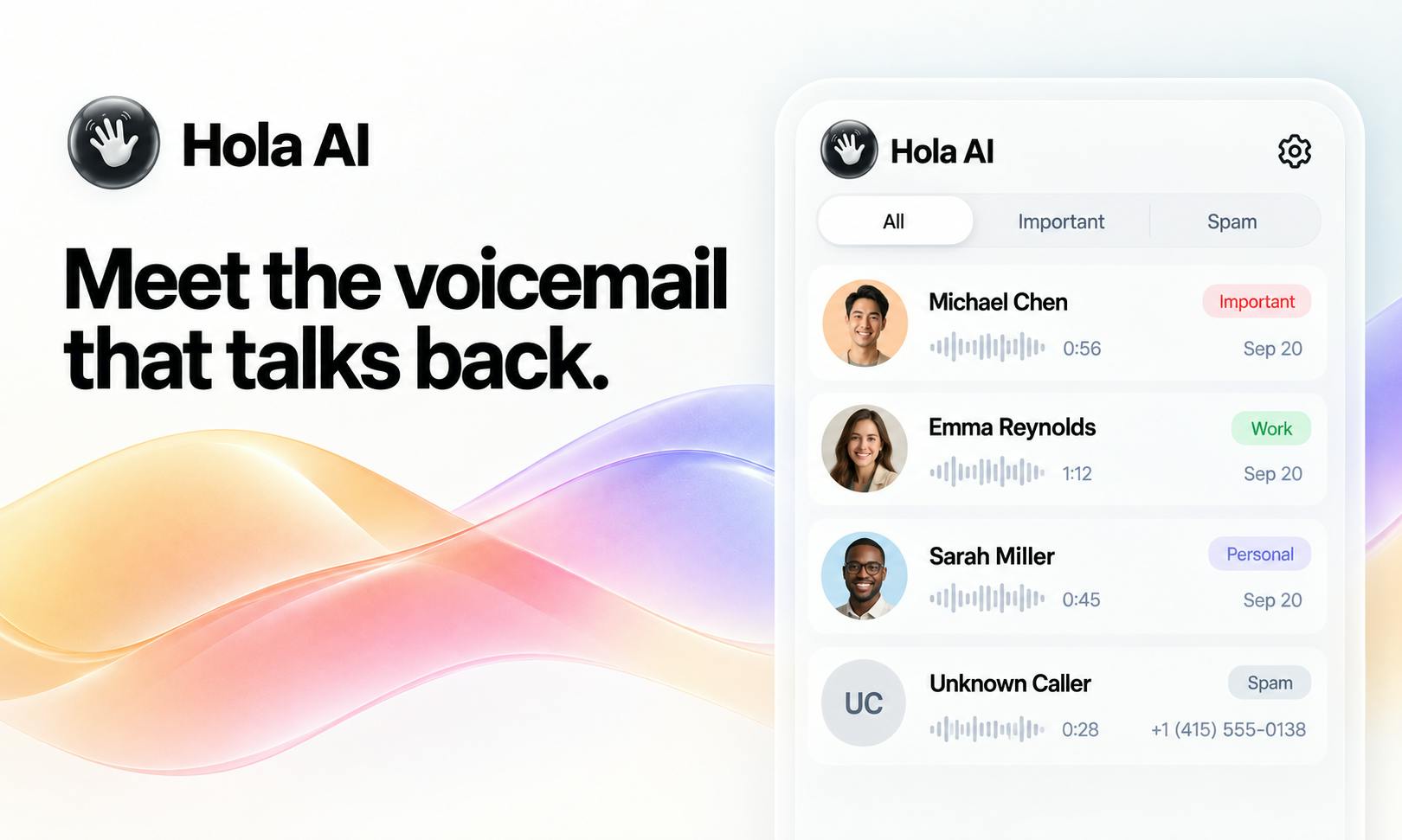
According to the official description, when you're unavailable, Hola AI proactively picks up the call, holds a real conversation with the caller to capture their intent, and filters out spam and robocalls in the process. Once the call ends, it sends you an instant summary — so you have enough context to decide whether to call back before you ever pick up the phone.
The core value here is simple: stay reachable without letting every call interrupt what you're doing. For people who are frequently in meetings, in deep focus, or simply tired of unknown callers, this is a genuinely practical proposition.
Breaking Down the Core Features
Hola AI's officially listed capabilities fall into a few key layers:
Smart Answering and Conversation
Rather than playing a static voice prompt, Hola AI actually engages callers in an interactive dialogue — proactively asking questions to understand their purpose. This sets it apart from traditional "please leave a message" voicemail and makes it behave more like a real human assistant.
This kind of technology typically relies on a combination of large language models (LLMs) and speech synthesis/recognition (TTS/ASR): the system transcribes the caller's voice in real time, a language model generates a response, and that response is converted back into natural-sounding speech. Keeping the entire loop under 1–2 seconds of latency is what makes it feel like a real person rather than a machine reading a script. Common implementations in the industry include the Twilio Voice API for call handling, models like Whisper for transcription, and GPT-4o or similar models for intent understanding and response generation. The naturalness of the conversation depends heavily on prompt design — specifically, whether the AI can be guided to proactively ask "What's this regarding?" rather than passively waiting for the caller to finish.
Spam Call Filtering
In the face of increasingly rampant robocalls and scam attempts, Hola AI acts as a first line of defense. It identifies and filters out junk calls, keeping them from ever reaching you.
Recording, Transcription, and Summaries
Every answered call is recorded, transcribed into text, and summarized by AI — giving you a direct answer to "why did this person call." You don't need to listen to the full recording; a quick glance at the summary is enough to triage the call's urgency.
This complete pipeline — answer → filter → transcribe → summarize — is what differentiates Hola AI from ordinary call management tools.
Who Is It For
Hola AI is categorized under Productivity, Artificial Intelligence, and Audio. Based on its feature set, the target user profile is fairly clear:
- Knowledge workers who need deep focus: They don't want random calls breaking their concentration, but they can't go completely off the grid.
- Everyday users overwhelmed by spam calls: They want an automatic filtering layer between them and unwanted callers.
- Professionals with frequent business communications: They need context on who's calling and why before they call back, making conversations more efficient.
For these users, call summaries and contextual notes are likely the most compelling features — they transform "answering a call" from a passive interruption into a piece of information you can handle asynchronously.
Market Reception and Observations
As of now, Hola AI has received 78 upvotes and 5 comments on Product Hunt, landing at #14 for the day. That's not a breakout hit, but it does signal that the product addresses a genuine need.
It's worth noting that the AI phone assistant space has grown increasingly competitive in recent years, with players ranging from built-in call screening features on major smartphones to a variety of standalone apps. For Hola AI to stand out, transcription accuracy, conversational naturalness, and spam detection precision will be the key metrics that determine success or failure. There's also the matter of privacy and compliance — voice assistants that record calls touch on sensitive territory that users will need to weigh carefully in practice.
The competitive landscape in AI call screening is worth putting in context: Google introduced Call Screen on the Pixel 3 back in 2018, with Google Assistant answering calls in real time and displaying the transcript to the user; Apple brought Live Voicemail to iOS 17, transcribing messages in real time as callers leave them. These native solutions already cover a huge share of Android and iOS users, which means independent apps need to find differentiation through deeper AI conversation or more flexible customization. Standalone apps also typically need to intercept calls via call forwarding or virtual numbers — an approach that varies across carriers and countries, and can introduce additional trust issues around number identity.
Wrap-Up
Hola AI represents a product category that's steadily maturing: using AI to automate and asynchronize the tedious parts of communication. Its value isn't in any single flashy feature, but in bundling the entire "answer, record, understand, relay" workflow into one low-friction assistant. For people who want to be reachable without being perpetually on-call, tools like this will only become more useful over time.
That said, as an early-stage product, its real-world performance still needs to be validated across more usage scenarios. If you're tired of endless unwanted calls, Hola AI at least offers a fresh approach worth trying.
Related articles

Cursor AI Programming in Practice: Build a Student Management System from Scratch in 30 Minutes
A Bilibili creator demonstrates Cursor AI programming: generating a student management system in 30 minutes with natural language. Details on Agent mode, Claude selection, prompt techniques, and thresholds.

Top 20 AI Coding Tools Ranking: From Rock-Solid to Lackluster, a Scored Matrix
Bilibili creator releases top 20 AI coding tools ranking, tiered T0–T4 from rock-solid to lackluster, with Claude Code and Codex tied at T0. This article details the scoring dimensions (capability, reliability, robustness, durability, cost, domestic availability) and tool performances to help developers choose the right AI coding assistant.

Vibe Coding Systematic Tutorial: Master AI-Assisted Programming from Zero
A three-month Vibe Coding tutorial from a Bilibili creator covering Codex, ClaudeCode, and Cursor, from core logic to commercial project practice for beginners.