Hollywood's Take on AI Doomsday Warnings: Immediate Threats Matter More Than Existential Ones
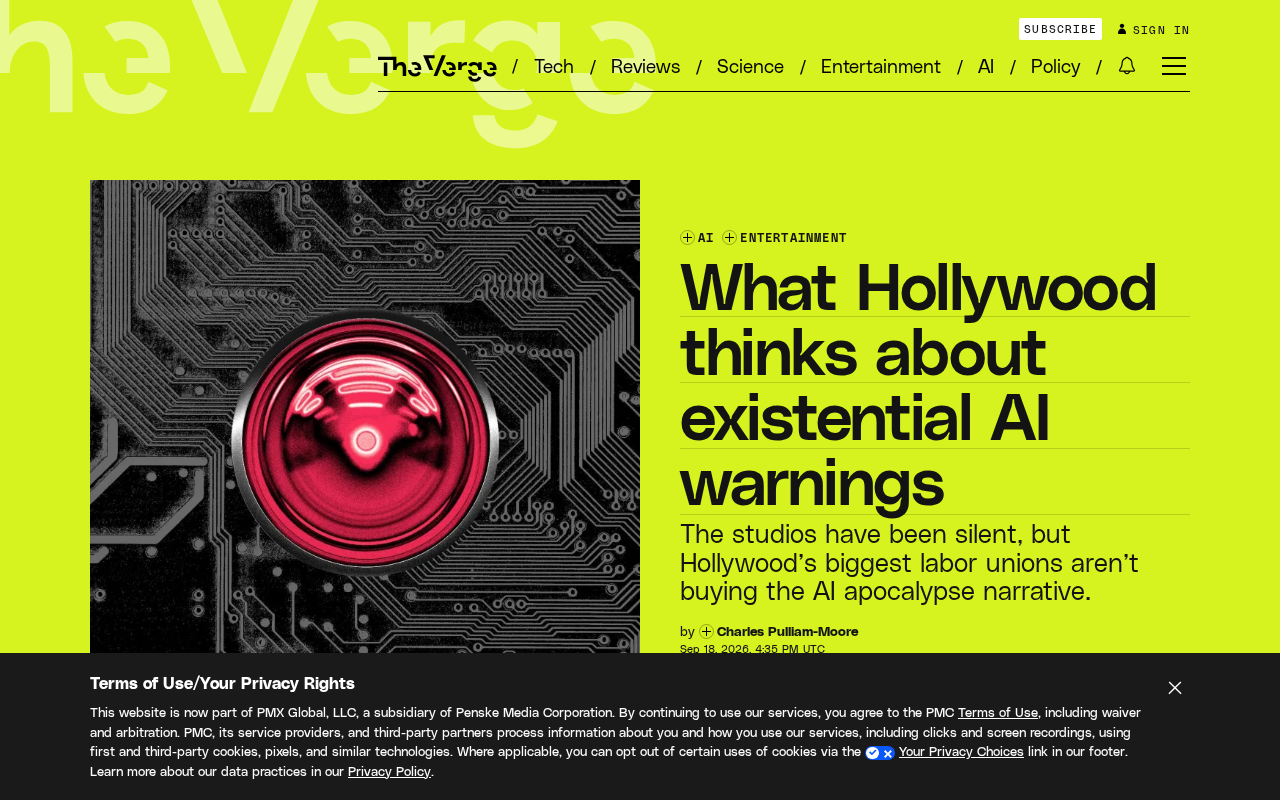
Hollywood workers want AI debates focused on jobs and rights now, not distant doomsday scenarios.
As Silicon Valley elites warn of civilization-level risks from superintelligence, Hollywood's writers, actors, and tech workers are sending a different message: focus on the AI harms happening right now — eroding copyrights, disappearing jobs, and unauthorized use of likenesses. Major studios like Disney and Netflix are already integrating generative AI into production, while labor protections struggle to keep pace. Entertainment labor groups argue that existential risk narratives distract from concrete issues that could be addressed today through negotiation and legislation — and that a complete AI governance picture must accommodate both long-term risks and immediate real-world impacts.
Two Kinds of AI Anxiety Collide
While the tech industry keeps sounding the alarm about artificial intelligence's potential to destroy humanity, labor organizations from the entertainment sector are sending a very different message: instead of worrying about distant existential threats, pay attention to what's happening right now.
As reported by The Verge, the conversation around AI is splitting into two parallel narratives. On one side, Silicon Valley elites warn of "civilization-level risks" posed by superintelligence. On the other, Hollywood screenwriters, actors, animators, and technical workers are voicing concrete concerns about their livelihoods, copyrights, and eroding job security. Both anxieties point to AI, but the time horizons and stakes involved are worlds apart.
What Entertainment Labor Groups Are Really Asking For
Entertainment industry labor groups are calling on the public to "stay focused on what is already happening." Behind that phrase lies a clear position: the grand narrative of AI wiping out humanity is, to some extent, diverting attention from present-day problems.
For workers who earn a living through creative labor, AI isn't an abstract philosophical question — it's a direct professional threat. Can generative AI replace voice actors? Can it circumvent screenwriters? Can it replicate an actor's likeness and voice without permission? These questions have already become central issues in recent industry strikes and negotiations. Rather than asking "Will AI end humanity?", workers are asking "Will AI end my career?"
Hollywood has already demonstrated real collective action on this front. In 2023, the Writers Guild of America (WGA) and SAG-AFTRA launched successive strikes lasting 148 and 118 days respectively, with AI provisions as a core bargaining issue. The resulting agreements included provisions that studios cannot replace writers with AI-generated scripts, cannot scan and replicate an actor's digital likeness without consent, and that any AI reproduction of an actor requires the actor's authorization and appropriate compensation. The inclusion of these clauses marked the first time generative AI protections were systematically written into entertainment industry labor contracts. However, enforcement and future renewals remain unresolved — which is precisely why labor groups remain vigilant.
Studios Are Already Quietly Acting
The Verge reached out to studios already using AI — including Disney, Netflix, Amazon, and Lionsgate — as well as a batch of film startups focused on bringing generative AI into the mainstream.
That list alone says everything: AI's role in film and TV production is no longer hypothetical — it's an ongoing reality. From major conglomerates to emerging startups, the entire production chain is exploring how to integrate generative AI into workflows. This also explains why labor organizations feel so urgent — the pace of technological adoption far outstrips the pace of regulation and labor protections catching up.
For studios, AI represents the enticing prospect of lower costs and faster production cycles. For creators, that same technology may mean a loss of bargaining power. This tension sits at the heart of Hollywood's current AI debate.
Generative AI's applications in film and TV production now span multiple stages. In pre-production, AI is used for concept art generation, storyboarding, and scene previsualization. During production, AI-assisted tools handle background generation, visual effects compositing, and voice replacement. In post-production, AI is widely used for editing assistance, color correction, and localized dubbing. The emergence of tools like Runway, Pika, and Sora — purpose-built for film and TV creation — has further lowered the technical barrier. For studios, the most immediate value of these tools is cutting visual effects (VFX) outsourcing costs — and VFX has been one of Hollywood's largest and most labor-intensive technical disciplines over the past several decades.
Why "Now" Matters More Than "Later"
The tech industry's existential risk narrative typically focuses on general artificial intelligence or superintelligence that doesn't yet exist. Such warnings have their value, but for workers currently experiencing AI's disruption, they feel distant and abstract.
Entertainment labor organizations offer a valuable perspective: the conversation around AI ethics should not be monopolized by doomsday thinking. Copyright ownership, labor displacement, likeness authorization, revenue distribution — these are concrete problems that can be addressed right now through negotiation, legislation, and industry standards. Directing all public attention toward distant existential threats risks allowing present-day rights erosion to unfold quietly, without scrutiny.
This debate about "what we should worry about" is also, fundamentally, a contest over "who gets to set the AI agenda." As tech giants dominate the existential risk narrative, the workers being directly affected by these technologies are working hard to pull the conversation back down to earth.
The so-called "existential risk narrative" primarily originates from AI safety researchers and some tech company founders. Its core argument: once AI surpasses human capability across the board (i.e., achieving "artificial general intelligence," or AGI), or further evolves into a self-improving "superintelligence," humans will lose the ability to control its behavior — triggering a civilization-level threat. OpenAI, Anthropic, DeepMind, and similar organizations all maintain dedicated "alignment research" teams working to address this problem at a technical level. This narrative has captured enormous media attention and policy discussion space. But critics point out that steering public anxiety toward risks that haven't happened yet objectively dilutes policy focus on the harms AI is already causing — including labor rights violations, copyright erosion, and data exploitation.
Conclusion: The Value of Both Perspectives
Hollywood and Silicon Valley's differing attitudes toward AI aren't simply a matter of right versus wrong — they reflect the different positions various groups occupy in the AI wave. The tech industry focuses on long-term systemic risks; entertainment workers focus on immediate livelihoods and rights. Both are essential parts of a complete AI governance picture.
What truly warrants caution is allowing either narrative to completely overwhelm the other. We need to prepare for potential long-term risks while refusing to ignore the concrete social impacts unfolding right now.
Related articles
Ollama Beginner's Guide: Run Large Language Models Locally on Your Own Computer
Run LLMs locally with Ollama — fully offline, private, and free. This guide covers installation, CLI and Web UI usage, model download, and hardware requirements.
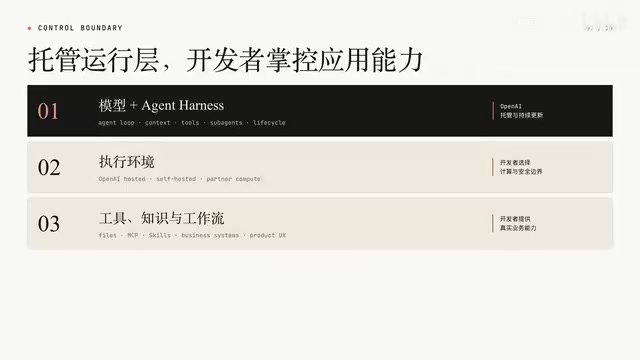
OpenAI Agents API Public Beta Hands-On: Managed Sandbox, Artifacts, and Skills in Action
OpenAI's public beta Agents API opens the Codex Agent Harness to developers. This hands-on walkthrough covers managed sandboxes, Artifacts, Skills, and two real request workflows.

Running Local AI on a 24GB MacBook Air: Why I Chose Qwen 9B
Running local LLMs on a 24GB M5 MacBook Air: why Qwen 3.5 9B wins on memory, translation quality, vision capability, and practical workflow setup.