HookLens: AI-Powered Root Cause Analysis Tool for Webhook Failures

HookLens uses Google Gemini AI to diagnose Webhook failures and generate code-ready fixes for developers.
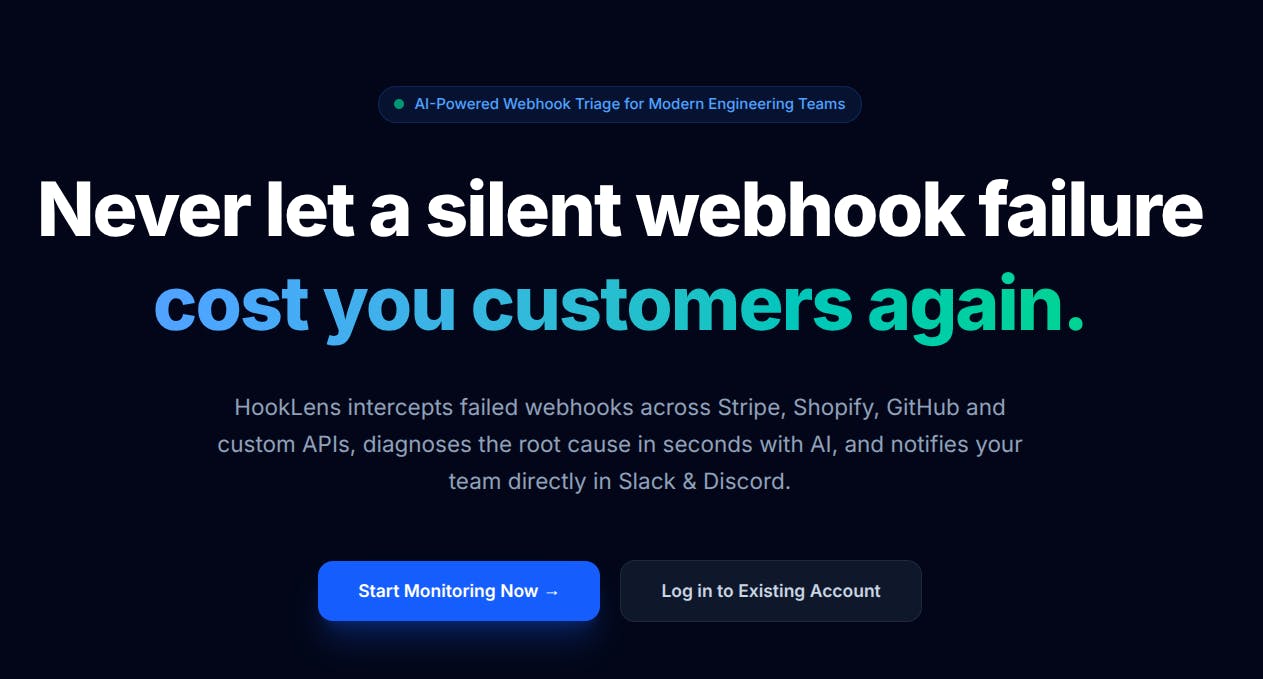
HookLens is an AI-powered developer tool that monitors Webhooks in real time and uses Google Gemini to perform root cause analysis on failures. Targeting Stripe and Shopify integrations, it transforms cryptic JSON payloads into clear failure explanations and actionable code fixes, compressing hours of manual debugging into minutes of AI-assisted troubleshooting.
When Webhooks Fail, the Developer's Nightmare Begins
For any developer integrating Stripe payments or Shopify e-commerce, Webhooks are the core nervous system that keeps business operations running. A Webhook is an HTTP callback-based event notification mechanism where third-party services proactively send POST requests to a pre-registered URL when specific events occur. Unlike traditional polling, Webhooks use a "push" architecture that only sends data when an event actually happens, dramatically reducing API call volume and server load. In payments and e-commerce, Webhooks play a critical role in cross-system state synchronization—for example, Stripe notifies merchant systems to confirm orders via Webhook after a successful charge, and Shopify notifies ERP systems to update data when inventory changes. They're responsible for notifying your system in real time when critical events like successful payments, order creation, or subscription changes occur. However, once a Webhook fails, trouble follows—payment statuses don't sync, orders go missing, users complain, and all you're left staring at is a pile of cryptic JSON payloads and vague error codes.
Traditional debugging means manually sifting through logs, parsing payloads layer by layer, cross-referencing API documentation, and even reproducing issues repeatedly. This process is not only time-consuming but also heavily dependent on the engineer's experience. HookLens, which recently launched on Product Hunt, targets exactly this pain point: it's a developer tool focused on real-time Webhook triage and AI-powered root cause analysis.
Core Features and Use Cases of HookLens
HookLens positions itself as a "real-time Webhook triage and AI root cause analysis" tool. It primarily targets two mainstream scenarios—Stripe payments and Shopify e-commerce Webhook handling.
Stripe's Webhook system supports over 200 event types, covering the full lifecycle of payment intents, subscriptions, refunds, disputes, and more. Shopify covers change notifications for core commerce objects including orders, products, inventory, and customers through Webhooks. Both use signature verification mechanisms (Stripe uses HMAC-SHA256, Shopify uses HMAC-SHA256 with base64 encoding) to ensure payload integrity and source authenticity. Common failure scenarios include: signature verification failures (key rotation not synced), endpoint timeouts (Stripe requires responses within 20 seconds), idempotency conflicts (duplicate deliveries triggering database unique constraint errors), and more.
Three Core Capabilities
- Real-time Monitoring (Monitor): Continuously tracks Webhook delivery status, catching failed events immediately rather than waiting until business anomalies trigger reactive investigation.
- Intelligent Triage: Facing massive volumes of Webhook events, HookLens helps you distinguish which are critical failures requiring human intervention and which can be automatically retried or ignored, effectively preventing alert fatigue. Alert Fatigue is a classic problem in DevOps and SRE—when monitoring systems generate too many low-value alerts, engineers gradually ignore all alerts, including genuinely serious failure notifications. Research shows that when false alarm rates exceed 30%, team response times to alerts decline significantly. In Webhook scenarios, a single network hiccup might trigger hundreds of delivery failures, but most will succeed after automatic retries, with fewer than 5% truly requiring human intervention. The core value of intelligent triage is precisely distinguishing noise from signal.
- AI Root Cause Analysis: This is HookLens's most differentiated capability. Leveraging Google Gemini AI, it transforms cryptic JSON payloads into clear failure descriptions and provides code-ready fix suggestions that can be directly implemented.
In simple terms, HookLens compresses the lengthy Webhook debugging chain of "read logs → guess causes → check docs → write fixes" into just two steps: "see conclusions → use code."
How Gemini AI Transforms JSON into Actionable Fix Proposals
HookLens's most noteworthy technical highlight is embedding large language model capabilities into a very specific engineering scenario. The official description states: "Turn cryptic JSON payloads into clear root causes and code-ready fixes."
Google Gemini is a multimodal large language model series released by Google DeepMind in late 2023, featuring strong code comprehension, logical reasoning, and structured data parsing capabilities. Compared to general conversation scenarios, Gemini performs particularly well when processing structured text like JSON, as its training data includes vast amounts of open-source code repositories and API documentation. In HookLens's application scenario, Gemini can cross-reference Stripe/Shopify API specifications to perform cross-reasoning on error fields, status codes, and timestamp anomalies in payloads, delivering deep diagnostics that go beyond simple pattern matching.
Why Webhook Debugging Is Well-Suited for LLM Assistance
Webhook troubleshooting is fundamentally a task involving "structured information + contextual reasoning"—exactly the domain where large models excel:
- Payloads are structured text: JSON format is naturally suited for model parsing and comprehension;
- Error patterns are highly repetitive: Signature verification failures, timeouts, missing fields, idempotency conflicts, and other issues have abundant reference cases in the Stripe and Shopify ecosystems;
- Fix solutions are relatively standardized: Once the cause is identified, the corresponding code fix typically follows established best practices.
Therefore, using Gemini for "payload diagnosis + fix suggestion generation" is a highly compatible AI application direction. It lowers the troubleshooting threshold for junior and mid-level developers while saving senior engineers time on repetitive work.
Product Positioning and Competitive Analysis
HookLens was built by independent developer Allan Pedersen and is categorized under three tags: API, SaaS, and Developer Tools. Based on Product Hunt data, it's currently in its early stage—receiving 12 upvotes, 1 comment, and ranking #20 for the day.
This indicates HookLens is still a nascent independent product that hasn't yet achieved significant traction. However, its product approach deserves attention: verticalizing general AI capabilities to deeply serve a specific developer pain point.
Differentiation from Existing Webhook Tools
In the Webhook monitoring space, mature tools like Hookdeck, Svix, and Webhook.site already exist, mostly focusing on delivery reliability, retry mechanisms, and debugging panels. Hookdeck positions itself as a Webhook infrastructure layer, providing async queues, automatic retries, rate limiting, and event transformation capabilities—essentially a managed message middleware. Svix focuses on the Webhook sending side, helping SaaS companies build enterprise-grade Webhook delivery systems with signatures, retries, and admin dashboards. Webhook.site is a lightweight debugging tool that lets developers temporarily generate URLs to receive and inspect Webhook content. These tools solve "delivery reliability" and "debugging visibility" problems, while HookLens adds a "semantic understanding" layer on top—not only showing what happened but explaining why it happened and how to fix it. HookLens's differentiation lies in making "AI root cause analysis" its core selling point, rather than merely displaying raw logs.
However, it's important to be objective: AI-generated diagnostic conclusions still carry accuracy risks. For highly sensitive scenarios like payments, developers cannot blindly trust AI-generated fix code and still need human review. Therefore, HookLens is better positioned as an "accelerated troubleshooting assistant" rather than a "fully managed automated fix solution."
Practical Value for Developers
If you're maintaining systems with Stripe or Shopify integrations, HookLens delivers value primarily in these areas:
- Dramatically shortened troubleshooting time: From hours of manual debugging down to minutes of AI-assisted identification;
- Lower knowledge barriers: Newcomers don't need to master every Webhook event type's details to quickly understand failure causes;
- Reduced business losses: Faster discovery and resolution of payment and order-related failures directly impacts revenue security.
Conclusion: A Pragmatic Path for Vertical AI Tools
HookLens is a typical example in the "vertical AI tools" wave: rather than pursuing a large, all-encompassing platform, it selects the painful and specific niche of Webhook debugging, applying Gemini's reasoning capabilities to solve it. This "small but deep" product strategy is precisely the most pragmatic path for independent developers and AI application startups today.
As an early-stage product, HookLens still needs to continuously build on diagnostic accuracy, supported platform coverage, and user trust. But for developers who battle Webhook errors daily, it at least offers a new approach worth trying—letting AI read those JSONs that nobody wants to read.
Related articles

Apple HomeView Hands-On Review: Is the $300 Smart Home Hub Worth It?
Apple HomeView hands-on: a $300 smart home hub with facial recognition for quick account switching, but no App Store or voice recognition. Is the wall-mounted version worth it? Should you buy the first generation?

Meta Muse Wonder Launch: What It Means for Meta's Return to the Frontier AI Race
Meta releases Muse Wonder and WonderFull, benchmarks reach the frontier, community feedback is polarized. An in-depth look at Meta's return to the frontier AI race, its personal agent strategy, and Zuckerberg's different path.

Apple Home Smart Home Lineup Leaked: LG and Schneider Team Up, UWB Door Lock on Board
Apple Home ecosystem gains new LG and Schneider devices: UWB smart lock with proximity unlock, 2.5K dual-camera doorbell, privacy indoor camera, and AirPods-like seamless pairing.