How AI Automation Makes Business Operations Smarter and More Efficient

AI automation helps businesses free up human resources and boost operational efficiency by understanding unstructured information, optimizing workflows, and integrating systems.
The article explains the value and implementation path of AI automation in business operations. Unlike traditional rule-based automation, AI automation can understand unstructured information and support flexible workflows, with typical applications including AI customer service, email management, data processing, and decision support. Its core value lies in freeing employees from repetitive labor while improving customer experience and decision quality. The article emphasizes that AI tools must be integrated with existing digital systems (such as CRM and websites) to unlock their full value, and notes that implementation requires attention to data security, system compatibility, result accuracy, and human oversight. The author recommends that businesses start with small projects, validate results before scaling up, and prioritize data foundations and continuous evaluation mechanisms.
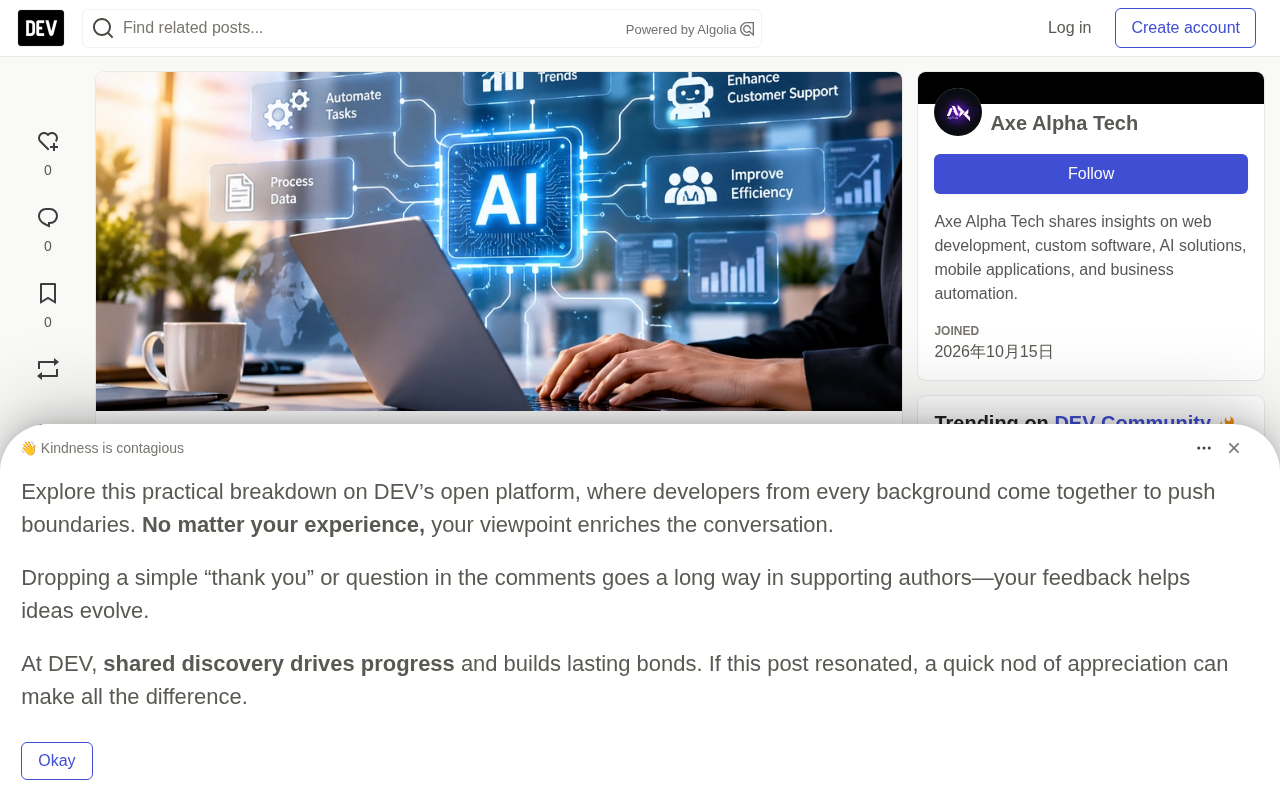
Daily business operations are filled with repetitive tasks—responding to customer inquiries, organizing information, managing internal processes. While necessary, these tasks slow teams down and drag productivity lower. This is precisely where AI automation delivers value: by combining artificial intelligence with automated processes, it helps businesses streamline routine affairs, improve decision quality, and build more efficient workflows. The key point is that it doesn't replace human expertise—it frees people from mechanical labor so they can focus on higher-value work.
What Is AI Automation
AI automation refers to using artificial intelligence to complete tasks that require analyzing information, recognizing patterns, or processing data. Its fundamental difference from traditional automation lies in this: traditional automation follows fixed instructions, while AI-driven systems can understand different types of information and support more flexible workflows.
A typical example is an AI customer service system—it can identify customer issues, classify requests, and suggest responses. This allows businesses to efficiently handle large volumes of routine inquiries while letting employees focus on more complex situations. For companies exploring AI automation solutions, the first step is usually identifying which repetitive processes are most worth prioritizing for simplification.
The Technical Divide Between Traditional and AI Automation
Traditional automation (such as RPA, Robotic Process Automation) relies on pre-written rule scripts—essentially deterministic logic of "if A happens, execute B." It excels at handling tasks with fixed formats, like batch-generating invoices from templates, but once the input changes (for example, a customer describes the same problem using different wording), the script fails.
AI automation introduces technologies like machine learning and natural language processing (NLP), enabling systems to handle unstructured data—email bodies, chat logs, scanned documents, voice, and more. Its core capability lies in "generalization": even without having seen exactly the same input, it can make reasonable judgments based on training data. For instance, an NLP model can understand that "Why hasn't my package arrived yet" and "order logistics status" express the same intent.
This difference determines the applicable boundaries of each: scenarios with clear rules and uniform formats are more cost-effective with traditional automation; scenarios involving semantic understanding, pattern recognition, and dynamic judgment require AI involvement. In practice, the two are often used complementarily, forming a layered architecture where "AI handles understanding and decision-making, while RPA handles execution."
How AI Automation Improves Business Operations
Reducing Repetitive Work
Employees spend large amounts of time each day entering data, organizing emails, updating records, and creating reports. AI automation solutions can significantly compress these administrative tasks by processing information and triggering preset actions. Common applications include:
- Email management: Automatically categorizing messages and flagging important requests
- Data processing: Extracting key information from documents
- Task management: Scheduling work assignments and sending reminders
- Report generation: Consolidating business information for review
Automating suitable tasks reduces administrative burden while improving operational consistency.
Creating Better Customer Experiences
Customers value fast responses, accurate information, and convenient service. AI-driven chatbots and virtual assistants can answer common questions, provide basic guidance, and route requests to the appropriate teams.
For example, an online retail company can use an AI assistant to help customers find product information or understand delivery processes. When issues become complex, human representatives take over to provide further support. This combination of automation and human assistance creates a smoother customer experience.
Supporting Smarter Business Decisions
Businesses accumulate vast amounts of information through websites, sales platforms, and customer interactions, but converting that information into actionable insights is no easy task. AI analytics tools can identify trends, consolidate data, and uncover patterns that might otherwise be overlooked—providing a basis for inventory planning, customer service improvements, and operational decisions.
It's important to recognize that reliable output still depends on accurate data input and ongoing evaluation mechanisms. If data quality falls short, AI conclusions are equally unreliable.
Connecting AI with Existing Digital Systems
AI tools deliver greater value only when connected to websites, customer management platforms, and internal applications.
Through software integration, businesses can build AI-driven workflows that link different stages together. For example, an online inquiry can be automatically classified and forwarded to the appropriate department, eliminating manual judgment and handoff steps. Companies planning business automation solutions should seriously consider how interconnected technologies can streamline operations and reduce unnecessary manual steps.
The Basic Mechanics of APIs and Software Integration
For AI tools to connect with existing systems (such as CRM, ERP, ticketing systems), they typically rely on APIs (Application Programming Interfaces). An API is essentially an agreed-upon "communication protocol" between systems: one system sends a request to another through the API, and the other processes it and returns a result.
A concrete example: when a customer submits an inquiry form on a website, the content can be sent via API to an AI classification model. After the model returns a "post-sale issue" label, the system makes another API call to automatically create a ticket in the CRM and assign it to the after-sales team. The entire process requires no human intervention.
Beyond APIs, there are several other common integration approaches: Webhooks (event-triggered push, suitable for real-time scenarios), middleware/integration platforms (such as Zapier, Make—ideal for non-technical teams to quickly build integrations), and direct database connections (suitable for large-batch data synchronization, but less flexible).
When choosing an integration approach, businesses need to weigh real-time requirements, development costs, and maintenance complexity. It's generally recommended to first validate process feasibility using mature integration platforms, then decide whether to invest in custom development based on business scale.
Challenges Businesses Need to Watch For
AI automation offers tangible opportunities, but successful implementation requires planning. Several key considerations:
- Data security: Protecting customer and business information from leakage or misuse
- System integration: Ensuring compatibility with existing software
- Accuracy: Reviewing AI-generated results and identifying potential errors
- Human oversight: Keeping employees involved in important decisions
Starting with a small project and gradually expanding automation scope after validating results is a more prudent approach.
Conclusion
AI automation is helping businesses break free from the constraints of repetitive tasks and move toward smarter, more interconnected operating models. By optimizing workflows, supporting employees, and making information easier to manage, intelligent technologies can sustain long-term business efficiency. For companies looking to plan smarter workflows and improve digital operations, starting with specific scenarios and prioritizing data foundations and human oversight is a practical path worth following.
Related articles

Free Unlimited Claude Code Solution: Agnes AI + CC Switch Setup Guide
No paid subscription needed — pair the free AI platform Agnes AI with the open-source tool CC Switch to provide a backend for Claude Code, enabling unlimited free calls to text, image, and video models. This guide covers the full setup, test results, and usage boundaries.

A Complete Zero-Cost Guide to Getting Started with Claude Code for Beginners in China
A beginner's guide to Claude Code for users in China: two installation methods (command line and IDE plugin), full configuration steps for replacing the official API with the free domestic LongCat model, and a hands-on demo of building a small tool with natural language, plus tips.

When the NSA Gets Involved: The AI Supply Chain Crisis Behind Open-Source CVEs and API Key Hijacking
Multiple open-source projects disclosed severe CVEs in one day, PHP flaws alarmed the FBI, and Railway and OpenCode were breached with API keys stolen. This article breaks down the vulnerability window, AI-accelerated exploitation, and the AI supply chain crisis behind the API key black market, with a developer defense checklist.