How AI Newcomers Can Break Into Remote and Freelance Markets: Lessons from a Job-Seeking Post
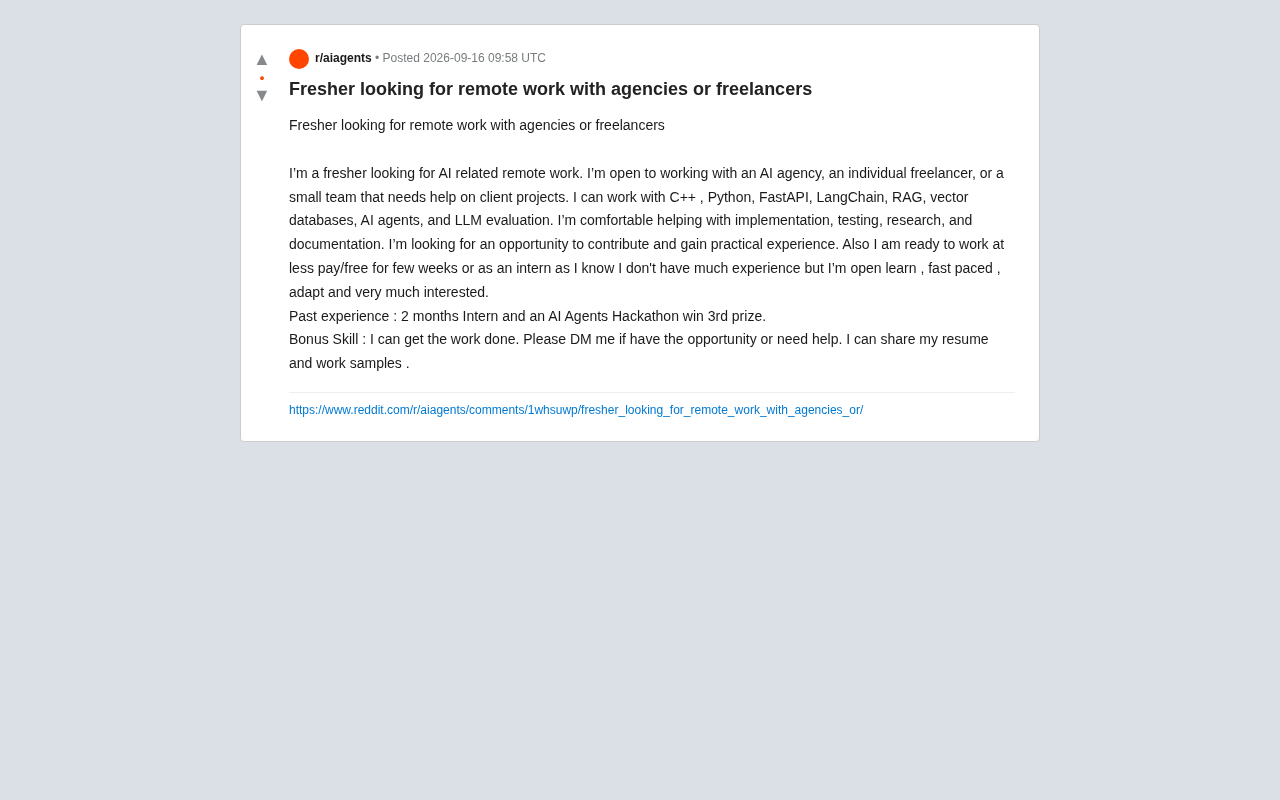
An AI fresher's Reddit job post offers a practical blueprint for newcomers breaking into freelance and outsourcing markets.
An AI newcomer with just two months of internship experience posted on Reddit seeking remote collaboration, showcasing a tech stack covering Python, FastAPI, LangChain, RAG, vector databases, and LLM evaluation. His willingness to start at low or no pay to gain real project experience highlights a common entry strategy—along with its risks, including the need for clear time limits, deliverable scopes, and retaining work samples. The post also provides a reusable self-promotion template: clear positioning, specific skill lists, honest experience disclosure, and a concrete call to action. This reflects a structural gap in AI engineering where hackathons and outsourcing have become the primary routes for newcomers to build verifiable credentials.
The Reality Behind an AI Job-Seeking Post
On Reddit, a developer who described himself as a "fresher" posted a request for remote work. He had no impressive résumé—just two months of internship experience and a third-place finish at an AI Agents hackathon—yet he clearly laid out the technical skills he could offer and his work ethic. Posts like this are becoming increasingly common in AI job-seeking communities, and they reflect a real cross-section of today's AI talent market: the tech stack evolves at lightning speed, and the question of how newcomers can parlay limited experience into a foot in the door is impossible to ignore.
His positioning was clear—rather than chasing a formal full-time role, he was targeting AI agencies, independent freelancers, or small teams that needed outsourced help. This "get a seat at the table first, negotiate later" strategy is worth considering for anyone else at the same starting point.
What His Tech Stack Reveals
The skill set listed in the post is quite representative: C++, Python, FastAPI, LangChain, RAG (Retrieval-Augmented Generation), vector databases, AI Agents, and LLM evaluation.
This combination covers the mainstream engineering chain for AI application development fairly comprehensively:
- Python + FastAPI: The standard setup for backend services and API development—essentially a prerequisite for shipping AI applications.
- LangChain + RAG + Vector Databases: The core trio for building knowledge Q&A and enterprise-grade retrieval applications, and currently the direction where client project demand is most concentrated.
- AI Agents and LLM Evaluation: More cutting-edge capabilities. Agent development and model evaluation are areas where many teams are short-staffed and struggle to standardize.
Notably, this newcomer proactively mentioned his willingness to take on four types of work: implementation, testing, research, and documentation. In real client projects, testing and documentation are often the parts senior engineers are reluctant to invest time in—yet they're indispensable. This is precisely a reasonable entry point for newcomers breaking into team collaboration.
RAG (Retrieval-Augmented Generation) is currently one of the most mainstream architectures for enterprise AI applications. The core idea: when a user asks a question, the system first retrieves relevant passages from an external knowledge base (such as company documents or product manuals), then feeds those passages along with the question into a large language model to generate an answer—addressing the twin pain points of knowledge cutoff dates and hallucinations. Vector databases (such as Pinecone, Weaviate, and Chroma) serve as efficient semantic search engines: text is converted into high-dimensional vectors and stored, then queries find the most relevant content by calculating vector similarity. LangChain provides the framework abstraction that chains LLMs, vector databases, and tool calls into a complete application pipeline. Together, these three form the dominant implementation path for everything from enterprise knowledge Q&A to customer service chatbots—and the technical direction with the densest concentration of client outsourcing demand.
The "Low Pay or Free" Strategy: Opportunity or Trap?
The most discussed point in the post was his explicit statement that he was willing to "work for low pay or free for the first few weeks, or join as an intern." This is a classic "trade experience for compensation" approach.
On the positive side, for a newcomer lacking commercial project experience, the training value of working on real client projects genuinely outweighs short-term pay. Participating in a deployed RAG system or Agent workflow yields debugging experience and collaboration process knowledge that grinding LeetCode and building personal demos simply can't replicate.
But this strategy carries risks that deserve a clear-eyed assessment:
- Boundaries on free work: Unpaid work should have a clearly defined time limit and scope of deliverables, to prevent it from becoming prolonged unpaid exploitation.
- Ownership of output: Even on low-pay or free projects, push to retain displayable work samples—that's the real "compensation."
- Market signaling: Overemphasizing "free" can be read by some employers as a lack of confidence in your own abilities. A safer framing is "willing to start with a trial project" rather than simply undercutting on price.
A Reusable Template for Newcomer Job Posts
Beyond this individual case, the post actually provides a solid self-promotion template in terms of structure—one that AI job seekers can borrow from:
1. Clear Positioning
Open by specifying your target collaborators (agencies, freelancers, small teams) rather than speaking in vague generalities.
2. A Specific Technical List
Present your capabilities with concrete tool names rather than empty phrases like "familiar with AI," so potential employers can quickly assess fit.
3. Honest Description of Experience
Acknowledge frankly that you don't have much experience, while using the internship and hackathon placement as credibility markers—more convincing than exaggeration.
4. Highlight Soft Advantages
Phrases like "fast learner, adaptable, I can get the work done" compensate for the lack of hard experience.
5. A Clear Call to Action
Proactively invite DMs and commit to providing a résumé and work samples, lowering the friction for the other party to reach out.
An Observation on the AI Industry's Talent Ecosystem
The prevalence of these kinds of job posts reflects a persistent structural tension in the AI engineering field: companies need engineers who can hit the ground running with LangChain, RAG, and Agents, but formal training pipelines haven't matured, and a large portion of capability comes from self-study and project practice. As a result, hackathons, open-source contributions, and short-term outsourcing have become the primary channels through which newcomers accumulate "verifiable experience."
For hiring parties, newcomers willing to start with small projects are also a low-cost way to test the waters—a short-cycle task can reveal someone's real skill level. For job seekers, the key is converting every low-barrier opportunity into displayable output, gradually building a reputation and portfolio.
The barrier to entry in the AI tech stack may look steep, but the path in is actually more flexible than you might imagine. This brief Reddit post is, in some ways, a snapshot of exactly that path.
LLM Evaluation is a specialized capability that has risen rapidly alongside the proliferation of large model applications—yet it's often overlooked by newcomers. The core problem it solves: when model output is open-ended natural language, how do you systematically measure its quality? Common evaluation dimensions include accuracy, faithfulness (does it stay true to retrieved source material?), relevance, and safety. On the engineering side, this typically involves frameworks like RAGAS and DeepEval, combined with human annotation or using another LLM as a "judge" to score outputs. Because the evaluation process is tedious and lacks unified standards, many teams skip this step during rapid iteration—only to have quality issues surface after launch. Newcomers who can take on evaluation work are actually filling a genuine staffing gap in the product delivery chain.
Related articles
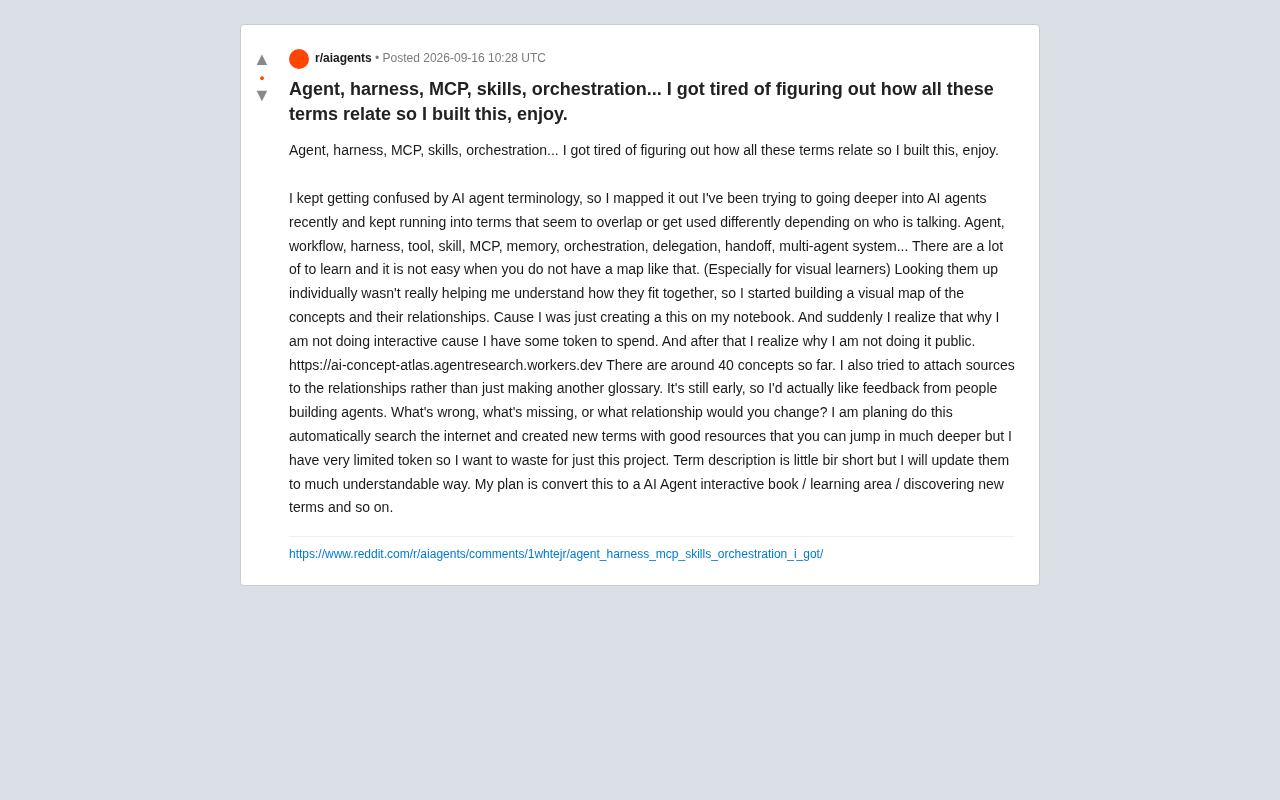
AI Agent Terminology Too Confusing? One Interactive Concept Map to Untangle 40+ Core Terms
Confused by AI Agent terms like MCP, harness, orchestration, and skills? AI Concept Atlas is an interactive map visualizing 40+ concepts and their relationships, with cited sources.

Meta's Broken Promise: Community Demands to Know Where the Muse Spark Weights Are
Meta promised to open-source Muse Spark model weights over a month ago, but still hasn't delivered. The community questions how this squares with Zuckerberg's "can't delay even a month" stance.
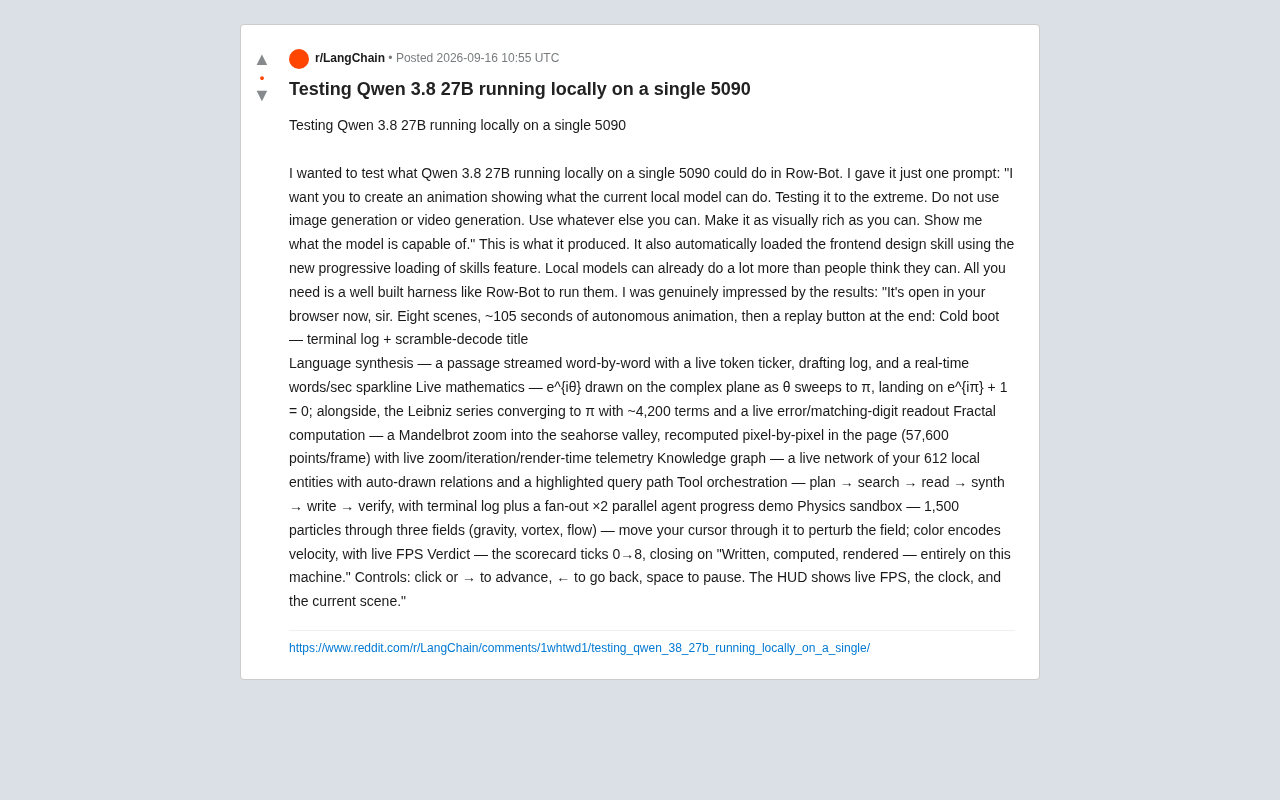
Running Qwen3 27B Locally on a Single RTX 5090: What Can It Actually Do?
A developer runs Qwen3 27B locally on a single RTX 5090 via the Row-Bot Agent framework, generating an 8-scene, 105-second interactive animation from one prompt — including real-time math, fractals, and physics.