How AI Tutors Break Through Student Learning Impasses: Key Findings from 20,000 Conversations
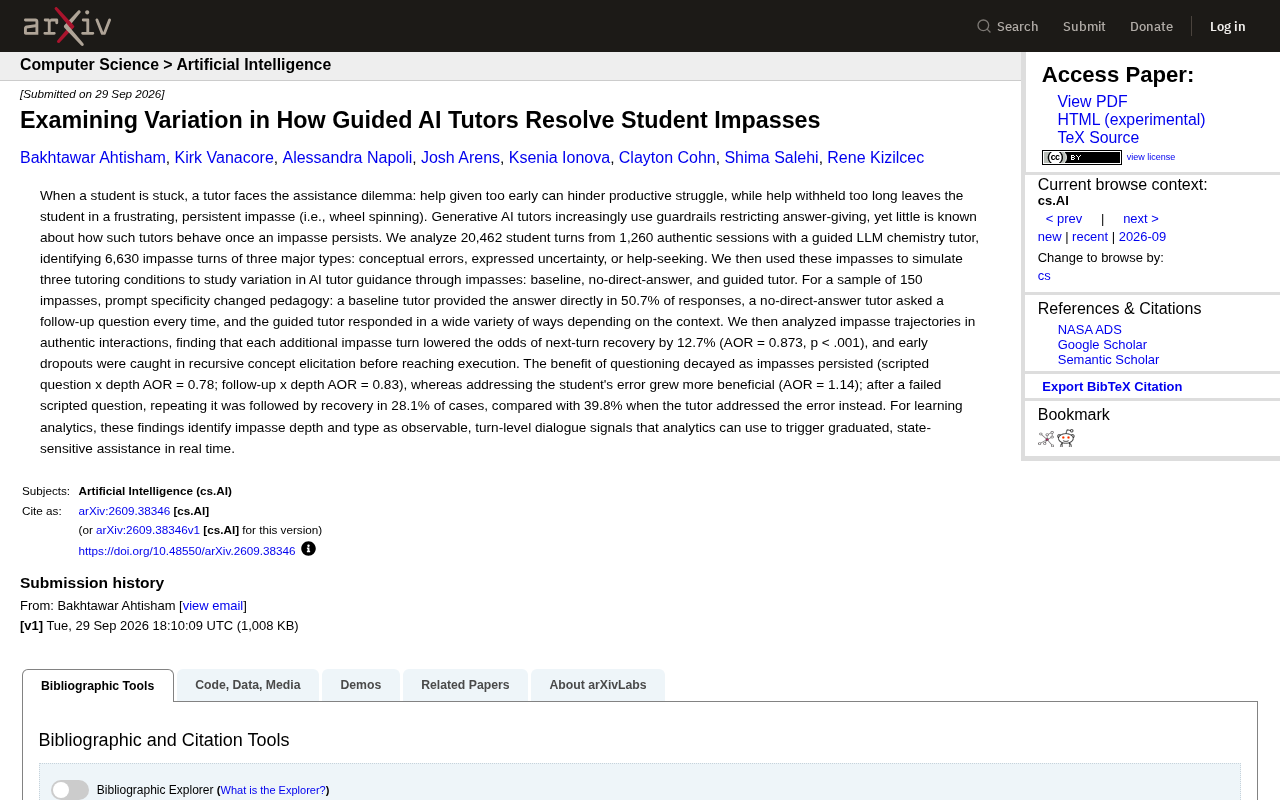
20,000 AI tutoring conversations show: the deeper the impasse, the less questioning helps — direct error correction is the key.
A study analyzing 1,260 real learning sessions found that each additional impasse turn reduces a student's resolution probability by 12.7%, and that intervention effectiveness reverses as impasses deepen. Early questioning helps, but persistent follow-up questions lose effectiveness over time — while directly addressing errors becomes increasingly powerful. After a failed scripted question, repeating it yields a 28.1% resolution rate; switching to direct error correction raises it to 39.8%. The findings challenge the popular "never give answers" guardrail approach, urging AI tutoring products to detect impasse states in real time and dynamically adjust support strategies.
When a student gets stuck, what should an AI tutor do? This seemingly simple question hides a classic dilemma at the heart of educational theory. A new study published on arXiv (arXiv:2609.38346) analyzed over 20,000 real tutor-student conversations to systematically reveal — for the first time — how guided AI tutors respond when students fall into persistent learning impasses, and how different intervention strategies actually perform.
The Assistance Dilemma: Too Soon or Too Late?
The study opens by framing the core contradiction in AI-based teaching: the "assistance dilemma." Providing help too early robs students of "productive struggle" opportunities and undermines learning outcomes. But withholding help for too long leaves students trapped in frustrating, unproductive cycles — a phenomenon known as "wheel spinning."
Today's generative AI tutors increasingly use "guardrails" to restrict direct answers, encouraging students to think independently. But a long-overlooked question is: what do these AI tutors actually do when impasses persist and students keep getting stuck at the same point? Until now, the field had almost no data on this.

The concept of "productive struggle" originates at the intersection of cognitive load theory and constructivist learning theory. Psychologist Robert Bjork incorporated it into his "desirable difficulties" framework: moderate cognitive resistance forces learners into deeper information processing, leading to more durable long-term memory. By contrast, "wheel spinning" was formally defined by Baker et al. in 2011 in the context of intelligent tutoring systems (ITS), describing a state where students repeatedly fail at a knowledge point without any progress — a negative signal that learning systems need to detect and address. Together, these concepts define the core design tension that adaptive learning systems have always faced: intervening too early eliminates productive struggle, while allowing ineffective loops to continue drains student motivation.
Mapping "Stuck Moments" Across 20,000 Real Conversations
The research team analyzed real usage data from a guided LLM-based chemistry tutor: 20,462 student turns across 1,260 authentic learning sessions. From this, they identified 6,630 "impasse turns" and categorized them into three types:
- Conceptual errors: students misunderstand the material
- Expressed uncertainty: students are unsure about their own answers
- Direct help-seeking: students explicitly ask for assistance
This data-driven classification grounds the research in real learning obstacles that students actually encounter — rather than lab-based hypotheses. It also represents a methodological strength: impasse depth and type are observable, turn-level conversational signals.
Prompt "Specificity" Shapes Teaching Style
To study how AI tutor behavior varies during impasses, the team designed three teaching conditions for simulation: a baseline tutor, a no-direct-answer tutor, and a guided tutor.
Tested on 150 impasse samples, the specificity of prompting directly changed teaching behavior:
- The baseline tutor provided a direct answer in 50.7% of responses
- The no-direct-answer tutor responded with follow-up questions every single time, mechanically avoiding answers
- The guided tutor showed the most flexibility, offering varied responses depending on context
This comparison is instructive: a blunt "never give answers" rule may hold the guardrail in place, but it also makes the tutor rigid — defaulting to questions regardless of the student's actual state. Only a thoughtfully designed guidance prompt enables AI to find a dynamic balance between "giving answers" and "promoting thinking."
In large language model applications, "guardrails" typically refer to behavioral constraints applied to model outputs through system prompts or external filtering layers. In educational settings, these constraints are often designed to prevent direct answers, stopping students from bypassing the learning process by copying AI responses. However, the granularity of prompting determines how flexible those guardrails are: highly rule-based prompts (e.g., "never give the answer") cause the model to mechanically execute the same strategy in every context, while fine-grained, context-aware prompts allow the model to select different responses for different learning states. This finding aligns with research in prompt engineering — the clarity and specificity of instructions directly affect LLM behavioral diversity and contextual adaptability.
The Deeper the Impasse, the Harder to Escape
The study's most valuable findings come from analyzing "impasse trajectories" in real interactions. The data shows that for each additional impasse turn a student experiences, the probability of successfully resolving the next turn drops by 12.7% (adjusted odds ratio AOR = 0.873, p < .001). In other words, impasses compound — the longer a student is stuck, the harder it becomes to get unstuck.
More critically, the effectiveness of different intervention strategies reverses as the impasse deepens:
- Questioning loses its effect: the interaction term for scripted questioning and impasse depth yielded AOR = 0.78; for follow-up questions, AOR = 0.83 — both indicating that questioning becomes less helpful as the impasse persists
- Error-targeting responses grow more effective: strategies that directly address student errors actually become more effective over time (AOR = 1.14)
One particularly striking data point: after a scripted question fails and the tutor simply repeats it, the student's resolution rate is 28.1%. But if the tutor instead directly addresses the student's error, the resolution rate rises to 39.8%.
This means persistent questioning is not a universal remedy. Early in an impasse, questions can spark thinking. But when a student is already deeply stuck, continued roundabout questioning only amplifies frustration — at that point, directly confronting and correcting the error is the more effective path forward.
The "Adjusted Odds Ratio" (AOR) used in the study is a statistic from logistic regression analysis that measures the effect of a given factor on a binary outcome (here, whether the student resolved the impasse), while controlling for other variables. AOR = 0.873 means each additional impasse turn reduces the probability of resolution by approximately 12.7% (i.e., multiplied by 0.873); AOR = 1.14 means each instance of error-targeting response increases resolution probability by approximately 14%. The inclusion of "interaction terms" is especially important — they capture not the main effect of a strategy in isolation, but the joint effect of a strategy combined with impasse depth, revealing the counterintuitive finding that the same strategy can have opposite effects at different stages of an impasse. This type of dynamic effect analysis, tracking how outcomes evolve over time, is far more reflective of the complexity of real teaching situations than simply comparing which strategy is "better."
Practical Implications for AI Education Products
The study also flags a concerning pattern: students who dropped out early were often trapped in "recursive conceptual questioning" loops, never able to move from conceptual discussion into actual problem-solving. AI tutors repeatedly circling at the conceptual level ultimately pushed students to the point of giving up.
For learning analytics and AI education products, this research offers actionable design guidance: impasse depth and type are real-time, observable conversational signals that systems can use to trigger "tiered, state-sensitive" assistance.
Specifically, an effective AI tutor should:
- Use questions in the early stages of an impasse to encourage independent exploration
- Monitor impasse depth in real time, and switch strategies when repeated sticking points are detected
- For deep impasses, decisively shift from "questioning mode" to "direct error-correction mode" to avoid unproductive loops
This challenges the currently dominant "one-size-fits-all, never give answers" approach to guardrail design. Truly effective AI teaching isn't about whether to give answers — it's about whether the system can dynamically adjust the intensity and method of support based on the student's real-time state. As AI tutors become more prevalent in educational settings, this kind of data-driven, nuanced pedagogical strategy may become the key differentiator between products that work and those that don't.
Related articles

LLaMA-Factory in Practice: A Complete No-Code Guide to Fine-Tuning Large Models
An introduction to LLaMA-Factory, the open-source fine-tuning tool: its 60.1K-star background, supported models and algorithms, local vs. cloud deployment, and CUDA setup steps.

Zeng Ming's Deep Retrospective: Why OpenAI May Not Be the Ultimate Winner — and Why the Corporate System Will Disappear
Zeng Ming's deep retrospective on the AI endgame: model companies are just infrastructure, OpenAI and Anthropic won't be the final winners; the next battle is the Agent entry point standard; the corporate system will disappear as AI restructures collaboration, and only mission-driven companies can survive the cycle.

OpenHands v1.28.0: OpenCode and PI Added as Built-in Agents, API Keys Requestable In-Conversation
OpenHands ships 5 releases in 21 days: v1.27.0 adds OpenCode and PI as built-in agents, v1.28.0 enables in-chat key requests. ACP integration, credential reuse, model list changes, and upgrade advice.