How Cursor Indexes Codebases: Engineering Practices with Merkle Trees and Incremental Sync
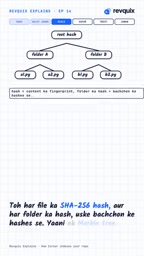
Cursor uses Merkle-tree incremental codebase index sync to cut query time from 7.87s to 525ms.
The article explains how Cursor uses Merkle trees to make full-codebase search efficient for AI coding assistants. Each file gets a SHA-256 hash, and folder hashes aggregate child nodes up to a root hash, making the tree a fingerprint of codebase state. Sync has four steps: build the hash tree bottom-up; compare downward from the root and sync only changed branches; the client submits its full tree so the server can filter out unprovable search results via Content Proofs; and finally return an index snapshot strictly matching the client's code state. Because costs shift from codebase-size-proportional to change-size-proportional, median first-query time drops from 7.87s to 525ms. The mechanism shares its origins with Git, showing that AI tool performance often depends on the refinement of the underlying data pipeline.
Why AI Coding Tools Need an Indexing Mechanism
An AI coding assistant has to answer a seemingly simple question: "Where is this function used in this project?" Behind that lies a search across the entire codebase. If every edit required re-uploading and re-parsing all files, the network bandwidth and processing overhead would be unbearable, and responses would be unacceptably slow.
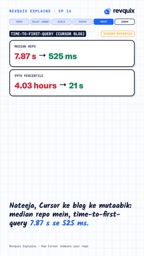
Cursor's solution borrows a classic data structure from distributed systems—the Merkle tree: the content hash of each file, along with the sub-hashes of each folder, are aggregated to form a tree that can be compared quickly. This way, each sync only needs to identify the changed branches and sync those, rather than re-uploading everything. According to the video explanation, this mechanism reduced the first-query time for the median repository from 7.87 seconds to 525 milliseconds.
A Merkle tree is a hash-aggregation tree structure proposed by Ralph Merkle in 1979. Its core construction is: leaf nodes store the hashes of data blocks, and the hash of a non-leaf node is obtained by concatenating and re-hashing the hashes of all its child nodes, recursing upward until a single root hash. In this way, the root hash acts as the "fingerprint" of the entire dataset—any single bit change in the data propagates up the path to the root, changing the root hash. To verify whether a data block belongs to the tree, you only need to provide the sequence of sibling node hashes from that block to the root (i.e., a Merkle Proof), with verification cost O(log n) and no need to transmit all the data. This property makes Merkle trees widely used in consistency verification of distributed systems, transaction integrity proofs in blockchains, Git's object storage, and chunk verification in BitTorrent.
Four-Step Sync: From Hash Comparison to Result Filtering
Step 1: Build the Hash Tree Bottom-Up
Compute a SHA-256 hash for each file; each folder's hash is aggregated from the hashes of all its child nodes (child files and child folders), layer by layer up to the root node. Any change in file content propagates all the way up through parent nodes to the root hash, making the entire tree a "fingerprint" of the codebase state.
Step 2: Compare Layer by Layer Downward from the Root
The client and server each hold their own tree. During sync, both sides compare hashes starting from the root and moving downward layer by layer: as soon as a branch's hash matches, the entire subtree is skipped; only the branch whose hash has changed is explored further, ultimately syncing only the content that actually changed.

Step 3: Content Proofs Verify Content Ownership
The client sends its complete Merkle tree to the server, and the server compares each search result against the tree submitted by the client. Any file that the client cannot prove (i.e., the hash doesn't match, the file has changed, or the file isn't held by the client) has its search results directly filtered out. This amounts to a consistency check on search results, preventing the return of stale index content or content that doesn't belong to that client.
A key premise of hash-tree comparison is that both trees involved must come from a trusted party. By sending its complete Merkle tree to the server, the client is effectively submitting a declaration of "my current code state"; if a search result returned by the server points to a file hash that doesn't exist in the client's tree, that result is based on a stale index or belongs to another codebase. This approach is isomorphic to light-client verification in blockchains: a light node doesn't download all blocks, only holds block headers, and uses Merkle Proofs to verify whether a transaction is included in a block. Cursor here inverts the "prove that some data exists" mechanism into a filter that "proves that some result is invalid," thereby ensuring consistency between results and the client's current code state amid unreliable networks and asynchronous indexing.
Step 4: Return by Snapshot
After layer-by-layer sync and result filtering, the client obtains an index snapshot that strictly corresponds to its current code state. Subsequent edits only require incremental updates along the changed branches, with no need to repeat full processing.
Why the Performance Gain Reaches This Magnitude
The time is concentrated in two places: upload and comparison. With full re-upload, network transmission and server-side parsing are the main costs; with a Merkle tree, the vast majority of branches are determined to be unchanged at the root or high-level nodes, so only the small changed portion needs to be transmitted and processed—shifting the cost from "proportional to codebase size" to "proportional to change size."
This explains the magnitude of the difference in that data: 7.87 seconds to 525 milliseconds is nearly an order-of-magnitude reduction, not a minor optimization. For projects with larger codebases, this benefit is usually even more pronounced.

Engineering Wisdom Shared with Git
Interestingly, this design is not an original invention of the AI era. Git likewise builds tree structures using content-generated hashes to determine which objects have changed and which can be reused. The video states outright that this is "the same trick" Git uses.
Migrating a mechanism proven for years in the version-control domain to the AI indexing scenario is a pragmatic engineering choice: there's no need to invent a new protocol—just layer proof and filtering logic for search results on top of an existing structure. This also illustrates that the performance competition among AI tools is often not about the model itself, but about how refined the data pipeline around the model is.
Takeaways from This Mechanism
For developers, the Merkle tree approach has broader reuse value: any scenario that needs to determine "where two data structures differ"—incremental builds, cache invalidation, object synchronization—can consider using a hash tree to minimize comparison costs. For tool developers, Cursor's case shows that, at a time when model capabilities are converging, low-level engineering details such as indexing and synchronization are often the key variable determining interaction smoothness.
One-line Summary
Cursor uses Merkle trees to incrementally sync its codebase index, cutting query time from 7.87 seconds to 525 milliseconds.
Paragraph Summary
The article explains how Cursor uses Merkle trees to solve the efficiency of full-codebase search for AI coding assistants. Each file is hashed with SHA-256, and folder hashes are aggregated from child nodes layer by layer up to a root hash, making the entire tree a fingerprint of the codebase state. Sync proceeds in four steps: build the hash tree bottom-up; compare layer by layer downward from the root and sync only changed branches; the client submits its complete tree so the server can use Content Proofs to filter out search results that cannot be proven; and finally return an index snapshot strictly corresponding to the client's code state. Because transmission and comparison costs shift from "proportional to codebase size" to "proportional to change size," the first-query time for the median repository drops from 7.87 seconds to 525 milliseconds. This mechanism shares its origins with Git, showing that the performance competition among AI tools often depends on the refinement of the underlying data pipeline.
Related articles
Cursor Agent Whiteboard Breakdown: Rul…
Cursor Agent Whiteboard Breakdown: Rules, Checkpoints, and Safety Nets
A whiteboard breakdown based on Cursor's official docs and course, covering the Cursor Agent's working loop, three rule types (project rules/user rules/AGENTS.md), checkpoints and steering as two safety nets, plus officially acknowledged loop traps and advice to start with small tasks.

Simulive One-Click Connect Claude/ChatGPT/Cursor to Your Workspace
Simulive now supports one-click connection of Claude, ChatGPT, Cursor and other AI tools to your workspace—no API key copying, with fine-grained permissions, operation confirmation, rate limiting and audit logs, letting users process data with their own AI.

Goodbye Repetitive Prompting: A Practical Guide to Cursor Project Rules
Cursor Project Rules let the AI agent read preset instructions before coding, so you stop repeating prompts. Learn how to create rules, the four activation modes, and team tips to unify coding conventions with .cursor/rules.