How Databricks Manages AI Model Deployment at Scale with Unity Gateway

Databricks uses Unity Gateway to deploy frontier AI models company-wide on day one, guided by real usage data.
Databricks has outlined a mature enterprise AI adoption framework centered on making new models available to all employees the day they launch. The Unity Gateway serves as a unified entry layer that centralizes model access control, usage budgets, and model switching — consolidating scattered API calls into a single observable, governable plane. This architecture standardizes new model onboarding so engineering teams don't need to rework downstream applications each time. Built on top of this foundation, Databricks takes a data-driven approach to model governance: deploy quickly, then use real usage frequency, task performance, and cost-efficiency data to determine which models merit long-term investment — rather than relying on pre-deployment theoretical benchmarks.
Getting Employees on the Best Models from Day One
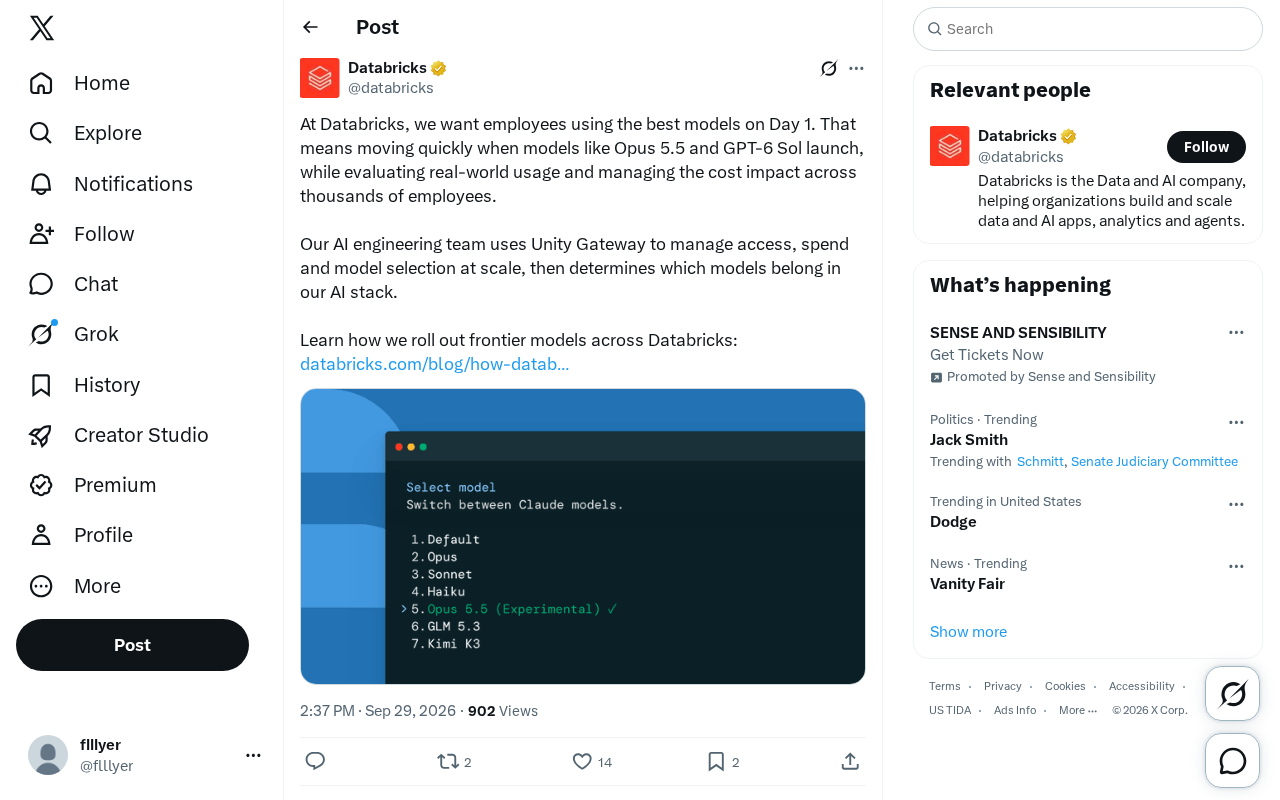
Databricks has publicly shared its internal strategy for rolling out frontier AI models, and the core goal is simple: make sure employees can access the best available models the day they launch. When next-generation models like Opus 5.5 or GPT-6 Sol emerge, the question for enterprises isn't whether to adopt them — it's how to deploy them quickly and in a controlled way.
For a company with thousands of employees, this seemingly straightforward goal hides three challenges that must be solved simultaneously: how to onboard new models quickly, how to evaluate real-world performance, and how to keep costs under control at scale. These may sound simple, but they represent the practical barriers nearly every large organization runs into when adopting generative AI.
Three Core Challenges: Speed, Evaluation, and Cost
Databricks' approach reveals the central tension in enterprise AI adoption. First is speed — frontier models iterate rapidly, and falling behind means employees lose out on productivity and innovation advantages. Second is evaluation — the benchmark metrics vendors advertise often diverge from actual business performance, so organizations need real usage data to determine whether a model genuinely delivers value. Third is cost — when thousands of employees simultaneously call high-performance models, token consumption and API fees accumulate fast, and without controls, spending can spiral out of control.
These three factors pull against each other: chasing speed can compromise evaluation rigor, while strict cost controls can slow down deployment. Databricks' solution is a unified gateway system designed to address all three at once.
Unity Gateway: A Centralized Model Access Hub
According to Databricks, its AI engineering team uses Unity Gateway to manage three things at scale: access, spend, and model selection. In effect, this is a unified entry layer for all enterprise AI model interactions.
Through this hub, organizations can centrally manage who can access which models, set usage budgets per team or individual, and flexibly switch between multiple available models. The architectural value lies in consolidating what would otherwise be scattered model calls into a single observable, governable plane — administrators no longer need to build separate onboarding pipelines for each new model, and they can monitor company-wide AI usage and spending in real time.
Critically, the gateway layer turns "rapidly onboarding a new model" into a reusable, standardized operation. When a new model like Opus 5.5 or GPT-6 Sol becomes available, the engineering team simply configures it in the gateway, and everyone can start using it immediately — no need to rework downstream applications one by one.
From an architectural standpoint, Unity Gateway is essentially an AI model routing proxy layer (AI Gateway / LLM Proxy) — a category of infrastructure component that has rapidly become a standard part of enterprise AI engineering over the past two years. The core principle is inserting a middleware layer between business applications and underlying model APIs, exposing a single unified endpoint to downstream callers. Open-source implementations of similar concepts include LiteLLM, PortKey, and Kong AI Gateway. These gateways typically provide: unified API key management (eliminating the security risk of individual teams holding their own vendor credentials), per-team or per-user token quotas, cross-vendor model alias routing (so business code doesn't need to know whether it's calling Claude or GPT under the hood), and centralized call log aggregation. For Databricks specifically, the "Unity" naming also suggests integration with Unity Catalog — the company's data and AI asset governance platform — meaning model access permissions can be tied into the organization's existing data permission framework rather than maintained as a separate, isolated control system.
From Usage Data to AI Stack Decisions
There's another notable feedback loop in Databricks' process: deploy first, then use real-world usage data to decide which models should be officially incorporated into the company's AI technology stack.
This is a data-driven approach to model governance. Rather than conducting extensive theoretical evaluations before deployment, the strategy is to roll out models quickly within a controlled environment, then use actual usage frequency, task performance, and cost-effectiveness to filter out which models are worth long-term investment. The usage and spend data surfaced by the gateway provides exactly the evidence needed for these decisions.
This methodology offers a useful template for other organizations looking to adopt AI at scale: model selection shouldn't be a one-time, static decision, but an ongoing, iterative process driven by real usage data — survival of the fittest based on actual results.
This "deploy first, evaluate later" mindset methodologically maps to the Shadow Testing and Online Evaluation paradigm — analogous to the Canary Release pattern in traditional software delivery. Unlike offline benchmarking (e.g., running MMLU or HumanEval scores on a fixed dataset), online evaluation captures real user behavioral signals: which requests were retried (suggesting unsatisfactory results), which task types had higher completion rates, and which models are used more heavily in specific departments. These signals reflect business value far better than lab metrics, but they require systematic collection and analysis. The logging infrastructure at the gateway layer is precisely what makes online evaluation possible: only when call data is centrally recorded can you make cross-model, cross-team comparisons, and form quantitative judgments about which models are worth renewing or deeply integrating.
Implications for Enterprise AI Adoption
Databricks' approach, though summarized briefly, outlines a mature enterprise AI adoption framework: set "best model available on day one" as the goal, use a unified gateway as the technical foundation, and rely on real usage data as the basis for decisions — striking a balance between speed, performance, and cost.
For teams exploring large-scale AI deployment, there are two core takeaways. First, onboarding frontier models requires an abstraction layer — a unified gateway can dramatically reduce the cost of switching and governance. Second, model evaluation should be embedded in real business workflows, not confined to laboratory benchmarks. Organizations that can get new models into employees' hands faster, more efficiently, and more intelligently will have a decisive edge in the AI race.
Related articles

Free Unlimited Claude Code Solution: Agnes AI + CC Switch Setup Guide
No paid subscription needed — pair the free AI platform Agnes AI with the open-source tool CC Switch to provide a backend for Claude Code, enabling unlimited free calls to text, image, and video models. This guide covers the full setup, test results, and usage boundaries.

A Complete Zero-Cost Guide to Getting Started with Claude Code for Beginners in China
A beginner's guide to Claude Code for users in China: two installation methods (command line and IDE plugin), full configuration steps for replacing the official API with the free domestic LongCat model, and a hands-on demo of building a small tool with natural language, plus tips.

When the NSA Gets Involved: The AI Supply Chain Crisis Behind Open-Source CVEs and API Key Hijacking
Multiple open-source projects disclosed severe CVEs in one day, PHP flaws alarmed the FBI, and Railway and OpenCode were breached with API keys stolen. This article breaks down the vulnerability window, AI-accelerated exploitation, and the AI supply chain crisis behind the API key black market, with a developer defense checklist.