How Did Vercel Make the Mercedes F1 Team Website Faster?
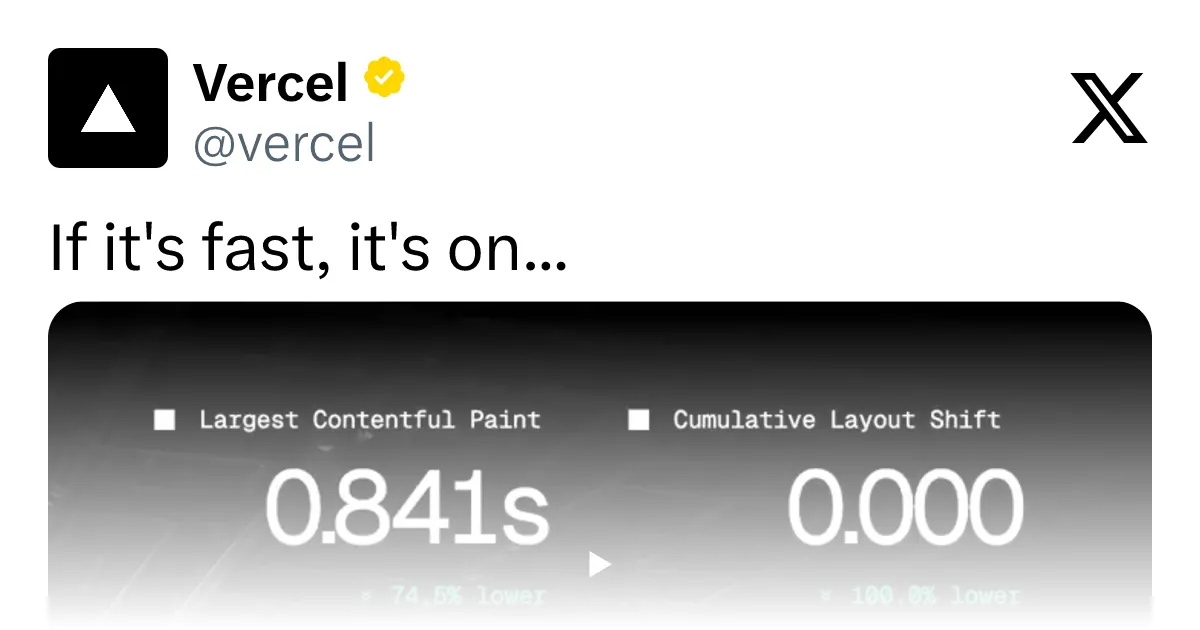
Vercel claims to have made the Mercedes F1 website faster, highlighting the business value of performance in sports.
Vercel announced on social media that it made the Mercedes-AMG F1 team website faster, drawing attention from developers and fans. The article notes that the F1 website is not just an information window but a core channel for monetization, where loading speed directly affects conversion rates and sponsor satisfaction. Vercel likely achieved the speed boost through its global edge network, image optimization API, and Incremental Static Regeneration (ISR), though specific data was not disclosed. Sports digitalization is becoming teams' second battlefield off the track—performance is business results. For developers, this case showcases modern web architecture concepts like edge computing and on-demand static generation that are worth learning from.
Vercel posted a brief update on social media: "If it's fast, it's on Vercel. We just made @MercedesAMGF1 even faster." The message quickly drew attention from the developer community and F1 fans alike. As a star platform in the frontend deployment space, Vercel's collaboration with the Mercedes-AMG F1 team is nothing new—but the phrase "even faster" reflects just how important high-performance websites are to the modern sports business.
Why F1 Teams Need "Faster" Websites
An F1 team's official website is more than just an information display window—it's a core channel for commercial monetization. From live race data, sponsor exposure, and merchandise sales to VIP ticket bookings, every millisecond of loading delay can translate into lost users. According to industry research, for every 1-second increase in page load time, mobile conversion rates can drop by roughly 20%. For a top-tier team like Mercedes F1, the official site must simultaneously handle instant visits from millions of fans worldwide, especially on race weekends.
Vercel's global edge network and automatic static optimization capabilities are a perfect match for this high-concurrency, low-latency scenario. Although Vercel hasn't disclosed specific technical details, judging from its product matrix, this "speed boost" likely involves upgrades to edge rendering, image optimization, and intelligent caching strategies.
How Vercel Achieves "Speed"
Vercel's core competitiveness lies in automating deployment and performance optimization. Its edge network covers multiple regions worldwide, allowing static assets and dynamic content to be served from the node closest to the user. For sites like the F1 official website that contain large amounts of high-definition images, real-time scores, and video content, Vercel's image optimization API can generate images tailored to device dimensions on demand, reducing bandwidth consumption.
Additionally, Vercel's Incremental Static Regeneration (ISR) technology allows pages to be regenerated on demand in the background, combining static speed with dynamic updates. This means frequently changing content like race results and standings can be updated quickly without a full site rebuild. This architecture is especially critical for the F1 scenario, where races take place every week during the season.
Edge Network refers to an architecture that distributes servers and data centers across multiple geographic locations worldwide, so that user requests are handled by the nearest node, thereby reducing network latency. Vercel's edge network is built on CDN (Content Delivery Network) but goes further by supporting server-side logic execution at edge nodes (such as edge functions), rather than merely caching static files. For globally accessed sites like the F1 official website, the edge network can significantly reduce round-trip time (RTT) across continents, especially maintaining responsiveness during traffic spikes on race weekends.
Incremental Static Regeneration (ISR) is a rendering strategy introduced by Next.js that allows static pages to be regenerated on demand after build time. Developers can set a revalidation time (revalidate) for a page; when a request arrives and the cache has expired, the system triggers page regeneration in the background while first returning the old version to ensure speed. This approach combines the performance of static site generation (SSG) with the dynamism of server-side rendering (SSR), making it particularly suitable for scenarios where content updates frequently but doesn't require real-time personalization—such as race results and standings.
The Performance Race in Sports Digitalization
Mercedes F1's collaboration with Vercel is not an isolated case. In recent years, multiple sports leagues and teams have begun treating digital experiences as a "second battlefield" off the track. Website speed directly affects sponsor satisfaction and fan loyalty. By emphasizing "faster" at this moment, Vercel is both confidently showcasing its own technology and sending a message to potential customers: in an era of scarce attention, performance is business results.
You may not have noticed that this tweet didn't disclose specific performance improvement data (such as changes in LighthouseAd scores or loading time comparisons), so the outside world cannot yet quantify the degree of "faster." But what's certain is that Vercel is using the F1 team as a high-profile case for its high-performance deployment capabilities, and more detailed technical blogs or case studies may be released in the future.
Takeaways for Developers
For ordinary developers, Vercel's collaboration with Mercedes F1 provides a window into modern web architecture. Edge computing, on-demand static generation, and automated image optimization are becoming standard features of high-performance websites. If your project also faces the challenges of global user access and dynamic content updates, it's worth referencing Vercel's solution approach—even if you don't directly use its platform, you can still learn from its architectural philosophy.
Although this tweet is brief, the technical story behind it is worth following. As the F1 season progresses, the Mercedes official website's performance may become Vercel's best living advertisement.
Related articles

Claude Code in Practice: Building a Zero-Code Clip Factory That Turns Long Videos into Vertical Shorts Automatically
Bilibili creator Wukong uses Claude Code to build a zero-code clip factory, automatically turning a 35-minute long video into 10 vertical shorts. Full workflow from Plan Mode, Whisper transcription, claude.md rules, hook QA to subagent review and plugin distribution, with real measured data.

WorkBuddy Complete Guide: How AI Agents Automate File Conversion for You
WorkBuddy hands-on guide: from Doubao giving only plans to AI agents that actually execute—batch-convert PDFs and archive them in three minutes. Includes installation, points system, Codex comparison, and getting-started tips.

Zero to One: Java + DeepSeek in Practice — A Programmer's Guide to Transitioning into AI Large Model Development
Based on a Bilibili livestream tutorial, this article explains how Java programmers can transition into AI large model development from zero, covering skill paths, building your first Java AI app, resume packaging, and job-hunting strategies to help you seize opportunities in the large model era.