How Do Production AI Agents Unify Email and Multi-Channel Messaging Integration?

Production Agents need adapter layers, queues, and identity mapping to solve multi-channel integration and session state challenges.
The article centers on a Reddit developer's question about connecting the same production Agent to email, Slack, and other channels. The core contradiction: Agent business logic should exist in one copy, but channel protocol, format, and session boundary differences fork the integration layer. Mainstream practices include a channel adapter layer unifying inbound events and outbound reply contracts, webhooks or IMAP polling for inbound, queued outbound consumption at channel rates, an identity mapping layer normalizing email addresses, chat user IDs, and phone numbers into a unified entity, channel-native threads as session keys with explicit lifecycle, and externalized state for stateless scalability. Self-built connectors and integration platforms coexist, with choice depending on channel count and team operations.
Why Multi-Channel Routing Is a Must-Answer Question for Production Agents
When an AI Agent moves from demo to production, the first problem that surfaces is often not model capability but "how does it talk to the real world." Email, Slack, Discord, SMS, in-app messaging—each channel has its own protocol, rate limits, message formats, and conversation boundaries. A developer on Reddit posted asking: "How do you organize the integration structure and session state when connecting the same production Agent to email and other messaging channels?" The poster explicitly wanted experience from "people who have already shipped this," not theoretical speculation.
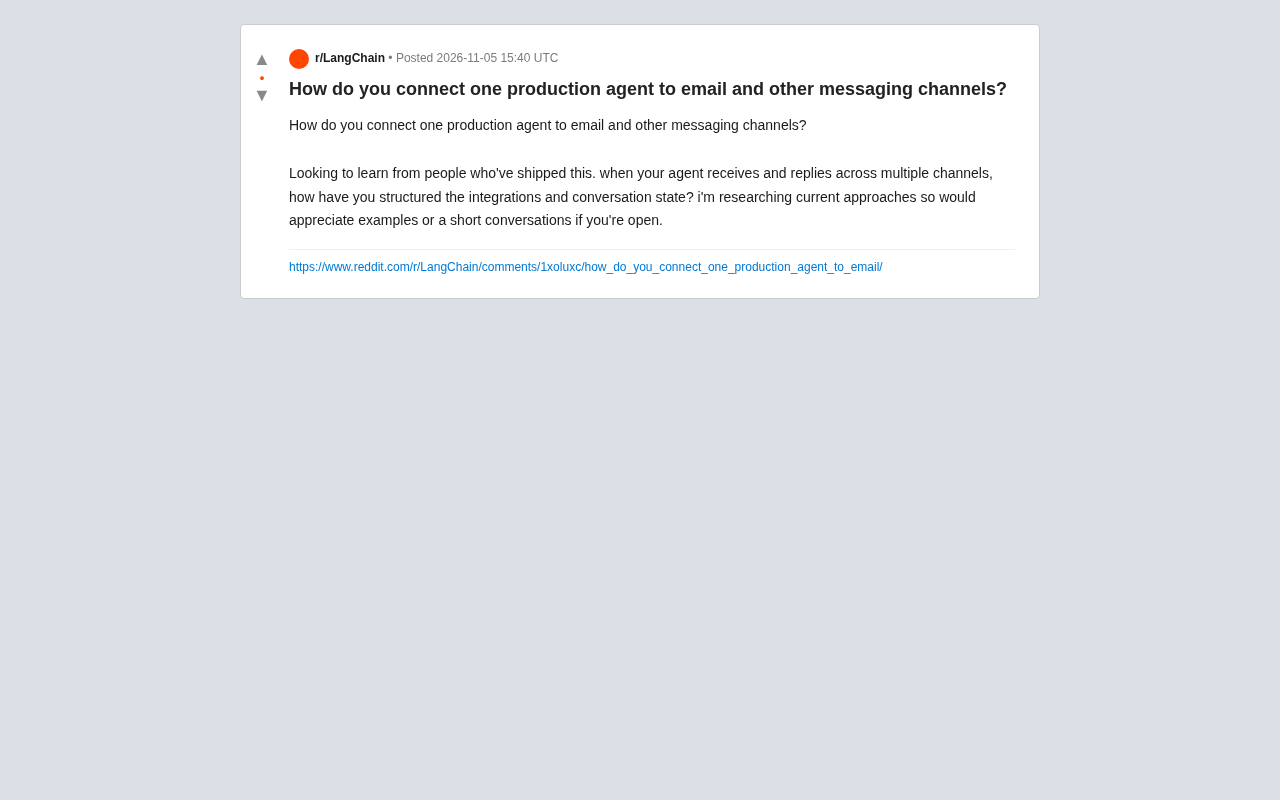
This question itself points to the core contradiction: the Agent's business logic should exist in only one copy, but the channel integration layer often forks due to platform differences. Below we break down current mainstream approaches along two dimensions: integration architecture and session state.
Integration Layer: Keeping Channel Differences Outside the Agent
The Adapter Pattern Is the Most Common Answer
Most teams that have shipped won't let the Agent call each platform's SDK directly. Instead, they add a "channel adapter" layer in between. Each channel implements a unified input/output contract: inbound messages are converted into standard events (sender identity, channel type, session ID, text or rich media), and outbound replies are translated back into the corresponding channel's format. This way the Agent's core logic only faces one message abstraction, and adding a new channel means adding an adapter rather than modifying the Agent itself.
The adapter pattern is essentially one of the structural patterns in the GoF design patterns. Its core idea is to convert the interface of a class into another interface that clients expect, enabling classes that couldn't collaborate due to incompatible interfaces to work together. In the Agent channel integration scenario, it typically lands in the form of "ports-and-adapters" architecture (hexagonal architecture): the Agent core defines a set of abstract ports, such as receive_message and send_reply, and each channel implements a corresponding adapter. The key benefit of this design is dependency inversion—the core business logic doesn't depend on any specific channel SDK but on abstract contracts, making new channels pure incremental work. Note that the adapter pattern doesn't eliminate semantic differences between channels; it only isolates them at the boundary. Therefore, the granularity of adapters and the quality of contract design directly determine whether the abstraction layer will "leak."
Webhooks for Inbound, Queues for Outbound
Channel integration usually splits into two directions. On the inbound side, email goes through IMAP polling or the email provider's webhooks, while instant messaging platforms generally offer event callbacks. On the outbound side, calling channel APIs synchronously can easily trigger rate limits during peak periods, so a more robust approach is to first deliver replies to an internal queue, then have independent sender workers consume at each channel's rate. A recurring consensus in the discussion is: the integration layer must be able to deploy and scale independently of the Agent, otherwise a failure in one channel can drag down the entire Agent.
A webhook is an HTTP callback mechanism initiated by the server: when the channel platform receives a new message, it pushes a POST request containing event data to a URL pre-registered by the developer. Compared to polling, webhooks offer lower latency and lower resource consumption, but require the integrator to provide a publicly reachable endpoint that responds quickly and to handle signature verification, replay attack protection, and failure retries. IMAP polling is the traditional approach for email scenarios, fetching new emails by periodically pulling mailbox folders, with real-time performance affected by the polling interval. The "queue" mentioned on the outbound side usually refers to a message queue (such as RabbitMQ, Kafka, SQS), whose value lies in peak shaving and decoupling: sender workers can consume from the queue at a steady rate matching each channel's rate limit, so even if the upstream Agent instantly generates a large number of replies, it won't directly hit the channel API's rate limits. Queues also naturally support retries and dead-letter handling, improving the reliability of the outbound path.
Session State: Cross-Channel Identity Unification
Same User, Multiple Channel Identities
The truly tricky part is state management. The same user is an address in email, a workspace + user ID in Slack, and a phone number in SMS. For the Agent to remember "what this person asked about in email yesterday," you need an identity mapping layer that normalizes each channel's identifiers into a unified user or session entity. Without this layer, cross-channel context breaks, and the Agent behaves as if it has amnesia.
In engineering, the identity mapping layer usually takes the form of a "channel identity table": each record contains the channel type, the channel-unique identifier (such as email address, Slack's team_id + user_id, phone number), and a foreign key pointing to the unified user entity. When an inbound message arrives, the adapter first looks up the table to resolve the unified user ID, then injects it into the standard event handed to the Agent. For cases that cannot be matched directly, a common approach is to introduce an account binding flow—for example, linking multiple channel identities to the same user via verification codes or email confirmation. A further step is to maintain a two-level "session-user" mapping, allowing the same user to have independent session contexts on different channels while still aggregating on demand. The design challenges at this layer are conflict resolution (the same email used by multiple people) and privacy compliance (cross-channel user identity linking must comply with regulations such as GDPR).
Session Boundaries Need Explicit Definition
Email is inherently "subject threads," while chat channels are continuous streams. The poster was particularly concerned with "how conversation state is structured," hinting at another practice: there must be clear rules for opening, continuing, and closing sessions. A common approach is to use the channel's native thread (email subject, chat thread) as the session key, closing the session after a certain silence period or when the user explicitly ends it. The state itself usually lives in external storage rather than inside the Agent process, so context isn't lost when the Agent restarts or is deployed across multiple instances.
Externalizing session state in an Agent architecture typically corresponds to a "session store" or "memory layer" component. Technically, you can choose Redis (low latency, TTL-based auto-expiry), a relational database (strong consistency, easy auditing), or a dedicated conversation state service. The key benefit of externalization is making the Agent process stateless, thereby supporting horizontal scaling, rolling releases, and failover—any instance can restore context from storage based on the session ID. Explicitly defining the session lifecycle requires a state machine: typical states include "active," "idle," and "closed," with state transitions driven by silence timeouts (e.g., 30 minutes for chat channels, 7 days for email) and explicit end signals. Additionally, the session key design must consider idempotency to avoid the same message being processed repeatedly due to retries, usually by recording processed message IDs in storage for deduplication.
Divergence and Unresolved Areas
To be honest, there is no single correct answer to this topic in public discussion. One camp prefers using off-the-shelf integration platforms or message middleware to smooth over channel differences and reduce self-built maintenance costs; the other camp believes channel behaviors differ too much and abstraction layers will leak, preferring to write thin, purpose-built connectors for each channel. Both routes have shipped cases, and the choice depends more on the number of channels and the team's operational capability. Moreover, the poster was only soliciting experience and didn't share their own specific tech stack, so no comparable solution details emerged.
A Few Lessons for Those About to Ship
Drawing from the tendencies in the discussion, we can distill several actionable recommendations: decouple channel adaptation from the Agent core so that adding a channel becomes configuration rather than code changes; unify the inbound event model and route outbound through queues to handle rate limits; use an identity mapping layer to connect cross-channel context; externalize session state and explicitly define its lifecycle; and finally, the channel integration layer must be able to scale and circuit-break independently. These practices aren't novel, but they are precisely the gap between "the demo runs" and "production holds up."
One-line Summary
Production Agents need an adapter layer, queues, and identity mapping to solve multi-channel integration and session state challenges.
Paragraph Summary
The article centers on a Reddit developer's question about "how to connect the same production Agent to email, Slack, and other messaging channels." The core contradiction is that the Agent's business logic should exist in one copy, but differences in channel protocols, formats, and session boundaries cause the integration layer to fork. At the integration level, the mainstream approach is a channel adapter layer that unifies inbound events and outbound reply contracts; inbound typically uses webhooks or IMAP polling, while outbound is consumed through an internal queue at each channel's rate to avoid rate limits. At the session state level, an identity mapping layer normalizes email addresses, chat user IDs, and phone numbers into a unified entity, using channel-native threads as session keys, explicitly defining lifecycle, and externalizing state so the Agent remains stateless and scalable. The article also notes that self-built purpose-specific connectors and integration platforms coexist, with the choice depending on channel count and team operational capability, and finally distills actionable recommendations such as decoupled adaptation, queued outbound, identity unification, and externalized state.
Related articles
 Tech Frontiers
Stylome Bot Slammed as Useless Junk: Why Do AI Detection Tools Keep Failing?
Reddit users test the Stylome AI detection bot: Gemini-rewritten text judged human-written, consistently low confidence. An analysis of AI text detection's technical dilemmas, privacy concerns, and credibility crisis in community governance.
 Tech Frontiers
When AI Becomes a Productivity Divide: Clarity or "AI Psychosis"?
A civil engineer's deep use of agentic AI boosted efficiency but bred contempt for peers who refuse to learn. Is this clarity or AI psychosis? An analysis of the cognitive and psychological challenges behind the AI productivity divide.
 Tech Frontiers
Opus 5.5 Benchmark Scores Climb, Community Says Its "Weights Are Blessed"
Reddit community discusses Opus 5.5's rising scores on the Benchmaxxing Bench, with users describing its performance as "weights are blessed." This article interprets the community reaction and cautions against conflating benchmark scores with real capability.