How Does GPT Actually Work? Unpacking the LLM Black Box with a Single Sentence

One sentence unpacks the LLM black box: tokenization, embeddings, attention, and probabilistic prediction.
A developer used a single English sentence as a launchpad to explain how large language models work from the inside out — covering tokenization, vector embeddings, attention mechanisms, and next-token prediction. The core insight: LLMs don't query a database or truly "understand" language; they make probabilistic predictions based on statistical patterns. This mental model helps beginners explain hallucinations, understand prompt engineering, and build a foundation for learning Transformer architecture and fine-tuning.
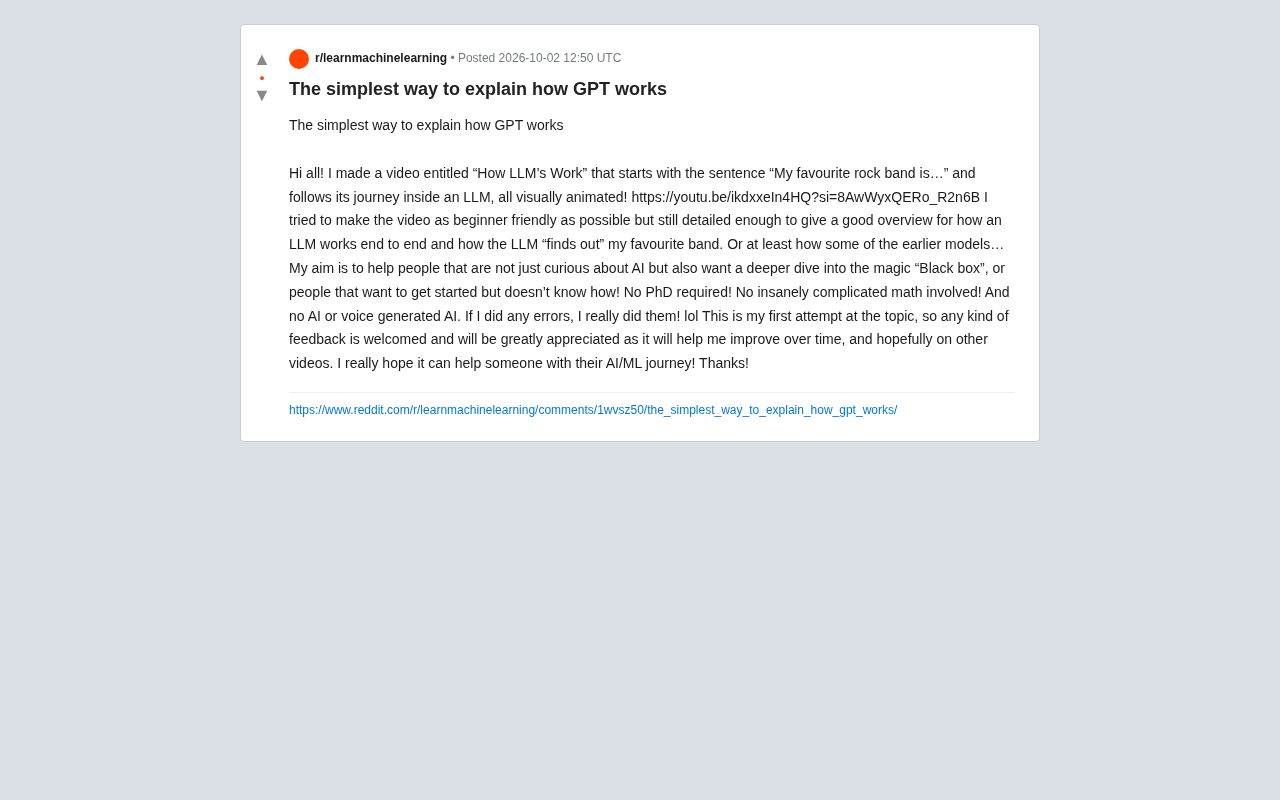
A developer shared a science explainer video called How LLMs Work on Reddit, aiming to explain what actually happens inside a large language model (LLM) in the most intuitive way possible. He chose a deceptively simple entry point — one sentence: "My favourite rock band is…" — and walked viewers through that sentence's complete journey inside the model, accompanied by animated visualizations throughout.
This approach stands out because it sidesteps the two extremes that plague most AI explainer content: either staying at the metaphor level of "AI thinks like a human brain," or immediately diving into matrices and attention mechanism formulas. The author is upfront about it: "No PhD required, no incredibly complex math."
Why Use a Single Sentence to Explain LLMs
The most counterintuitive thing about large language models is this: at their core, they are "predict the next word" systems. When you type "My favourite rock band is…", the model doesn't actually know your answer — it calculates which word is most likely to come next, based on statistical patterns learned from enormous amounts of text.
The cleverness of using this particular sentence as a starting point is that it naturally creates suspense: how does the model "figure out" your favourite band? The answer is — it doesn't figure out anything. It's making a probabilistic prediction based on context and the distribution of its training data. This approach of starting from a concrete sentence and peeling back layers makes it far easier for beginners to build an accurate mental model than abstract explanations ever could.
From Input to Output: What Happens to a Sentence Inside the Model
A complete LLM processing pipeline involves several key stages, and the video follows exactly this path:
Tokenization
The model doesn't directly understand the word "band" — it first breaks the sentence into individual tokens. A token might be a complete word, or just part of one. This step is the foundation for all subsequent computation.
Take BPE (Byte Pair Encoding), the tokenization scheme used by GPT-series models: "favourite" might be kept as a single token, while "tokenization" could be split into "token" + "ization". Chinese text is typically split by character or sub-word segments. This design reflects an engineering trade-off — a vocabulary that's too large causes the model's parameter count to explode, while one that's too small can't cover rare words. Most major models use vocabularies ranging from 30,000 to 100,000 tokens. Token boundaries can produce counterintuitive results: "ChatGPT" might be split into three tokens, which is exactly why tasks like counting word occurrences or reversing letters frequently trip up models — the unit the model operates on is the token, not the letter.
Embeddings and Vector Representations
Each token is converted into a sequence of numbers — a vector — that encodes semantic relationships between words. Words with similar meanings sit closer together in vector space. This is the mathematical foundation of how the model "understands" language.
The core idea behind embeddings comes from the distributional semantics hypothesis: words with similar meanings tend to appear in similar contexts, so they can be represented by similar mathematical vectors. The classic example — "king" - "man" + "woman" ≈ "queen" — was widely cited in early word vector models like Word2Vec to illustrate how semantic relationships can be encoded into the geometric structure of vector space. In modern Transformer architectures, each token's embedding can reach hundreds or thousands of dimensions (GPT-3 uses 12,288 dimensions). The "distances" and "directions" in these high-dimensional spaces encode information across multiple levels — part of speech, semantics, syntax — forming the mathematical prerequisite for attention mechanisms to capture linguistic patterns.
Attention and Layer-by-Layer Computation
Every word in a sentence needs to "pay attention" to other words in order to determine its own meaning. The word "favourite" will strongly influence the model's predictions about what comes next. Information flows and transforms through multiple layers of the model, ultimately converging into a predicted probability distribution over the next token.
The attention mechanism was formally established as the core of the Transformer architecture in the 2017 paper Attention Is All You Need. The basic idea: when processing a given word, the model is allowed to dynamically "look at" every other position in the sentence and assign different weights based on relevance. When processing a pronoun like "it," for example, attention helps the model trace back and find what it refers to. Modern large models typically use Multi-Head Attention — running multiple sets of attention computations simultaneously, each focusing on different dimensions of semantic relationships (syntactic dependencies, semantic similarity, coreference, etc.) — and then concatenating and integrating the results. These computations stack repeatedly across dozens or even hundreds of layers, enabling the final representations to capture extremely complex long-range dependencies.
Output: Predicting the Next Word
The model's final output is a probability distribution — every possible next token along with its likelihood of appearing. The model samples from this distribution or selects the highest-probability token, appends it to the sentence, and repeats the entire process. This is why LLMs generate text one word at a time.
The author explicitly notes that he's explaining how "some earlier models" work — an honest and important caveat. Modern large models have evolved in many architectural details, but the core "predict the next token" paradigm has remained unchanged, which is why understanding early models is still the best entry point.
Why Visualization Matters So Much for AI Beginners
LLMs are often called "black boxes," largely because their inner workings involve high-dimensional vector operations that are genuinely difficult to visualize. The author's choice to animate these abstract processes directly addresses this pain point.
For learners without a technical background, seeing "how a sentence flows through a network layer by layer" is far more intuitive than reading equations. Content like this fills an important gap in AI education: the space between "completely non-technical analogies" and "graduate-level coursework" — preserving technical accuracy without setting the bar too high.
The author openly acknowledges this is his first attempt at the topic and proactively admits "if there are mistakes, they're all mine," while welcoming feedback of all kinds. This openness is worth encouraging in AI science communication — accuracy, after all, is the lifeblood of this kind of content.
Practical Value for AI Learners
If you're in the early stages of learning AI/ML, understanding the core mechanism of "predicting the next word" will help you dispel a lot of common misconceptions:
- LLMs are not "querying a database" to find answers — they are making probabilistic predictions
- A model's "knowledge" comes from statistical patterns in training data, not genuine understanding
- So-called "hallucinations" are a direct byproduct of this prediction mechanism — when the highest-probability word happens to be factually incorrect
Once you have this foundational mental model in place, moving on to more advanced topics — attention mechanisms, Transformer architecture, fine-tuning — becomes significantly easier.
This effort is a reminder that great AI explainer content isn't about stacking up terminology. It's about finding the right entry point and breaking down a complex system into a journey that anyone can follow. A single sentence — "My favourite rock band is…" — is enough to crack open the black box of large language models.
Understanding the "predict the next word" paradigm also helps explain why the wording of a prompt significantly affects output quality: different input text activates different probability distributions, steering the model along different generation paths. This is the technical foundation that makes Prompt Engineering viable — it's essentially using language to shape the prior conditions for the model's next prediction. Similarly, techniques like Instruction Tuning and Reinforcement Learning from Human Feedback (RLHF) can be understood as "preference correction" layers stacked on top of this base prediction mechanism, nudging the model's output distribution to better match what humans expect — rather than simply mirroring the statistical patterns of internet text.
Related articles

Free Unlimited Claude Code Solution: Agnes AI + CC Switch Setup Guide
No paid subscription needed — pair the free AI platform Agnes AI with the open-source tool CC Switch to provide a backend for Claude Code, enabling unlimited free calls to text, image, and video models. This guide covers the full setup, test results, and usage boundaries.

A Complete Zero-Cost Guide to Getting Started with Claude Code for Beginners in China
A beginner's guide to Claude Code for users in China: two installation methods (command line and IDE plugin), full configuration steps for replacing the official API with the free domestic LongCat model, and a hands-on demo of building a small tool with natural language, plus tips.

When the NSA Gets Involved: The AI Supply Chain Crisis Behind Open-Source CVEs and API Key Hijacking
Multiple open-source projects disclosed severe CVEs in one day, PHP flaws alarmed the FBI, and Railway and OpenCode were breached with API keys stolen. This article breaks down the vulnerability window, AI-accelerated exploitation, and the AI supply chain crisis behind the API key black market, with a developer defense checklist.