How Generative AI Can Meet Innovation Requirements for R&D Tax Credits

How generative AI projects can demonstrate certifiable innovation to qualify for R&D tax credits.
This article examines the gap between using generative AI and qualifying for R&D tax credits, exploring how consulting firms can build certifiable innovation through structured generation algorithms, RAG-based fact verification, few-shot domain adaptation, and novel human-AI collaborative interfaces. It provides practical guidance on documenting and proving innovation for tax compliance.
An Overlooked Compliance Challenge
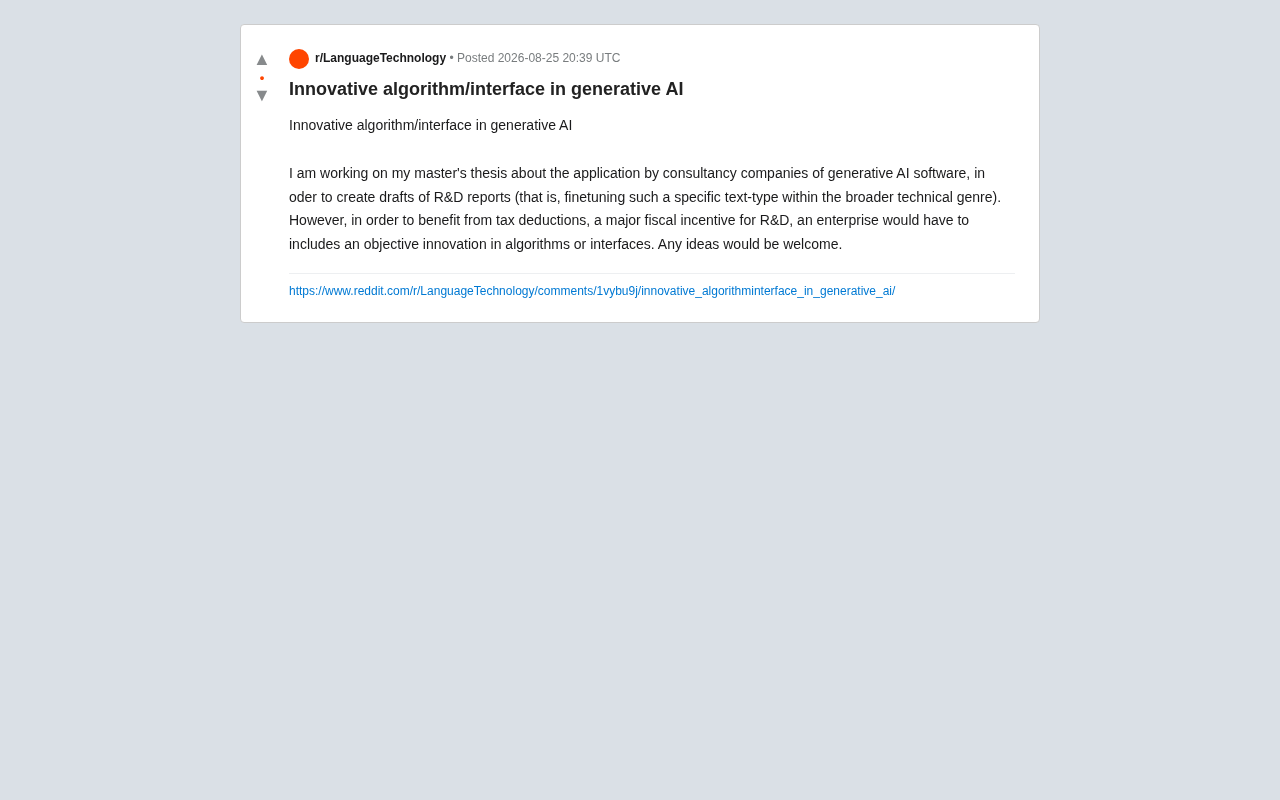
As generative AI rapidly permeates every industry, consulting firms are experimenting with large language models to automate the drafting of R&D reports. While this appears to be a typical AI deployment scenario, a Reddit user working on their master's thesis raised a more nuanced and practical question: how can such applications demonstrate "objective innovation" at the algorithm or interface level to qualify for R&D tax credit eligibility?
According to the user's Reddit post, their research focuses on "how consulting firms apply generative AI software to generate R&D report drafts" — essentially fine-tuning for a specific text type (a subcategory of technical documentation). However, the crux of the issue is that simply calling an off-the-shelf LLM API does not constitute "innovation" in the tax law sense. For a company to claim R&D tax benefits, its technical solution must demonstrate substantive technological breakthroughs at the algorithm or interaction interface level.
The value of this question lies in exposing a dimension often overlooked in AI commercialization: the certifiability of technical innovation. Many companies assume that using AI equals innovation, but from a tax and intellectual property perspective, there's a clear gap between the two.
Why "Using an LLM" Doesn't Equal R&D Innovation
Strict Definitions of Innovation for Tax Credits
R&D tax credit policies across countries (such as the U.S. R&D Tax Credit, the UK's R&D Relief, and similar incentives across EU nations) typically require qualifying activities to meet several core conditions: technological uncertainty, a systematic process of experimentation, and the goal of achieving technological advancement. Simply calling OpenAI or Anthropic's API and writing prompts is often classified as "routine application" rather than "R&D."
The R&D tax credit system traces back to the 1981 U.S. Economic Recovery Tax Act, which established the R&D tax credit provision (IRC Section 41). OECD countries subsequently followed suit, and today more than 30 countries offer some form of R&D tax incentive. The core purpose of these policies is to stimulate private-sector innovation investment by reducing corporate R&D costs, addressing the market's tendency toward underinvestment in research. In the AI field, due to extremely rapid technological iteration and heavy reliance on open-source infrastructure, tax authorities face new challenges in defining the boundary between "independent R&D" and "technology integration." The U.S. Internal Revenue Service (IRS) Four-Part Test requires R&D activities to satisfy: elimination of technological uncertainty, a process involving a technical discipline, experimentation purpose, and the goal of developing new or improved functionality. The UK's HMRC requires proof of "technological uncertainty that a competent professional in the field cannot easily resolve." These strict standards mean that merely deploying an AI system is far from sufficient to constitute R&D.
In other words, even if a consulting firm invests substantial time tuning model outputs, if its core technology relies on third-party off-the-shelf capabilities without independent algorithmic or architectural innovation, tax authorities will likely reject its credit application. This is precisely the compliance dilemma the original poster faces.
The Innovation Boundary of Fine-Tuning Itself
Fine-tuning for specific text types is a common practice, but the technical sophistication of fine-tuning varies enormously. Using standard supervised fine-tuning workflows with off-the-shelf open-source training scripts offers limited innovation. However, if the fine-tuning process introduces novel data processing methods, loss function designs, or domain adaptation strategies, it may constitute a substantive technical contribution.
From a technical classification perspective, fine-tuning is the core practice of transfer learning in the LLM era, with technical complexity ranging across multiple levels: the most basic involves using existing frameworks (such as Hugging Face Transformers) for full-parameter supervised fine-tuning of pretrained models; intermediate approaches include parameter-efficient fine-tuning methods like LoRA (Low-Rank Adaptation), QLoRA, and Adapters, which reduce computational costs by updating only a small number of parameters; more advanced methods include Reinforcement Learning from Human Feedback (RLHF), Direct Preference Optimization (DPO), and domain-specific curriculum learning strategies. From a tax innovation certification perspective, fine-tuning using only standard toolchains is difficult to qualify as R&D, whereas improvements to the training methodology itself carry stronger potential for innovation certification. The key criterion is: did the company encounter "technological uncertainty that a competent professional cannot resolve through routine means" during the fine-tuning process, and did it overcome these uncertainties through systematic experimentation?
Algorithm Directions That May Qualify as Innovation
For the specific scenario of R&D reports, the following technical directions are more likely to be recognized as innovative.
Structured Generation and Controllability
R&D reports have strict structural and logical requirements — problem definition, description of technological uncertainty, experimental methods, and results argumentation. A truly innovative solution could design structure-aware generation algorithms, such as constrained decoding based on document schemas, ensuring model outputs strictly follow the report's chapter logic and argumentation chains. Such controllable generation techniques remain an active research area in both academia and industry.
Constrained decoding is a class of techniques that impose structural constraints during the text generation phase. The core idea is to modify the token sampling probability distribution or introduce finite state automata during the model's autoregressive decoding process to ensure outputs meet predefined format or logic rules. Representative methods include regex-based constraints (e.g., the Outlines library), context-free grammar-based constraints (e.g., the Guidance framework), and neuro-symbolic semantic constraints. For the R&D report scenario, the challenge of constrained decoding extends beyond format (ensuring correct section headings) to semantics — ensuring logical consistency between the "technological uncertainty" description and the "experimental methods" design, and that "experimental results" respond to the technical questions raised earlier. Such cross-paragraph semantic consistency constraints currently lack mature general solutions, constituting clear technological uncertainty and thus providing a strong foundation for R&D certification.
Retrieval-Augmented Generation and Fact Verification
R&D reports demand extremely high factual accuracy, as fabricated technical details can lead to serious consequences. Building a Retrieval-Augmented Generation (RAG) + automated fact verification pipeline targeted at technical documentation — combining internal patents, experimental records, and code repositories for source tracing, and designing novel relevance scoring algorithms — this type of engineering-algorithm combined innovation is more likely to pass tax credit certification.
RAG was originally proposed by Facebook AI Research (now Meta AI) in 2020. Its basic architecture includes two core components: a Retriever and a Generator. The Retriever identifies document fragments relevant to the user's query from external knowledge bases, while the Generator produces answers based on this retrieved context. RAG technology has evolved from initial single-pass retrieval to multi-hop retrieval, adaptive retrieval, and hybrid retrieval architectures incorporating knowledge graphs. In the R&D report scenario, key RAG challenges include: indexing unstructured internal experimental records (experimental data often exists in mixed formats of tables, charts, and code), designing multi-granularity retrieval strategies for technical argumentation chains (sometimes requiring precision down to specific parameter configurations of a particular experiment), and achieving precise attribution between generated content and source documents. Notably, fact verification in R&D reports is more complex than in general scenarios — it requires verifying not only "whether facts are correct" but also "whether technical reasoning is sound," involving deep understanding of causal relationships and experimental logic, which is a generally weak area in current RAG systems.
Domain Adaptation and Few-Shot Learning
Consulting firms often lack massive volumes of high-quality R&D reports as training data. How to enable models to master domain-specific writing paradigms with limited samples involves cutting-edge techniques such as few-shot learning and parameter-efficient fine-tuning (e.g., improved variants of LoRA). If novel methods specific to the report scenario can be proposed, their innovativeness is evident.
LoRA (Low-Rank Adaptation) was proposed by Microsoft Research in 2021. Its core idea is to add low-rank decomposed trainable matrices alongside the pretrained model's weight matrices, reducing trainable parameters from billions to millions. Subsequent improvements include: QLoRA (combining 4-bit quantization to further reduce memory requirements to single-GPU feasibility), DoRA (decomposing weights into direction and magnitude components for finer adaptation), and AdaLoRA (adaptively allocating rank across different layers based on importance scores). In data-scarce consulting firm scenarios, PEFT methods are particularly important because high-quality R&D reports typically involve corporate secrets and are difficult to collect at scale. If researchers can design multi-task learning objectives that leverage the logical dependencies between report sections, or propose a novel adaptation strategy that effectively transfers writing style and argumentation structure from only a dozen sample reports, the likelihood of innovation certification is high. The technological uncertainty here lies in: whether general PEFT methods can capture the implicit argumentation logic conventions in R&D reports, and if not, what architectural improvements are needed to bridge this gap.
Innovation Possibilities at the Interface Level
Beyond algorithms, the interaction interface is equally a certifiable innovation dimension for tax credits, and is often underestimated.
Human-AI Collaborative Editing Paradigms
R&D reports cannot be completed entirely by AI alone — expert review and correction are critical. Designing a novel human-AI collaborative interface — for example, allowing users to assign "confidence annotations" to each technical assertion in the generated content, with the system dynamically regenerating or supplementing evidence based on these annotations — such interaction patterns themselves may constitute interface innovation.
Human-AI Collaboration presents unique design challenges in professional document domains. Traditional document editing interfaces (like Word or Google Docs) are based on the "human creates, tool assists" paradigm, while AI-assisted writing introduces an entirely new "AI drafts, human refines" workflow. These two paradigms have fundamentally different interface design requirements: the latter needs to enable human experts to efficiently assess AI output quality, locate sections requiring modification, and complete corrections with minimal cognitive burden. In the R&D report scenario, this challenge is further amplified — reviewers must judge not only "is it well-written" but also "is it technically correct" and "does it meet tax credit certification standards." If an interface paradigm can be designed that enables parallel review across these three dimensions with cross-referencing capabilities, this itself constitutes meaningful innovation in interaction design.
Explainability and Provenance Visualization
Presenting the model's reasoning process, citation sources, and uncertainty intervals to users through visualization, helping experts quickly identify which content requires human intervention. Such explainability interfaces are particularly valuable for high-stakes professional documents and represent an important trend in current AI product design.
Explainable AI (XAI) is a core issue in current AI governance and compliance. For large language models, explainability methods fall into two main categories: post-hoc explanation methods (such as attention weight visualization, SHAP value analysis, and influence functions tracing training data contributions to outputs) and inherently interpretable designs (such as Chain-of-Thought reasoning CoT and Self-Consistency SC). In generative AI applications, provenance visualization is particularly important — it not only helps users understand the basis for model outputs but also plays a key role in compliance auditing. For the R&D report scenario, explainability must simultaneously cover three dimensions: content source tracing (which experimental data or technical literature each generated sentence references), reasoning logic display (whether the derivation steps of technical arguments are sound), and uncertainty quantification (the model's confidence level for each technical assertion). From a tax credit perspective, such explainability systems also have "meta-value" — they can serve as tools for companies to document and prove their R&D process, helping companies satisfy the "systematic process of experimentation" requirement for R&D certification.
Practical Recommendations for Researchers and Companies
For this master's thesis and companies facing similar challenges, the following approaches are recommended:
First, clearly distinguish between "application" and "R&D." Clearly delineate which aspects of a consulting firm's AI deployment constitute routine application and which possess R&D characteristics — this itself is a valuable theoretical and practical contribution. In practice, an effective method is to establish a "technological uncertainty log" — whenever the team encounters a problem that existing technology cannot directly solve during development, record the nature of the problem, attempted solutions, and the eventual technical breakthrough (or conclusion). This not only aids subsequent tax credit applications but is also a good practice for disciplined R&D management.
Second, reference specific jurisdictional tax code provisions. Different countries define R&D very differently. Comparing certification standards across multiple tax incentive frameworks will greatly enhance the research's practical guidance value. For example, Australia's R&D Tax Incentive (R&DTI) explicitly includes software development but requires "core activities" to generate new knowledge, while France's Research Tax Credit (CIR) provides different deduction rates for "experimental development" versus "basic research." Understanding these differences is critical for compliance strategies at multinational consulting firms.
Finally, integrate technical innovation with compliance documentation. The true insight is: companies must not only innovate but also be able to document and prove the innovation process in a manner recognized by tax authorities. This points to a broader proposition — in the AI era, the "provability" of innovation is becoming as important as innovation itself. Specifically, companies should concurrently establish during the R&D process: version-controlled records of technical decisions (why this algorithm was chosen over another), quantitative evidence from experimental comparisons (what metrics the new method improved over the baseline), and the resolution process of technological uncertainty (how the cognitive leap from not-knowing to knowing occurred).
Conclusion
This Reddit user's question appears on the surface to be a technical request for academic research help, but it actually touches on a core tension in generative AI commercialization: when powerful general-purpose models are readily accessible, where exactly should true technical moats and certifiable innovation be built? The answer may lie not in whether AI is used, but in how irreplaceable and provable technical contributions are constructed in specific areas such as algorithmic constraints, retrieval verification, and human-AI collaboration. This is both a requirement of tax compliance and an inevitable step in the maturation of AI applications.
From a broader industry perspective, the emergence of this question signals that generative AI is transitioning from the "technical feasibility validation" phase to the "commercialization institutional development" phase. The core question in the early stage was "can AI do this," while now the question is transforming into "after AI has done it, how does it find its proper place within existing legal, tax, and intellectual property frameworks." This shift concerns not just individual companies' tax benefits but reflects society's broader effort to establish measurement and certification standards for AI's value creation — and the process of establishing these standards is itself a topic worthy of deep research.
Related articles

Risklytics: An Insurance Brokerage Platform Built for Frontier Tech Companies in AI, Nuclear Fusion, and Beyond
YC S26 startup Risklytics provides specialized insurance brokerage for AI, nuclear fusion, and autonomous driving companies, solving the gap where traditional insurance fails to cover emerging tech risks.

Coze 3.0 Workflow in Practice: Build an Automated AI Agent in Three Steps
Learn to build AI Agents on Coze 3.0 in three steps: prompt engineering & API calls, RAG knowledge base construction, and multi-agent autonomous decision-making for low-code AI app development.
Gemini 3.5 Transcribe Explained: From Dictation to Intelligent Speech-to-Text
An in-depth look at Google Gemini 3.5 Transcribe's intelligent speech-to-text capabilities, covering contextual correction, terminology recognition, and real-world applications.