How KAN Architecture Cuts Sample Requirements in Reinforcement Learning by 40%

KAN architecture reduces reinforcement learning sample requirements by 40% while staying robust to reward noise.
A recent arXiv study systematically validates the sample efficiency advantages of Kolmogorov-Arnold Networks (KAN) in reinforcement learning. Unlike MLPs, KAN places learnable activation functions on network edges, grounded in the Kolmogorov-Arnold theorem, offering higher parameter efficiency and interpretability. Experiments on the Feynman physics dataset and Gymnasium RL benchmarks show KAN achieves comparable performance to MLP with ~40% fewer samples, up to 50% relative improvement mid-training, and stable gains even under noisy reward conditions. Code is open-sourced, though scalability to complex real-world environments remains to be verified.
Sample Efficiency: The Core Bottleneck in Deploying Reinforcement Learning
Deep reinforcement learning (Deep RL) has surpassed traditional control methods on many tasks, but it has always had one unavoidable pain point — sample cost. In real-world applications, whether in robotic manipulation, industrial control, or autonomous driving, collecting training samples often comes with steep costs in time, money, and even safety. A recent study published on arXiv (arXiv:2610.10627) systematically investigates the potential of Kolmogorov-Arnold Networks (KAN) — an emerging architecture — to improve sample efficiency, presenting quite compelling experimental evidence.
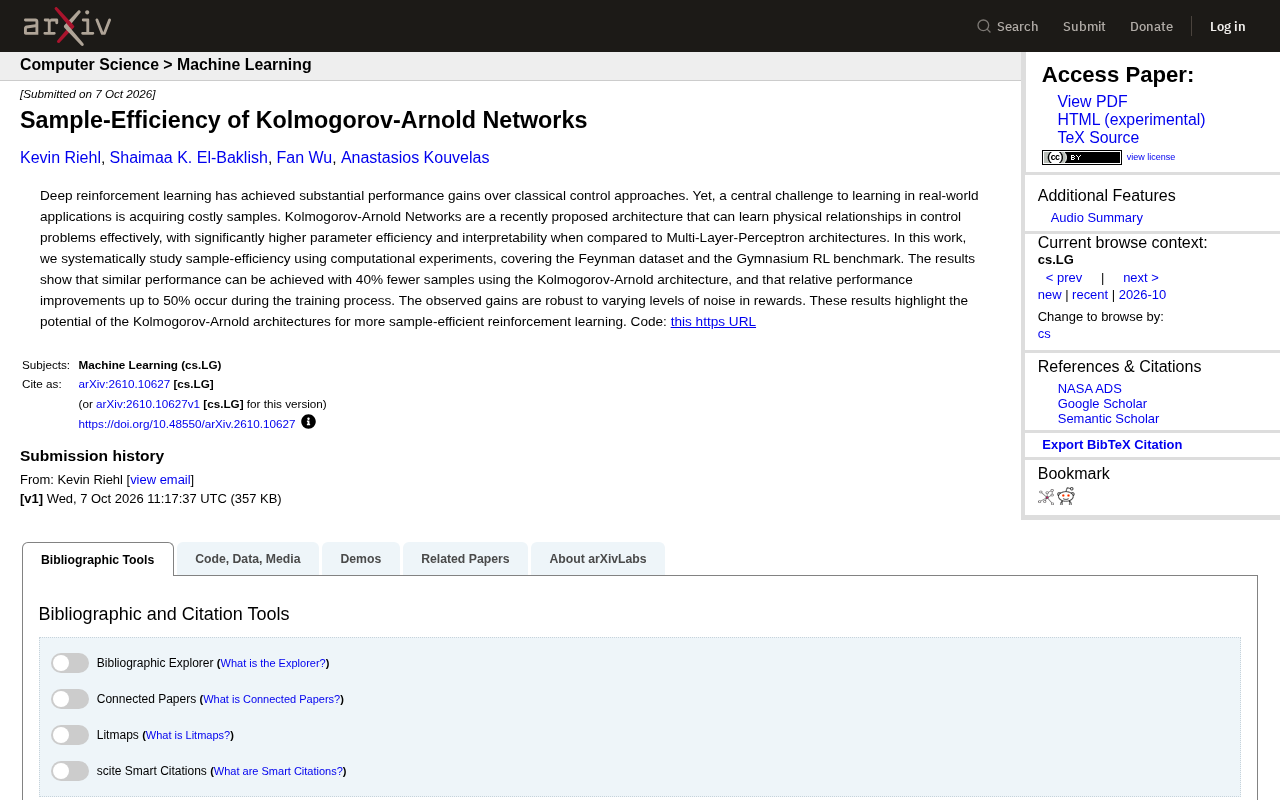
The paper's core conclusion is straightforward: using the KAN architecture, you can achieve performance comparable to traditional multilayer perceptrons (MLP) while using 40% fewer samples. For any team training agents in real-world environments, that number translates to tangible cost savings.
What Are Kolmogorov-Arnold Networks
KAN is a recently proposed neural network architecture grounded in the Kolmogorov-Arnold representation theorem. Unlike traditional MLPs, which use fixed activation functions at nodes and learnable weights on edges, KAN places learnable activation functions on the network's edges (connections). This design brings two key advantages.
The first is parameter efficiency. The paper shows that compared to MLP architectures, KAN can learn the physical relationships in control problems with significantly greater parameter efficiency — capturing the underlying patterns in a system using fewer parameters.
The second is interpretability. Because KAN learns the functional form on each edge, researchers can more intuitively observe what mathematical relationships the network has learned. This is especially valuable in control scenarios where understanding and validating model behavior is critical.
Why This Matters for Reinforcement Learning
The training process in reinforcement learning is fundamentally about agents accumulating experience through extensive interaction with an environment. If an architecture can learn an equally good policy with fewer interactions, it directly lowers the practical barrier to training. KAN's efficiency in modeling physical relationships aligns well with the data demands of control-oriented RL tasks.
The Kolmogorov-Arnold representation theorem (independently proven in 1957 by Soviet mathematicians Kolmogorov and Arnold) states that any continuous multivariate function can be represented as a finite composition and sum of univariate continuous functions. Formally, for any continuous function $f(x_1,\ldots,x_n)$, there exist outer functions $\Phi_q$ and inner functions $\phi_{q,p}$ such that $f$ can be exactly decomposed. This theorem theoretically guarantees KAN's expressive power — rather than heuristically stacking layers, it decomposes function structure in a mathematically grounded way. Traditional MLPs rely on the universal approximation theorem, which also theoretically fits any function but requires a sufficient number of neurons and offers no guarantee of learning the function's intrinsic structure. KAN was first introduced in 2024 by researchers from MIT and other institutions (Liu et al., 2024). Its core implementation typically uses B-splines or other learnable basis functions to parameterize the activation functions on edges, keeping the network flexible while allowing post-training "symbolification" into readable mathematical expressions.
Experimental Design and Key Findings
The researchers conducted systematic computational experiments on two types of benchmarks: the Feynman dataset (covering physical formula regression tasks) and Gymnasium reinforcement learning benchmarks (classic RL test environments). This combination allows them to verify both KAN's ability to fit physical relationships and its performance on real decision-making tasks.
The experiments yielded several noteworthy results:
- 40% fewer samples: Under conditions of comparable performance, KAN requires approximately 40% fewer samples than MLP.
- Up to 50% relative performance improvement during training: At certain stages of training, KAN's performance improvement relative to MLP can reach 50%.
- Robustness to reward noise: When the reward signal contains varying levels of noise, the gains from KAN remain stable — a finding with major practical implications, since real-world rewards are often noisy.
The reward noise robustness finding deserves particular emphasis. Real-world reinforcement learning rarely receives clean, precise reward feedback; sensor errors, delays, and environmental interference all corrupt the signal. If KAN can maintain its advantage under these conditions, its practical value carries far more weight than numbers from idealized experimental settings.
The Feynman dataset is a commonly used regression benchmark in physics-informed machine learning, drawn from the Feynman Lectures on Physics. It contains over 100 real physical formulas (such as Newton's second law, Coulomb's law, and relativistic kinetic energy). Each data point consists of randomly sampled physical quantity inputs paired with corresponding formula outputs, with the challenge being to recover the underlying symbolic formula from pure data. The dataset is widely used to evaluate neural networks' ability to capture physical laws, and is especially suited for assessing parameter efficiency and generalization. Gymnasium (formerly OpenAI Gym) is the most widely used benchmark environment library in the RL community, offering tasks ranging from classic control (CartPole, MountainCar, Pendulum) to more complex continuous action control. Using both benchmarks together allows the paper to separately validate KAN's function-fitting ability (Feynman) and policy-learning ability (Gymnasium), supporting the core argument of "KAN is more efficient" from multiple angles.
Implications for Industry and Research
This work provides a promising direction toward more sample-efficient reinforcement learning. For a long time, MLP has been the default backbone network in deep RL. The parameter efficiency and sample efficiency demonstrated by KAN suggest that there may be network architectures better suited to control problems.
That said, the paper's conclusions are primarily based on the Feynman dataset and Gymnasium benchmarks, which are relatively standardized environments. Whether KAN can replicate the same 40% sample savings in more complex, higher-dimensional real-world robotic or industrial systems remains to be verified. The architecture's training stability, computational overhead, and scalability to large-scale tasks are also questions that future research will need to answer.
For researchers looking to reproduce or build on these experiments, the authors have open-sourced the relevant code (GitHub: DerKevinRiehl/neurips26_kan_training), which provides a convenient foundation for community validation and extension.
Overall, KAN presents a candidate architecture worth serious evaluation in sample-cost-sensitive reinforcement learning scenarios. As more independent validation emerges, whether it can grow from an interesting new idea into a mainstream tool will depend on its robust performance across a wider range of tasks.
Related articles

Bilibili's Hit Dify Tutorial: A Practical Guide to Building 20+ AI Apps from Scratch
A distilled guide to Bilibili's top-rated Dify tutorial: Windows + Docker deployment, MySQL connection, five app types, model integration strategy, and publishing.

Agent Skills Beginner's Guide: From Concepts to Multi-Agent Collaboration in Practice
A comprehensive guide to Agent Skills: core concepts, components, the importance of Description, standardization, beginner learning paths, and multi-agent collaboration.

One Neuron Detects Both Cats and Cars? We Reproduced It and Found a New Explanation
The cat-car neuron reinterpreted: researcher Cammarata argues it distinguishes pointy from round, not cats from cars. We reproduced the experiment and found the new explanation holds on most inputs—but cars are the exception. The interpretability debate continues on language models.